

Dead Sea Almost Died Eons Ago

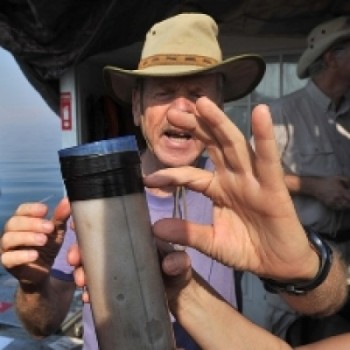
Zvi Ben-Avraham drilling dead sea, drying dead sea
New drilling results from the Dead Sea provides clues that the Dead Sea almost dried up because of climate change — 125,000 years ago!

The rapidly dropping water level of the Dead Sea, a cause of much concern today, occurred as well in the distant past, resulting in the severe drying up of the lake, an international drilling project there has shown. The project opens a window into the climatic and seismic history of the Dead Sea over the past hundreds of thousands of years.

The project discovered that about 125,000 years ago, the lake had dried up almost completely as a result of climate change. This finding arouses worry about the present status of the Dead Sea – the lowest place on earth — in which human intervention is causing acceleration of the drying-up process.

A special rig was brought to Israel for the purposes of the drilling project, including equipment to bring up sediment samples from beneath the lake floor. The drilling was done from November 2010 until March 2011 in two areas: in the center of the lake at a depth of 300 meters and near the Ein Gedi shore.

The drilling was done under the auspices of the International Continental Drilling Program (ICDP) under the direction of Prof. Mordechai Stein of the Geological Survey of Israel and the Hebrew University and Prof. Zvi Ben-Avraham of Tel Aviv University (pictured above), with support from the Israel Academy of Sciences and Humanities.

The Dead Sea is a salt lake located in a deep tectonic depression – the Dead Sea basin — in which the loss of water is only through evaporation. The lake behaves like a large water gauge of its watershed. The Jordan River and the Arava stream transport sediments and waters from north and south that reflect the environmental conditions in the Mediterranean and desert climate zones.

Over the past hundreds of thousand of years, the lake accumulated information on the hydrological–climate conditions in these regions. Moreover, the reconstruction of climates of the past are relevant to human history since the Dead Sea basin is located along a major route for pre-historic man on his way out of Africa.

The sediments that were drilled and recovered from the floor of the Dead Sea contain the information that enables us to reconstruct the climatic conditions that existed here and even in more distant areas such as the Arabian and Sahara deserts, said Stein.

A preliminary analysis of the drilled cores discovered, at a depth of 250 meters below the lake floor (and 550 meters below the lake surface), thick sequences of salt covered by rock pebbles that indicate a period when the lake retreated and nearly dried up. These sequences are overlain by marly (muddy) sediments that indicate, conversely, an enhanced input of freshwater to the lake and wetter climate conditions in the watershed.

Today, the Dead Sea is at a level of 426 meters below sea level and sinking rapidly. The evaporation of the lake in the past should be a warning sign for us now in terms of a possible drying up in the future, say the scientists. Whereas in the past, forces of natural climate change brought about a refilling on the sea through drainage of waters coming into the basin, this cannot happen as long as the waters of the Jordan River are diverted by its neighboring states.


2 COMMENTS
  1. Hear! Hear! The sooner the cities are at least for a generation on desalinated water to allow the R.Jordan to replenish the sea the better. Meanwhile a lot of orchards and market gardening agriculture can make do with recycled sewerage.
    The historic changes are probably to do with the ice ages which dried the atmosphere and lowered sea levels which is why there are traces of habitation and large land animals on the beds of the North Sea, the Black Sea, and the seas between Indo China and Indonesia.

  2. What we may learn fro0m this is that the climate change currently occurring may be more a natural phenomena than human caused. Of course,
    CO2 emissions and other factors caused by humankind don’t help the situation.

Comments are closed.

Hot this week

How Renewable Energy is Revolutionizing the Way We Power Our World

Solar has become the star of the transition thanks to modular hardware and straightforward installation. It fits dense cities and remote towns alike. Many companies are turning to rooftop arrays and carport systems - and exploring commercial solar installation as a practical way to lock in future savings.

How does one start prepping?

Faced with an extreme winter storm this year, Americans wonder how to be prepared for catastrophe. Miriam has lived through wars in the Middle East - so she's prepared on giving you a guide to prepping.

Fishermen sue tire manufacturers on behalf of the salmon

A federal trial in San Francisco has brought US tire manufacturers, fishing groups, and environmental scientists into court over a chemical most drivers have never heard of — but which scientists say may be silently reshaping aquatic ecosystems.

Listening to Water: Tarek Atoui’s Next Work for Tate Modern

Born in Beirut, Lebanon in 1980 and now living in Paris, Atoui has spent years building instruments that don’t sit comfortably in concert halls. Many of them involve water, glass, and ceramics — materials that react to sound instead of simply producing it.

Leading Through a Dual-Energy Transition: Balancing Decarbonisation with Energy Security

Experience in one area of the energy industry isn't enough to guarantee readiness across all the others. That's where a structured program like an MBA in energy can come in. Today's advanced curricula explore energy economics, finance, policy, and strategic management alongside the technical subjects. And when pursuing an energy MBA online, professionals can skill up and retrain without having to step out of the labor market -- an important perk at a time when skilled professionals are already in short supply.

Topics

How Renewable Energy is Revolutionizing the Way We Power Our World

Solar has become the star of the transition thanks to modular hardware and straightforward installation. It fits dense cities and remote towns alike. Many companies are turning to rooftop arrays and carport systems - and exploring commercial solar installation as a practical way to lock in future savings.

How does one start prepping?

Faced with an extreme winter storm this year, Americans wonder how to be prepared for catastrophe. Miriam has lived through wars in the Middle East - so she's prepared on giving you a guide to prepping.

Fishermen sue tire manufacturers on behalf of the salmon

A federal trial in San Francisco has brought US tire manufacturers, fishing groups, and environmental scientists into court over a chemical most drivers have never heard of — but which scientists say may be silently reshaping aquatic ecosystems.

Listening to Water: Tarek Atoui’s Next Work for Tate Modern

Born in Beirut, Lebanon in 1980 and now living in Paris, Atoui has spent years building instruments that don’t sit comfortably in concert halls. Many of them involve water, glass, and ceramics — materials that react to sound instead of simply producing it.

Leading Through a Dual-Energy Transition: Balancing Decarbonisation with Energy Security

Experience in one area of the energy industry isn't enough to guarantee readiness across all the others. That's where a structured program like an MBA in energy can come in. Today's advanced curricula explore energy economics, finance, policy, and strategic management alongside the technical subjects. And when pursuing an energy MBA online, professionals can skill up and retrain without having to step out of the labor market -- an important perk at a time when skilled professionals are already in short supply.

From Green Energy to Healthy Societies: Why old systems thinking is becoming relevant again

Across the Middle East and North Africa, large investments are being made in green hydrogen, renewable energy, water infrastructure and sustainability. Most of these efforts are discussed in the context of climate change, decarbonization and economic diversification. That framing is important, but it may not capture their full value.

We saw peace – an interreligious encounter deep in our eyes

They came from Israel, Palestine, Jordan, Iraq, Yemen, Morocco, Tunisia, Lebanon, Egypt… There are Sunni Muslims, Shiite Muslims, Jews (Orthodox and Reform), Orthodox Christians, Coptic Christians, Protestant Christians, Druze, Baha'is, a Scientologist.

Can biochar reduce ‘Forever Chemicals’ in food if it’s used in farms?

Biochar is produced by heating organic material in a low-oxygen environment so it does not burn. This process, known as pyrolysis, transforms plant matter into a stable, carbon-rich material.

Related Articles

Popular Categories