

 Who’s grabbing land at the fastest rate? An Arab country is among the top 3. The target: Africa.
The issue of land grabbing by Gulf countries for food security purposes has been in the news (including Green Prophet) for some years now, but the trend for large-scale acquisitions is accelerating. The new scramble for land in Africa and many parts of South East Asia, such as Philippines, Cambodia, and Vietnam, is creating a wide spread geo-political phenomenon, raising new concerns about the long held debate on the benefits and risks of these acquisitions.
Leading the rush are international agribusinesses, investment banks, hedge funds, commodity traders, sovereign wealth funds, and entrepreneurs. China is acquiring land at the fastest rate, followed by South Korea. Behind only these two countries, the United Arab Emirates has become one of the top purchasers of global farmland.
The Arab unrest has only accelerated the efforts of Gulf countries, as they try to build up their food security issues in an increasingly destabilized region. While it is difficult to measure the scale of such land purchases due to an absence of reliable data, there is little doubt among observers that the buying spree and increasingly global competition for land deals will continue.
Africa, where land is relatively cheap, has been a particularly easy target for land deals. So it comes as no surprise that a major study released by the World Bank last September found that in 2009 deals were being struck for the allocation of 45 million hectares of land, 70 per cent of this was in Africa.
However, development experts, policymakers and academics, meeting at a major conference on global land grabbing, held at the Institute of Development Studies in April, were told that a new ‘scramble for Africa’ is taking place, and that the real figure is substantially higher, perhaps double this amount.
The geographic scope of global land deals is also spreading. According to a recent article in Guardian, in Cambodia,”15% of land has been signed over to private companies since 2005, a third of which are foreign.”
Risks for the vulnerable
The 2010 World Bank Report on the subject remains supportive of large-scale land acquisitions in developing countries by foreign investors, although it highlights “significant risks” for vulnerable populations. The general conclusion is it that there is a potential for a positive development spill over effect but that land investments have very often failed because of a lack of management.
On the other side of the argument, among the purchases compiled by the World Bank, only 21% led to active farming operations. In addition, local reports have highlighted threats to traditional cultures and values, turning family run landscapes into enormous mono-cultural foundations with large-scale industrial agriculture techniques that require chemicals, pesticides, intensive water use, and large-scale transport, storage and distribution.
Several other observers have warned of the implications of transferring wealth from the poor to those who have access to capital and markets. The US environmentalist Lester Brown points out in his new book, World on the Edge, that in 2009 Saudi Arabia received its first shipment of rice produced on land it had acquired in Ethiopia while at the same time the World Food Programme was feeding 5 million Ethiopians. Similarly in the Democratic Republic of the Congo, China has acquired 7 million hectares for palm oil production and yet millions of people in the DRC are dependent on international aid for food.
In the end, many of the deals remain secret and low profile. As a result, the scale of what is happening and who is benefiting is not clear, adding to a growing anxiety by many around accountability and transparency. Although the idea of buying land overseas as a first step for building a food security strategy may be in principle a good one, particularly for the Arab world, what is clear is that not all deals can bring benefits for all parties.
Read more on land grab in the Middle East:
Egypt to Land Grab Sudan to Meet Wheat Needs
Africa For Sale, Is The Middle East Buying?
::Guardian
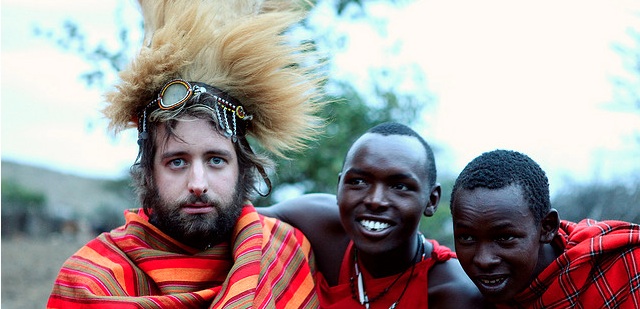
Image via promise_tangeman




For more information on the Global Land Grabbing conference held at the Institute of Development Studies see the news item at http://www.ids.ac.uk/go/news/experts-warn-of-new-scramble-for-africa-at-an-international-conference-on-land-grabbing