
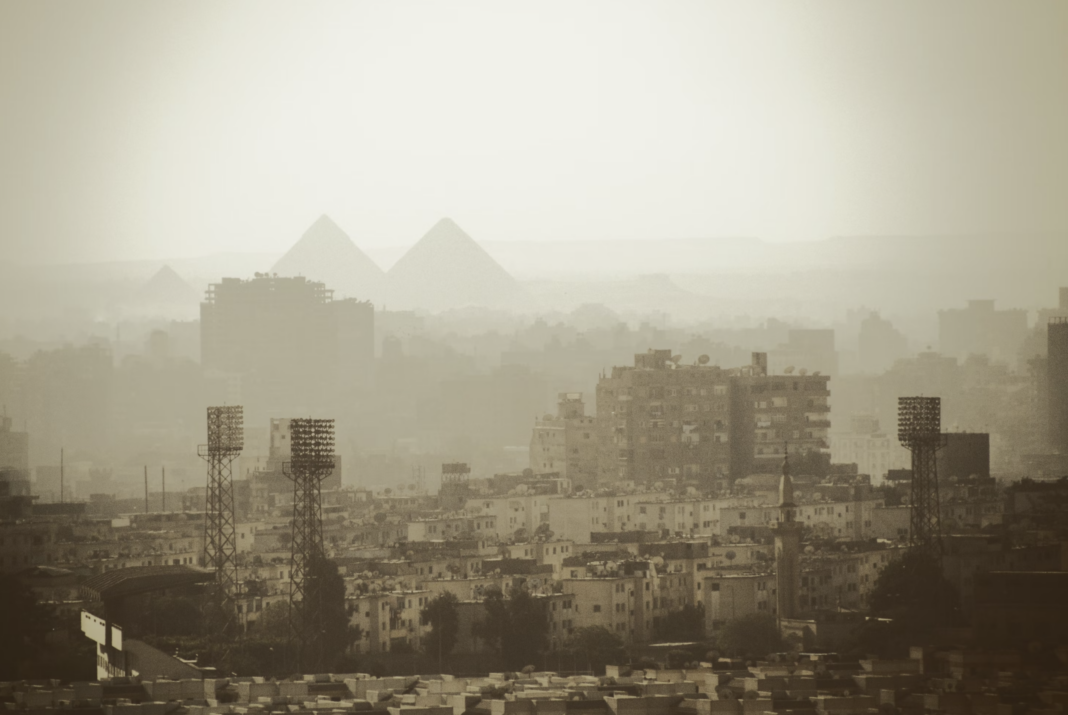
Black Cloud Season in Cairo

black smog cairo

In the West, leaves are falling from the trees. In the Middle East, Fall means the return of the throat-burning smog which settles over Cairo, Egypt once again. Rice fields are to blame.

Every year a noxious black smog hangs over Egypt as the seasonal burning of rice straw by farmers begins, and with it comes a surge in allergic reactions and lung infections. The inky haze lasts from October to November; it is a time when hospitals see a rise in patient numbers, and parents consider keeping their children out of school to avoid the worst of the throat-burning smog.

“Straw burning-induced pollution causes acute health problems,” Mahmud Abdel Meguid, chairman of the state-run Abbasiya Chest Hospital, told IRIN. “This pollution causes a long list of diseases, including chronic obstructive pulmonary disease, and chest sensitivity at best, and respiratory failure at worst.”

“This has led to pressure on the hospital,” he added. “Sometimes we run out of respirators for the patients.”

Egypt’s farmers have been burning the waste after the rice harvest for over 12 years. With more than 486,000 hectares of land devoted to the staple, farmers have huge amounts of straw to dispense with and torching it is the easiest solution.

The straw could be converted to animal feed or biofuel, but farmer Gamal al-Saedy says no one in his area of Sharqia, about 150km north of the capital, Cairo, has found a buyer. That makes burning “the normal solution for us”.

But it may have consequences for the rest of his community.

Suffering  from respiratory problems

Emad Hosni, a 30-year-old villager from the same governorate as al Saedy, has been visiting the Abbassiya Chest Hospital for more than three years seeking treatment for his respiratory problems: “My suffering increases particularly in October and November when the farmers burn the rice straw,” Hosni said. “I lock myself up in my home when I see the black cloud, but I am really afraid that my children may have respiratory diseases too.”

The Environment Ministry says rice straw burning accounts for 42 percent of Egypt’s overall air pollution during the two-month season, but it regards industrial pollution, the burning of garbage, and vehicle emissions as the biggest year-round threats to the air quality of the country’s 80 million people .

The ministry says it has managed to reduce the amount of pollution caused by straw burning, pointing to a decrease in the amount of land growing rice, and the presence of nine factories that buy the straw from farmers.

“Compared with previous years, the burning this year is much less,” said Ahmed Abulsoud, responsible for air quality at the Environment Ministry. “The cloud used to appear for 15 days, but now it appears briefly.”

However, with the burning of an estimated four million tons of straw this season, critics are loath to accept that the impact is minor: “True, the government does its best to reduce the burning, but the reality is the cloud is ushering in diseases that were rare in the past,” said Mohamed Awad Tag Eddin, Egypt’s former health minister.

“The farmers must get to know that the burning of the straw puts them and their fellow countrymen in extreme peril,” he told Egyptian TV recently.

More environment news from Egypt:
Top 5 Arab Designers
“Eco Options Egypt” Makes Egyptian Environmentalism Easy and Accessible
Gone Seabass Fishing…In Egypt’s Desert

Karin Kloosterman
Karin Kloostermanhttp://www.greenprophet.com
Karin Kloosterman is an award-winning journalist, innovation strategist, and founder of Green Prophet, one of the Middle East’s pioneering sustainability platforms. She has ranked in the Top 10 of Verizon innovation competitions, participated in NASA-linked challenges, and spoken worldwide on climate, food security, and future resilience. With an IoT technology patent, features in Canada’s National Post, and leadership inside teams building next-generation agricultural and planetary systems — including Mars-farming concepts — Karin operates at the intersection of storytelling, science, and systems change. She doesn’t report on the future – she helps design it. Reach out directly to [email protected]
2 COMMENTS
  1. Burning the straw is actually illegal and supposed to come with a big fine, but there’s no enforcement; the reason there’s no enforcement is that farmers have no other option (they often burn their straw at night, believing they won’t get in trouble).

    The government doesn’t provide any kind of waste management solutions – particularly out in the villages. A couple of NGOs had some success with one or two villages, but overall, the situation won’t improve until the government steps in. They should contract the same company that turned Alexandria’s trash situation around (Veolia, I think) – to find a reasonable solution.

Comments are closed.

Hot this week

The Christ’s thorn (sidr tree) is also a well-known folk medicine

Christ’s thorn jujube (Ziziphus spina-christi) also known as the sidr tree is a real, identifiable tree native to the Middle East, and it appears—directly or indirectly—in Islam, Judaism, and later Christian tradition. The connections between the three faiths are not theological agreements but overlapping uses, names, and symbolic associations rooted in the same landscape.

Farm To Table Israel Connects People To The Land

Farm To Table Israel is transforming the traditional dining experience into a hands-on journey.

The Lote Tree of the Utmost Boundary, explained

In Islamic tradition, there is a point where creation ends — a boundary that marks the limit of what any created being can reach. That boundary is called Sidrat al-Muntahā, often translated as “the Lote Tree of the Utmost Boundary.”

The Air Tea Kettle creates a new way to meet plants and herbalism

Air Tea is a new technology. Instead of drinking tea, you inhale herbal vapor through warm air extraction. There is no water and no combustion. The warm air releases essential oils that are often lost in hot water and digestion.

Why Health Systems Are Reaching a Turning Point

Health emerges from a continuous energy and material flow from water through food to human physiology. Technical energy systems support this cycle through water treatment, agriculture, and infrastructure.

Topics

The Christ’s thorn (sidr tree) is also a well-known folk medicine

Christ’s thorn jujube (Ziziphus spina-christi) also known as the sidr tree is a real, identifiable tree native to the Middle East, and it appears—directly or indirectly—in Islam, Judaism, and later Christian tradition. The connections between the three faiths are not theological agreements but overlapping uses, names, and symbolic associations rooted in the same landscape.

Farm To Table Israel Connects People To The Land

Farm To Table Israel is transforming the traditional dining experience into a hands-on journey.

The Lote Tree of the Utmost Boundary, explained

In Islamic tradition, there is a point where creation ends — a boundary that marks the limit of what any created being can reach. That boundary is called Sidrat al-Muntahā, often translated as “the Lote Tree of the Utmost Boundary.”

The Air Tea Kettle creates a new way to meet plants and herbalism

Air Tea is a new technology. Instead of drinking tea, you inhale herbal vapor through warm air extraction. There is no water and no combustion. The warm air releases essential oils that are often lost in hot water and digestion.

Why Health Systems Are Reaching a Turning Point

Health emerges from a continuous energy and material flow from water through food to human physiology. Technical energy systems support this cycle through water treatment, agriculture, and infrastructure.

Sustainability That Sells: How Profit and Purpose Come Together in the Hive

Whether you are a commercial grower, hobbyist beekeeper or retail equipment supplier, this system opens a new income stream with minimal environmental impact.

The Fitness App Revolution: Building the Future of Wellness Through Strategic Development

In an era where smartphones are ubiquitous and health consciousness is at an all-time high, the fitness industry has undergone a radical digital transformation. Fitness applications have moved far beyond simple pedometers, evolving into comprehensive wellness platforms that serve as personal trainers, nutritionists, and community hubs right in our pockets.

A Brief History of Basil From India to Italy

Beloved, fortunate, sweet, and royal; an herb with a long and storied history in Asia and across the world. Called by many names, basil has featured in previous Green Prophet articles, so enjoy another serving, a brief history of basil.

Related Articles

Popular Categories