Once a prized source of protein among Bedouin tribes, the Arabian spiny-tailed lizard—known locally as ḍabb or dhab—is finding new attention as a window into folk traditions, desert ecology, and sustainability in Saudi Arabia. Like locusts eaten by Jews in Egypt and Yemen (get the recipe here), lizard tails are delighting Saudi Arabians as news of this dish circles social media. The roots of lizard tails are rooted in survival, like Americans who eat prairie oysters, Gazans eating whales that swim close to shore, or pickled pigs’ feet were for slaves in the Caribbean.
In the heart of the Arabian Peninsula, long before farms and refrigeration, desert communities relied on their surroundings to survive. Among the most unusual yet enduring examples of this resilience is the tradition of eating the spiny-tailed lizard (Uromastyx aegyptia), a reptile that thrives in the arid sands of Saudi Arabia, Oman, and the UAE. Known in Arabic as ḍabb or dhab, the creature has been hunted, roasted, and stewed for generations by Bedouins who considered it a gift from the desert.
In many tribes, dhab stew was seen not as an exotic but as essential—a reliable protein source that could be found during long migrations. Historical accounts from travelers and early British explorers describe entire desert feasts centered on lizard meat, cooked slowly over open fires and served with flatbread. The meat, they wrote, was “white, mild, and a little like chicken.”
The Arabian spiny-tailed lizard is herbivorous, feeding on desert grasses, making it clean and permissible (halal) to many desert dwellers. The Prophet Muhammad reportedly neither ate nor forbade the consumption of ḍabb, leading Islamic scholars to conclude that while it’s not a delicacy for all, it is permissible—especially in times of need. Bedouins respected the animal for its toughness and spiritual symbolism: surviving where few other creatures could. To eat it was to honor the desert’s wisdom.
Traditionally, the lizard was hunted using snares or chased into burrows, then roasted whole or cut into chunks for dhab stew—a mix of meat, desert herbs, salt, and occasionally camel milk. The dish embodied the values of resourcefulness, adaptation, and gratitude—hallmarks of Arabian desert culture that began in what is known as Saudi Arabia today.
From a sustainability perspective, the lizard stew tradition is more than a curiosity—it’s a reflection of a closed-loop ecosystem. Bedouins hunted only what was needed, never to excess. The spiny-tailed lizard helped maintain insect and grass balance in the fragile desert biome. Understanding how traditional diets aligned with natural cycles offers modern lessons for food security in the Gulf.
Today, as Saudi Arabia reexamines its cultural identity through Vision 2030, heritage foods like dhab are being discussed not just as relics but as pathways to sustainable living. Perhaps this dhab will be a featured dish at one of the Saudi’s so-called sustainable resorts.
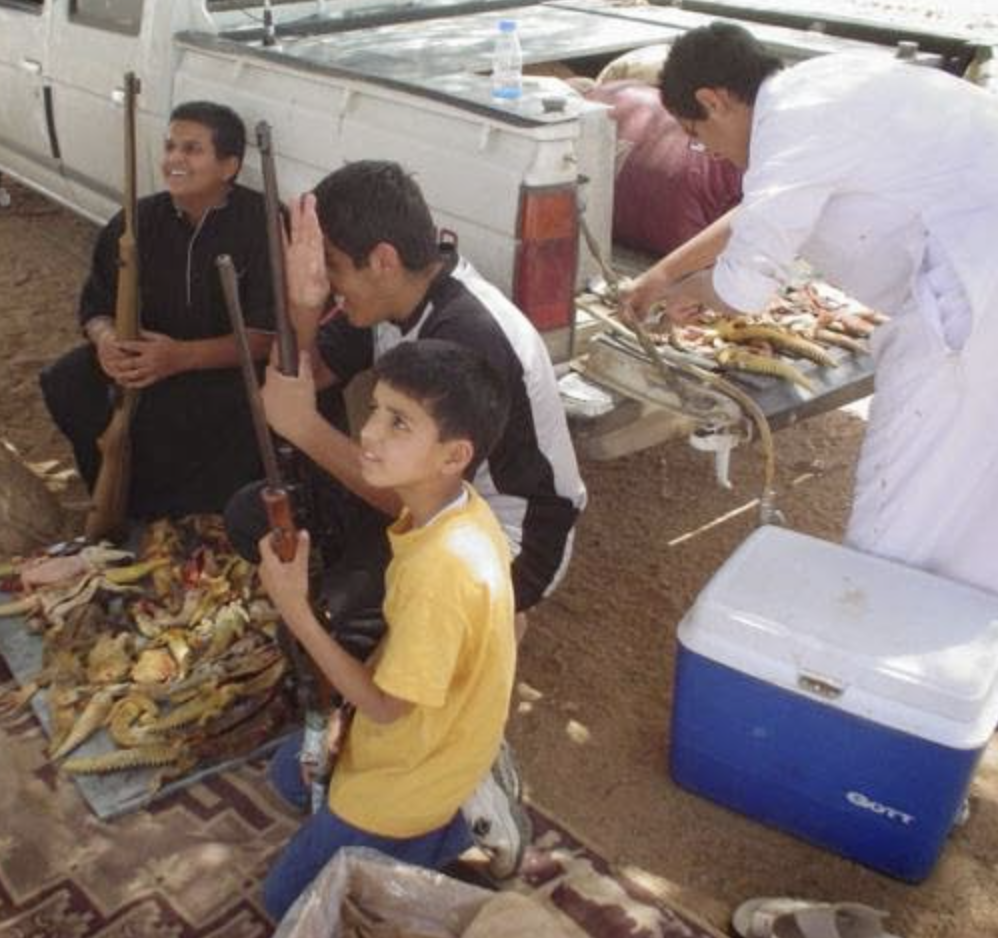
How do you hunt the reptiles: “There are several ways to hunt the dabb lizard, one is to let it sink in water by pouring water into the hole and forcing it to come out, another way is by chasing it and hunting it especially if it is far from the hole, the other way of hunting it is to use a firearm,’’ said Saudi lizard hunter Majed al-Matrudi to Al Arabiya News.
This blog woldbirder provides photos and a recipe from Jordan:


Recipe for Dhub Mansaf (recipe from eastern Jordan)
2 whole dhubs
½ kilo rice
5 pieces Arabic bread (Khubz mashrouh)
¼ kilo laban or yoghurt
100 g ghee
50 g pine nuts
Salt, pepper, allspice, cardamom
Serves 2 to 3.
Method: Catch two adult, well-grown dhubs, skin them and remove organs (except liver). Cut the dhubs into small pieces, wash them and cook in a small amount of water together with spices until the meat is half done. Add the laban and simmer until tender. Add the browned ghee, reserving a small quantity to brown the pine nuts. Meanwhile in another saucepan cook the rice. Keeping some bread aside to dip, break open the rest over a large tray, leaving an edging around the rim. Spread more of the laban sauce over this and pile with rice. Arrange the pieces of dhub on top of the rice. Sprinkle the entire plate of rice and dhub, with browned pine nuts.
Eat with right hand.

Like the problematic hunting of birds and owls in Jordan and Saudi Arabia, modernization has made lizard hunting largely symbolic. They are a protected animal in the UAE but are still reportedly eaten in Jordan.
The ḍahb population is under pressure from habitat loss, 4×4 vehicle use, and over-hunting. Conservationists now warn that without regulation, this ancient species could disappear from Saudi sands. The Saudi Wildlife Authority has begun monitoring populations and promoting education to protect the reptile’s role in the desert ecosystem. Since there is no free press in Saudi Arabia, your guess on how that’s going is as good as mine.
Related Reads on Sustainable food:
The Birth of Bread in Jordan and Israel
The Sacred Ritual of Arabic Coffee
Saudi Vision 2030 and the Revival of Folk Culture
Sustainable Food From Desert Landscapes
UAE Green Finance and Cultural Sustainability
Eco-Tourism and Bedouin Heritage
By exploring forgotten folk dishes like lizard stew, Green Prophet continues to connect the dots between culture, ecology, and the future of sustainable living in the Middle East.