Trump aims to make Gaza the new Riviera – can the US do it sustainably?

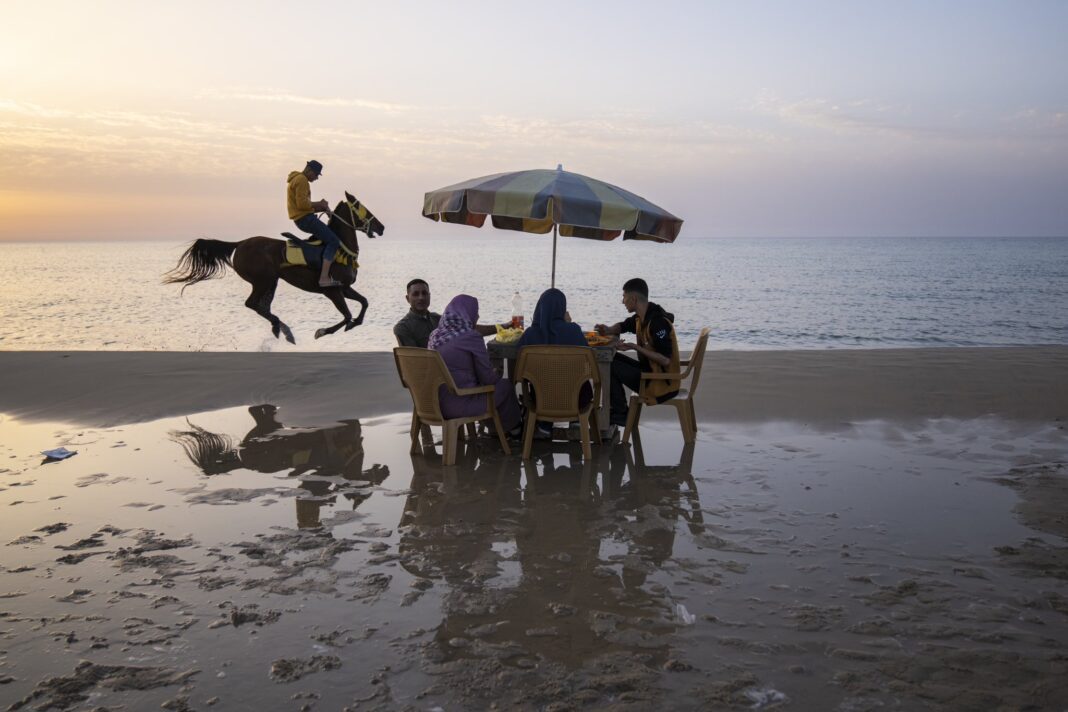
Gaza beach https://x.com/FatimaMshbair/status/1631686644918001666
Gaza beach via FatimaMshbair

In a jaw-dropping annoucement, US President Trump announced that the US will take over the radicalization of the Gaza Strip and that the current population will need to be displaced as they rebuild and clear out the rubble. War and conflict has disasterous environmental implications and we can imagine that environmental organizations are scrambling to figure out how to deal with the humanitarian crisis and the 37 million tonnes of debris and hazardous material that covers much of the Gaza Strip area. The Gaza Strip is a wasteland.

After meeting with Israeli Prime Minister Benjamin Netanyahu, Trump has declared that the US will “take over” the Gaza Strip envisioning a “long-term” US ownership of the territory after all Palestinians were moved elsewhere.

Gaza, he said, could be transformed into the “Riviera of the Middle East”. Trump did not explain how and under what authority the US could assume control of Gaza. “We will own it and be responsible for dismantling all of the dangerous unexploded bombs and other weapons on the site,” he said, adding that the US would “level” destroyed buildings and “create an economic development that will supply unlimited numbers of jobs and housing for the people of the area.”

Related: Gazans make remote-controlled bombs from UNWRA condoms

Condom bombs set off by Palestinians to set fires in Israel
Condom bombs set off by Palestinians to set fires in Israel. 2018

The Gaza Strip, was most notably in the news over the last year and a half after the violent terror attack against Israelis and foreign workers, where about 1200 people were killed and some 250 people taken hostage. The Strip is 25 miles (45 km) long and at its widest is 6 miles (10 km) wide. Its violent history and ruling of the terror regime called Hamas makes it untenable as a partner for peace. Israel retaliated in order to defend its country. Sadly, thousands of civilians and children have lost their lives in this battle in Gaza.

Australian women on the beach in Gaza, British Mandate Palestine, 1940
Australian women nurses on the beach in Gaza, British Mandate Palestine, 1940

Reconstruction, under what authority, and how long it will take are many of the unanswered questions, but the time might be right for zero energy technologies and building practices envisioned and put into practice in cities like Masdar, might make for some excellent case studies. Hassan Fathy, a well-known vernacular architect who built New Gourna in Egypt offers some reasonable and sound ecological design and building practices for the Middle East.

Related: Trump could use these sustainable technologies to rebuild Gaza

Original photo from the mid-1940s of New Gourna

What this offers is a new promise for a better future: I hope that the future people living there will not live under a brutal, evil regime. I recall a story from about 15 years ago that I was working on after meeting Middle East water leaders at an event in Switzerland. I spoke with the mayor of Ashkelon, Israel who was developing a new wastewater treatment plant for his city and offered the blueprint and outside development grants to the mayor of Gaza City, not far down along the coast. But Hamas would not let the mayor of Gaza City out.

The Ashkelon mayor had also offered to meet at a third location in Europe so that they could discuss cooperation on treating their population’s wastewater. The Gaza City mayor wanted to go but the Hamas regime, not the people of Israel, wouldn’t let him out.

Some Palestinians and left-wing Marxists call working with Israel as “normalization” and any act of peacebuilding even for their mutual good is seen as an act of sabotage against their vision of owning all of Israel. Under this theory, if you work with Israel, Hamas will threaten your livelihood and life and this is why Trump understands that only a reset can bring harmony to the people living there. We’ve seen enough videos to know how Hamas treats people who criticize the regime.

Peaceful, normalization is a train that has left the building. “Normalization” of the United Arab Emirates and Saudi Arabia with the west –– and Israel –– is already happening at a breakneck speed. Saudi Arabia wouldn’t survive without moving in this direction.

By 2030, Saudi Arabia plans to be an open-minded, ecological superhighway of ideas and commerce, that spring forth out of its mega city Neom projects and head out of an oil economy. While early visitors are paid to live in Neom projects (X readers compare it to a penal colony) and stars like Will Smith and Tom Brady come out to endorse island paradise projects like Sindalah, Saudi Arabian’s sudden and moderate politics make us hopeful of the impact, and speed of America’s colonization of Gaza and sustainable development in the region.

Israeli irrigation expert Dr. Daniel Hillel with Palestinian leaders.

Related: how America’s Daniel Hillel pioneered drip irrigation in the Middle East

Establishing an American presence in the Middle East that is not in the corrupt Qatar will give a great chance for developing new clean water, energy and agricultural solutions for the entire Middle East (read how the Taliban killed the Japanese water bring clean water to Afghanistan). New Gazans could train all the Arab nations on these new fruits of success.

Up next: Lebanon. Make it free from the Hezbollah.

Want to work with a network of partners that rebuild Gaza sustainably? Send us a message if you work in sustainable development and land rehab. [email protected]


Hot this week

How Renewable Energy is Revolutionizing the Way We Power Our World

Solar has become the star of the transition thanks to modular hardware and straightforward installation. It fits dense cities and remote towns alike. Many companies are turning to rooftop arrays and carport systems - and exploring commercial solar installation as a practical way to lock in future savings.

How does one start prepping?

Faced with an extreme winter storm this year, Americans wonder how to be prepared for catastrophe. Miriam has lived through wars in the Middle East - so she's prepared on giving you a guide to prepping.

Fishermen sue tire manufacturers on behalf of the salmon

A federal trial in San Francisco has brought US tire manufacturers, fishing groups, and environmental scientists into court over a chemical most drivers have never heard of — but which scientists say may be silently reshaping aquatic ecosystems.

Listening to Water: Tarek Atoui’s Next Work for Tate Modern

Born in Beirut, Lebanon in 1980 and now living in Paris, Atoui has spent years building instruments that don’t sit comfortably in concert halls. Many of them involve water, glass, and ceramics — materials that react to sound instead of simply producing it.

Leading Through a Dual-Energy Transition: Balancing Decarbonisation with Energy Security

Experience in one area of the energy industry isn't enough to guarantee readiness across all the others. That's where a structured program like an MBA in energy can come in. Today's advanced curricula explore energy economics, finance, policy, and strategic management alongside the technical subjects. And when pursuing an energy MBA online, professionals can skill up and retrain without having to step out of the labor market -- an important perk at a time when skilled professionals are already in short supply.

Topics

How Renewable Energy is Revolutionizing the Way We Power Our World

Solar has become the star of the transition thanks to modular hardware and straightforward installation. It fits dense cities and remote towns alike. Many companies are turning to rooftop arrays and carport systems - and exploring commercial solar installation as a practical way to lock in future savings.

How does one start prepping?

Faced with an extreme winter storm this year, Americans wonder how to be prepared for catastrophe. Miriam has lived through wars in the Middle East - so she's prepared on giving you a guide to prepping.

Fishermen sue tire manufacturers on behalf of the salmon

A federal trial in San Francisco has brought US tire manufacturers, fishing groups, and environmental scientists into court over a chemical most drivers have never heard of — but which scientists say may be silently reshaping aquatic ecosystems.

Listening to Water: Tarek Atoui’s Next Work for Tate Modern

Born in Beirut, Lebanon in 1980 and now living in Paris, Atoui has spent years building instruments that don’t sit comfortably in concert halls. Many of them involve water, glass, and ceramics — materials that react to sound instead of simply producing it.

Leading Through a Dual-Energy Transition: Balancing Decarbonisation with Energy Security

Experience in one area of the energy industry isn't enough to guarantee readiness across all the others. That's where a structured program like an MBA in energy can come in. Today's advanced curricula explore energy economics, finance, policy, and strategic management alongside the technical subjects. And when pursuing an energy MBA online, professionals can skill up and retrain without having to step out of the labor market -- an important perk at a time when skilled professionals are already in short supply.

From Green Energy to Healthy Societies: Why old systems thinking is becoming relevant again

Across the Middle East and North Africa, large investments are being made in green hydrogen, renewable energy, water infrastructure and sustainability. Most of these efforts are discussed in the context of climate change, decarbonization and economic diversification. That framing is important, but it may not capture their full value.

We saw peace – an interreligious encounter deep in our eyes

They came from Israel, Palestine, Jordan, Iraq, Yemen, Morocco, Tunisia, Lebanon, Egypt… There are Sunni Muslims, Shiite Muslims, Jews (Orthodox and Reform), Orthodox Christians, Coptic Christians, Protestant Christians, Druze, Baha'is, a Scientologist.

Can biochar reduce ‘Forever Chemicals’ in food if it’s used in farms?

Biochar is produced by heating organic material in a low-oxygen environment so it does not burn. This process, known as pyrolysis, transforms plant matter into a stable, carbon-rich material.

Related Articles

Popular Categories