Sudan is starving and 25 million people face famine

Sudan
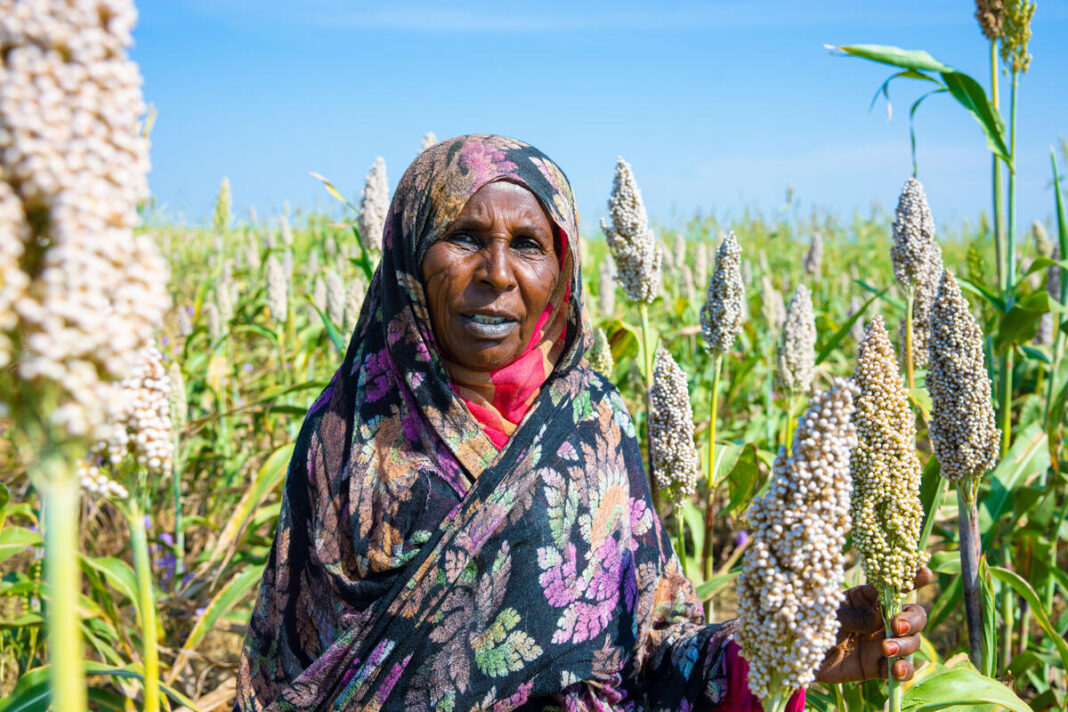
21 October 2024. Gadam Baliah village, Wasat Al Gedaref locality, Gedaref, Sudan. Hawa Ahmed, a resilient farmer from Gadam Baliah village, Gedaref, showcasing her crops’ progress.

Urgent action, in particular immediate and unimpeded humanitarian access, is required to address the widening famine in Sudan, where almost 25 million people face acute food insecurity.

According to the latest analysis from the Integrated Food Security Phase Classification (IPC), half of Sudan’s population – or 24.6 million people – are facing acute food insecurity levels. This is 3.5 million more people since June 2024.

The latest report by the IPC, a multi-partner initiative for improving food security and nutrition analysis and decision-making, is the worst in the country’s history. Widespread starvation and acute malnutrition have already resulted in tens of thousands of deaths in a country where almost two-thirds of the population depends on agriculture.

Production of key crops such as sorghum, millet and wheat during the first year of the conflict – the 2023/24 season – was down 46 percent from the previous year. This production loss could have fed approximately 18 million people for a year and represented an economic loss of between $1.3 and $1.7 billion.

Restricted humanitarian access is exacerbating the situation, while sustained violence and economic turmoil have disrupted markets, driving the price of staple goods to unaffordable levels.

This marks the fourth time that famine has been confirmed in a country over the past 15 years.

“We must take urgent action to address the famine in Sudan,” said Beth Bechdol, the Deputy Director-General of the Food and Agriculture Organization of the United Nations told a UN Security Council meeting in New York.

“If we fail to act now, collectively, and at scale, millions of lives are even further at risk, and (…) so is the stability of many nations in the region,” she added.

According to Bechdol, the following actions deserve prioritizing and require the Security Council’s support:

1) political leverage to end hostilities and bring relief to the people of Sudan;

2) immediate and unimpeded humanitarian access, as well as safe reopening of commercial supply routes to address current shortfalls in key hunger hotspots, as stated recently by FAO and its UN partner agencies;

3) the delivery of multi-sectoral humanitarian assistance, especially emergency agricultural support which is key to ensuring local food production, building resilience and preventing further humanitarian catastrophe.

The source of Sudan’s conflicts?

2020 Pew Research Center data estimates that 91 percent of the population is Muslim, 5.4 percent Christian, 2.8 percent follow Indigenous religions, and the remainder follow other religions or are unaffiliated. Some religious advocacy groups estimate non-Muslims make up more than 13 percent of the population.

Sudan ended over a quarter-century of Islamist-military rule with the 2019 overthrow of President Omar al-Bashir, whose rule was based on Islamism, Arab supremacy, and the ruthless application of military power, according to the Jameston Foundation: A joint civilian-military government was formed to lead the transition to a civilian-led democracy. However, an October 2021 coup led by Sudan’s military and security forces ended all progress toward civilian rule, severing at the same time most of Sudan’s economic and financial ties to the West.

Hot this week

How Renewable Energy is Revolutionizing the Way We Power Our World

Solar has become the star of the transition thanks to modular hardware and straightforward installation. It fits dense cities and remote towns alike. Many companies are turning to rooftop arrays and carport systems - and exploring commercial solar installation as a practical way to lock in future savings.

How does one start prepping?

Faced with an extreme winter storm this year, Americans wonder how to be prepared for catastrophe. Miriam has lived through wars in the Middle East - so she's prepared on giving you a guide to prepping.

Fishermen sue tire manufacturers on behalf of the salmon

A federal trial in San Francisco has brought US tire manufacturers, fishing groups, and environmental scientists into court over a chemical most drivers have never heard of — but which scientists say may be silently reshaping aquatic ecosystems.

Listening to Water: Tarek Atoui’s Next Work for Tate Modern

Born in Beirut, Lebanon in 1980 and now living in Paris, Atoui has spent years building instruments that don’t sit comfortably in concert halls. Many of them involve water, glass, and ceramics — materials that react to sound instead of simply producing it.

Leading Through a Dual-Energy Transition: Balancing Decarbonisation with Energy Security

Experience in one area of the energy industry isn't enough to guarantee readiness across all the others. That's where a structured program like an MBA in energy can come in. Today's advanced curricula explore energy economics, finance, policy, and strategic management alongside the technical subjects. And when pursuing an energy MBA online, professionals can skill up and retrain without having to step out of the labor market -- an important perk at a time when skilled professionals are already in short supply.

Topics

How Renewable Energy is Revolutionizing the Way We Power Our World

Solar has become the star of the transition thanks to modular hardware and straightforward installation. It fits dense cities and remote towns alike. Many companies are turning to rooftop arrays and carport systems - and exploring commercial solar installation as a practical way to lock in future savings.

How does one start prepping?

Faced with an extreme winter storm this year, Americans wonder how to be prepared for catastrophe. Miriam has lived through wars in the Middle East - so she's prepared on giving you a guide to prepping.

Fishermen sue tire manufacturers on behalf of the salmon

A federal trial in San Francisco has brought US tire manufacturers, fishing groups, and environmental scientists into court over a chemical most drivers have never heard of — but which scientists say may be silently reshaping aquatic ecosystems.

Listening to Water: Tarek Atoui’s Next Work for Tate Modern

Born in Beirut, Lebanon in 1980 and now living in Paris, Atoui has spent years building instruments that don’t sit comfortably in concert halls. Many of them involve water, glass, and ceramics — materials that react to sound instead of simply producing it.

Leading Through a Dual-Energy Transition: Balancing Decarbonisation with Energy Security

Experience in one area of the energy industry isn't enough to guarantee readiness across all the others. That's where a structured program like an MBA in energy can come in. Today's advanced curricula explore energy economics, finance, policy, and strategic management alongside the technical subjects. And when pursuing an energy MBA online, professionals can skill up and retrain without having to step out of the labor market -- an important perk at a time when skilled professionals are already in short supply.

From Green Energy to Healthy Societies: Why old systems thinking is becoming relevant again

Across the Middle East and North Africa, large investments are being made in green hydrogen, renewable energy, water infrastructure and sustainability. Most of these efforts are discussed in the context of climate change, decarbonization and economic diversification. That framing is important, but it may not capture their full value.

We saw peace – an interreligious encounter deep in our eyes

They came from Israel, Palestine, Jordan, Iraq, Yemen, Morocco, Tunisia, Lebanon, Egypt… There are Sunni Muslims, Shiite Muslims, Jews (Orthodox and Reform), Orthodox Christians, Coptic Christians, Protestant Christians, Druze, Baha'is, a Scientologist.

Can biochar reduce ‘Forever Chemicals’ in food if it’s used in farms?

Biochar is produced by heating organic material in a low-oxygen environment so it does not burn. This process, known as pyrolysis, transforms plant matter into a stable, carbon-rich material.

Related Articles

Popular Categories