Israel’s BeeHero a top 100 cleantech company

BeeHero technology to locate hives

Pollination is big business in the United States. Pollination from bees, beetles, flies and birds makes sure that olive trees and agriculture crops such as strawberries and almonds will grow. In fact 75% of all pollination comes from bees. But about 40% of managed honey bee colonies in the US were lost between 2021 to 2022, a problem for farms and farmers.

Part of the reason the bees are being lost –– or colonies dying –– I am acutely aware, is because of the conventional farming system that creates monoculture crops and which uses pesticides. However, beekeeping for honey and as a pollinator service is big business in the United States, expected to grow to about $700 million USD by 2027.

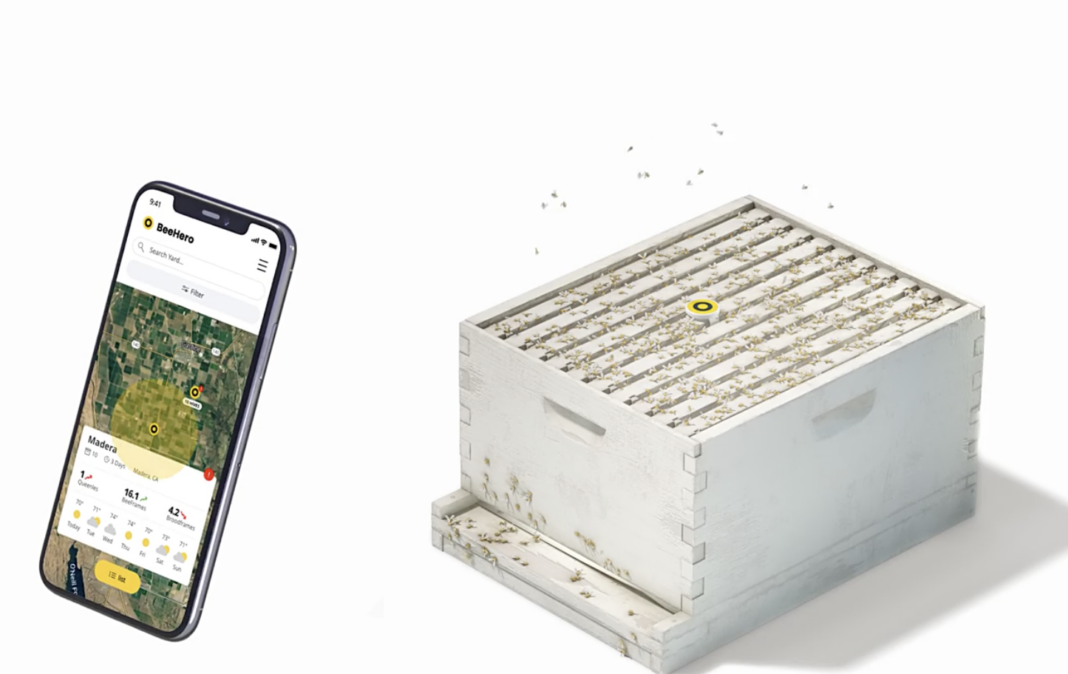
A startup from Israel called BeeHero, based now in California with an R&D office in Tel Aviv, is using sensors and data to help conventional beekeepers maintain healthy hives. A sensor in the hive that monitors conditions paired with data inputs from research and a sharing app helps commercial beekeepers keep track of their hives in the field, real time.

In 2022 BeeHero had already raised $42 million USD. This year they are voted one of 100 companies of the year by the CleanTech Group. The Cleantech Group totaled 25,435 nominations from over 65 countries to offers a fair representation of global innovation and private company creation.

Beeher’s latest $42M Series B funding round led by Convent Capital was joined by General Mills, Cibus Capital (formerly ADM Capital), Rabobank, MS&AD, Firstime, J-Ventures, Plug&Play, iAngels, Gaingels, UpWest, and more. By that point they had raised $64M.

BeeHero creates what they call a Healthy Hive Score, a metric for measuring bee health that promotes bee welfare management. Their beehive sensors collectively saved a quarter of a billion bees this past year, according to their data, and beekeepers using BeeHero’s technology have reported 33% fewer colony losses compared to the US national average.

BeeHero screengrab
BeeHero screengrab

As the human population continues to rise, growers are faced with the challenge of producing more food with fewer resources. Bee pollination is indispensable to this production of the world’s most valuable and nutritious foods, providing $18 billion annually in value to US agricultural crops alone.

BeeHero currently runs the largest database of bee behavior in existence, according to the company. They have amassed  data from hundreds of thousands of monitored colonies, and existing academic research, to give beekeepers a way to assess colony health based on colony growth, brood health, and queen presence, normalized against weather conditions and flight hours.

Beehives in Israel, by Karin Kloosterman, near the Banias
Beehives in the Banias, Israel. Photo by Karin Kloosterman for Green Prophet

For growers, they can decide where and when to place bees for better pollination rates: “While beekeepers and growers depend upon strong and healthy hives, they have long struggled to accurately see inside their hives to better understand and care for their colonies, leaving both their crop yields and bottom lines at risk,” says Omer Davidi, the CEO of BeeHero. This is especially true in the United States and Canada where a significant number of colonies do not withstand winter. Other stressors include disease and climate change.

We wrote about the problems with almonds and almond milk here. And our demanding almond milk is also part of the problem. California supplies 80% of the world’s almonds. In 2019, that amounted to 2.5 billion pounds of the nuts. And the demand rises, with companies especially eyeing the growing Chinese market. California farmers have ripped out citrus trees and planted almond groves that cover over 1000,000 acres – an area comparable to the size of Delaware.

While Americans eat plenty of almonds – an estimated 900 grams every year – it’s the demand for almond milk that’s driving the industry.  At sales of $1.2 billion yearly, hugely topping other non-dairy milks, it’s easy to see why.

The catch is that almond farmers can’t rely on native bees to pollinate their orchards. There aren’t enough of them, and they can’t be counted on to pollinate a predictable number of trees. The farmers contract commercial beekeepers to transport their hives to the orchards while the trees blossom. 1.6 million hives are needed to make USA almond trees produce every spring – over ten times what other crops, like apples, demand.

And this is where BeeHero hopes to fit into the market.

The first application of BeeHero’s Healthy Hive Score was during the 2023 almond pollination season in California. Growers received scores based on analysis of each of the orchards pollinated by hives under BeeHero management. Based on the average outcome of almonds per acre, growers that worked with BeeHero during this season collectively produced about 270 million pounds of almonds all grown under bee-friendly conditions.

Karin Kloosterman
Karin Kloostermanhttp://www.greenprophet.com
Karin Kloosterman is an award-winning journalist, innovation strategist, and founder of Green Prophet, one of the Middle East’s pioneering sustainability platforms. She has ranked in the Top 10 of Verizon innovation competitions, participated in NASA-linked challenges, and spoken worldwide on climate, food security, and future resilience. With an IoT technology patent, features in Canada’s National Post, and leadership inside teams building next-generation agricultural and planetary systems — including Mars-farming concepts — Karin operates at the intersection of storytelling, science, and systems change. She doesn’t report on the future – she helps design it. Reach out directly to [email protected]

Read More

TRENDING

Dan Zaslavsky’s energy tower dream is rising again in Iran and China

The Energy Tower idea never made the leap from drawings and engineering studies to full-scale construction. But nearly two decades after most people stopped talking about it, the concept is quietly evolving in two unexpected places: China and Iran. The concept let dreamers dream and doers do - figuring out more pleasing designs and engineering.

A visit to Amirim, Israel’s first all-vegetarian village in the Galilee

Just 15 kilometers from Tzfat there is a moshav that was founded in the late 50s that was ideologically influenced by organic, vegetarian and vegan principles. My hostess at Ohn-Bar, the tzimmer where I stayed, explained that the people of Amirim were among the pioneers of Israel’s strong vegetarian movement.

Israeli Hydrogen Startup H2Pro Are Trying to Solve Clean Energy’s Hardest Problem

The company has attracted backing from major investors including Breakthrough Energy Ventures, the climate fund founded by Bill Gates, along with industrial partners such as Sumitomo, ArcelorMittal, and Temasek, a multi-billion dollar company that owns Singapore airlines. H2Pro has raised more than $100 million USD and is moving from pilot projects toward commercial-scale deployments.

Desalination experts debunk Aqua Solaire, the floating desalination barge

AI makes it easy to dream, develop, and create images of what could be world-changing ideas, until the reality sets in. A new project making the rounds is Aqua Solaire, an allged French concept for a solar-powered desalination vessel designed to bring drinking water to coastal communities facing drought, storms, and infrastructure failures.

From Pasture to ROI: Implementing Autonomous Systems in Livestock and Pasture Management

The livestock and pasture management sector is currently facing...

Locals From Rishon Fight IKEA

Big Box stores are a pretty new concept in Israel, and thank God that not every Israeli city wants them in their backyard. A word from someone who has see the beautiful farmland around her hometown Newmarket, Ontario stripped and converted into vulgar strip malls of big box shops: they have no place in a healthy and sustainable town or city.

The Jewish National Fund Meets An Inconvenient Truth

According to the JNF, it has transformed thousands of acres of barren land into green forests in Israel. They state that each person emits about 23 tons of carbon per year, estimating that each tree planted can absorb one ton of carbon in its lifetime. That's a whole lot of trees you'd need to be planting. Could so many fit in Israel?

How to quiet noise from construction in your office

Streets need to be resurfaced in New York but the humming and grinding noise is unsettling. Noise is environmental pollution. 

EarthX and a blueprint for sustainable investing

Trammell S. Crow, a Dallas-based businessman and father of four, is focusing his efforts on impact investing, and media that focuses on saving the planet through EarthX.

Mining Afghanistan’s Mineral Discoveries Similar to Avatar

Now that American forces in Afghanistan are commemorating the longest period of any war that America has been involved in, including the 1965-73 Vietnam War, the recent discoveries of large and extremely valuable mineral and metal deposits may finally bring to light a reason to continue the presence of US fighting forces in this war torn and backward country.

From Pilot Plant to Global Stage: How Aduro Clean Technologies’ 2026 Expansion Signals a Turning Point for Chemical Recycling Investors Like Yazan Al Homsi

The company's Next Generation Process (NGP) Pilot Plant in London, Ontario, has officially moved into initial operating campaigns, generating the kind of structured, repeatable data that separates laboratory promise from commercial viability.

Nobul’s Regan McGee on Shareholder Value: “Complacency Is the Silent Killer” 

Why the governance framework designed to protect shareholders so...

Should You Invest in the Private Market?

startustartup Unlike public stock exchanges, which offer daily trading, strict...

Popular Categories