
Happy New Year Trees, and spiritual reasons for Tu B’Shevat Customs

Tu Be shevat
Tonight marks the end of the Jewish holiday Tu B’Shevat. The Jewish New Year of the trees. Here is an enlightening article on the spiritual customs surrounding this ecological, Jewish holiday.

Growing up in the Midwest, our Hebrew School celebrated Tu B’shevat (The New Year for the Trees) as a minor holiday. We collected money for the Jewish National Fund to plant trees in Israel and munched on some carob pods and dried pineapple.

I immigrated to Israel in 1983 and soon afterward I moved to Tzfat where Tu B’Shevat is serious business. My Hassidic and Sepharadi neighbors spend a good amount of time planning for the holiday and spend a good amount of money stocking up on every possible type of fresh and dried fruit, nut and wine so that they can create a Tu B’Shevat Seder that comes as close to the Kabbalistic tradition as possible.

Origins of Tu B’shevat
The origins of Tu B’shevat derive from the Talmud where the Rabbis wrote that there are four new year celebrations in the Jewish year. The 15th of the month of Shvat is the New Year of the trees. The day relates to the Biblical mitzvoth of ma’aser (tithing), orlah (refraining from picking a tree’s fruit for the first 3 years) and shmitta (Sabbatical year). For purposes of determining the start and end dates of each year’s agricultural cycle for trees Tu B’Shevat was set as the end of the previous year and the beginning of the new year.

According to the Shulhan Aruch (Code of Jewish Law — written in Safed) fasting and eulogies are forbidden and all penitential prayers are omitted on Tu B’shevat. It’s seen as a day of great joy and is a time to thank God for all of His goodness.

Tu B’shevat, Kabbalah and Safed
Rabbi Isaac Luria — the Ari — lived in Safed between the years 1570 – 1573. The Ari instituted many different Jewish traditions which many Jews, particularly Hassidim and Sepharadim, continue to observe. These include the customs of cutting a little boy’s hair fir the first time when the child turns three, studying all night on Shavouth and the Tu B’Shevat Seder.

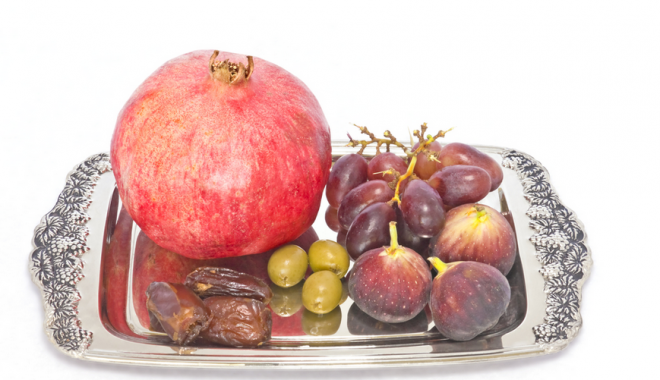
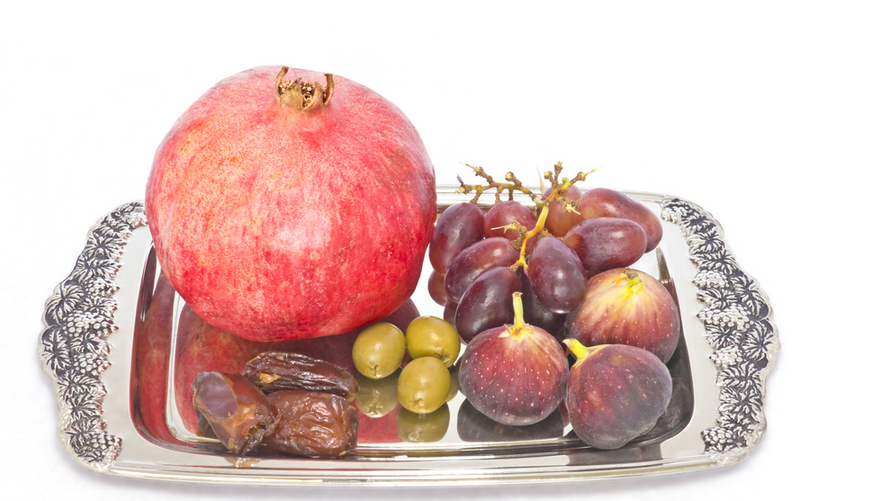
The Ari established a Seder — Order — in which participants eat specific produce in a particular order as they read appropriate mystical passages. The Ari’s Seder was recorded by one of his students in the Pri Etz Hadar booklet. His Seder involved twelve fruits which correspond to the permutations of G-d’s four-letter name, along with related verses from the Zohar. These first 12 “fruits” include wheat (the only one of the 12 for which the blessing is “blessed is the fruit of the earth” instead of “blessed is the fruit of the trees”), olives, dates, grapes, figs, pomegranates, citrons/etrogim, apples, walnuts, almonds, carobs and pears.

Explanations of the customs
One of the Ari’s students, Rabbi Chaim Vital, wrote that there are 30 fruits which parallel the ten sefirot. Fruits which are wholly edible (those with no pits or hard cores, skins which can be cooked) manifest in the world of Beriah, one of the four spiritual worlds. Fruits which can be wholly eaten except for a pit relate to the spiritual world of Yetzirah, which is a lesser level of purity. Fruits which are enclosed in a totally inedible, protective shell (almonds, walnuts) represent the world of Asiyah — our world. In the same way that the Passover Seder involves discussions of each of the symbolic foods, the Tu B’Shevat Seder includes discussions of the kabbalistic concepts that are manifested by each of these different types of fruits.

Discussions during the Tu B’shevat Seder relate to the different tastes, consistencies, colors and cultivation needs of each fruit.

Finally, as in the Pesach Seder, the Tu B’shevat Seder involves wine, though for this Seder the wine must be both red and white. The different colors are symbolic as well….the seder begins with white wine which symbolizes winter, dormancy and hibernation. The second cup is mostly white wine with a bit of red, symbolizing the new life force — spring — which is beginning to appear. The third cup is mostly red with a residue of some white wine and the fourth cup, symbolizing the emergence of spring, is a cup of red wine.

Laurie Rappeport lives in Safed, Israel. She teaches about Judaism and Israel for an online education concern and researches American Jewish music traditions, including traditions of the Tu B’Shevat holiday, for the Milken Archives.

Image of Tu B’Shevat plate from Shutterstock

LEAVE A REPLY

Please enter your comment!
Please enter your name here

TRENDING

Earth building with Dead Sea salt bricks

Researchers develop a brick made largely from recycled Dead Sea salt—offering a potential alternative to carbon-intensive cement.

The Christ’s thorn (sidr tree) is also a well-known folk medicine

Christ’s thorn jujube (Ziziphus spina-christi) also known as the sidr tree is a real, identifiable tree native to the Middle East, and it appears—directly or indirectly—in Islam, Judaism, and later Christian tradition. The connections between the three faiths are not theological agreements but overlapping uses, names, and symbolic associations rooted in the same landscape.

Farm To Table Israel Connects People To The Land

Farm To Table Israel is transforming the traditional dining experience into a hands-on journey.

Remilk makes cloned milk so cows don’t need to suffer and it’s hormone-free

This week, Israel’s precision-fermentation milk from Remilk is finally appearing on supermarket shelves. Staff members have been posting photos in Hebrew, smiling, tasting, and clearly enjoying the moment — not because it’s science fiction, but because it tastes like the real thing.

An Army of Healers Wins the 2025 IIE Goldberg Prize for Peace in the Middle East

In a region more accustomed to headlines of loss than of listening, the Institute of International Education (IIE) has chosen to honor something quietly radical: healing. The 2025 Victor J. Goldberg Prize for Peace in the Middle East has been awarded to Nitsan Joy Gordon and Jawdat Lajon Kasab, the co-founders of the Army of Healers, for building spaces where Israelis and Palestinians — Jews, Muslims, Christians, Druze, and Bedouins — can grieve, speak, and rebuild trust together.

Qatar’s climate hypocrisy rides the London Underground

Qatar remains a master of doublethink—burning gas by the megaton while selling “sustainability” to a world desperate for clean air. Wake up from your slumber people.

How Quality of Hire Shapes Modern Recruitment

A 2024 survey by Deloitte found that 76% of talent leaders now consider long-term retention and workforce contribution among their most important hiring success metrics—far surpassing time-to-fill or cost-per-hire. As the expectations for new hires deepen, companies must also confront the inherent challenges in redefining and accurately measuring hiring quality.

8 Team-Building Exercises to Start the Week Off 

Team building to change the world! The best renewable energy companies are ones that function.

Thank you, LinkedIn — and what your Jobs on the Rise report means for sustainable careers

While “green jobs” aren’t always labeled as such, many of the fastest-growing roles are directly enabling the energy transition, climate resilience, and lower-carbon systems: Number one on their list is Artificial Intelligence engineers. But what does that mean? Vibe coding Claude? 

Somali pirates steal oil tankers

The pirates often stage their heists out of Somalia, a lawless country, with a weak central government that is grappling with a violent Islamist insurgency. Using speedboats that swarm the targets, the machine-gun-toting pirates take control of merchant ships and then hold the vessels, crew and cargo for ransom.

Leopoldo Alejandro Betancourt López Turned Ocean Plastic Into Profitable Sunglasses

Few fashion accessories carry the environmental burden of sunglasses. Most frames are constructed from petroleum-based plastics and acrylic polymers that linger in landfills for centuries, shedding microplastics into soil and waterways long after they've been discarded. Leopoldo Alejandro Betancourt López, president of the Spanish eyewear brand Hawkers, saw this problem differently than most industry executives.

Why Dr. Tony Jacob Sees Texas Business Egos as Warning Signs

Everything's bigger in Texas. Except business egos.  Dr. Tony Jacob figured...

Israel and America Sign Renewable Energy Cooperation Deal

Other announcements made at the conference include the Timna Renewable Energy Park, which will be a center for R&D, and the AORA Solar Thermal Module at Kibbutz Samar, the world's first commercial hybrid solar gas-turbine power plant that is already nearing completion. Solel Solar Systems announced it was beginning construction of a 50 MW solar field in Lebrija, Spain, and Brightsource Energy made a pre-conference announcement that it had inked the world's largest solar deal to date with Southern California Edison (SCE).

Related Articles

Popular Categories