For centuries, the Sámi shaman drum was one of the most powerful sacred objects in northern Europe, and one of the most feared by church and state. If ISIS looks bad to us today for its religious fundamentalism, Christians were just as fervent.
In Denmark-Norway during the 17th and early 18th centuries, Sámi drums were confiscated as part of aggressive Christian missionary campaigns. In some witchcraft and idolatry prosecutions, drum owners faced severe punishment, including death sentences, although the legal reality varied case by case rather than through one simple blanket ban.
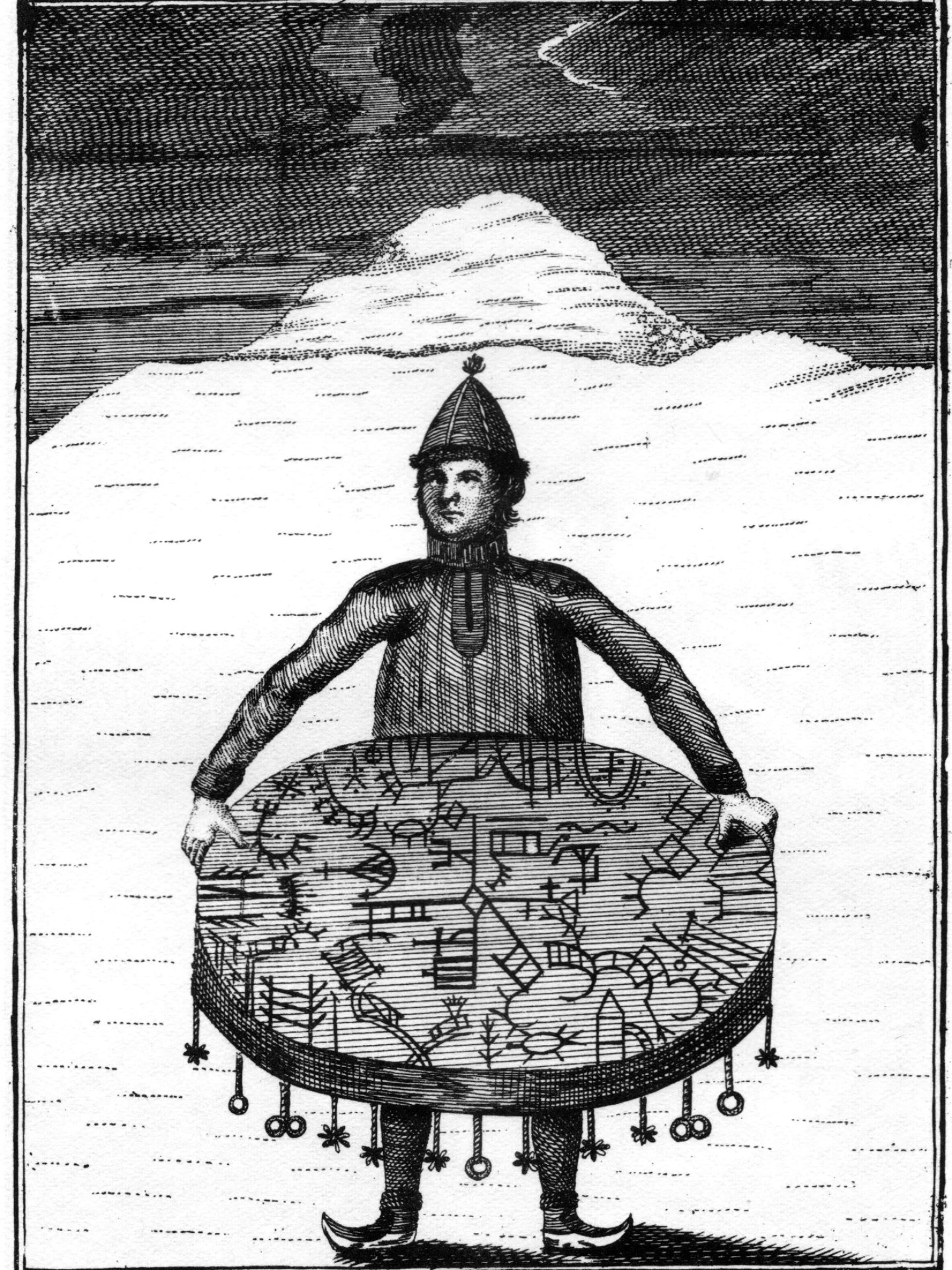
One of the most important records of these drums survives because of Knud Leem (1697–1774), a Norwegian priest and linguist who worked in Finnmark and became one of the earliest major documentarians of Sámi life, language, and belief. Leem began missionary work among the Sámi in 1725, learned Sámi language, and closely observed daily life, religion, and reindeer culture.
His landmark work, Beskrivelse over Finmarkens Lapper, was published in Copenhagen in 1767. The book included parallel Danish/Norwegian and Latin text and was illustrated with numerous copperplate engravings, making it one of the most significant 18th-century ethnographic works on the Sámi published in northern Europe. Some of the imagery was engraved by O.H. von Lode from drawings associated with Leem’s documentation.
How the Sámi drum worked
The Sámi drum, also called a runebomme or shaman drum, was used by a noaidi (Sámi ritual specialist or shaman) for divination and spiritual communication.
The drum membrane was often marked with symbolic figures, sometimes painted in red pigment, and these symbols could represent gods, humans, animals, sacred sites, hunting, illness, or the dead. On some North Sámi drums, the surface was structured into symbolic zones representing the upper world, human world, and underworld.
To use the drum, the noaidi placed a small metal pointer or ring, often referred to in sources as a vuorbi, on the skin and beat the drum. The movement of the ring was then interpreted as an answer to a question like a ouija board. Some questions they might ask include
Where a lost reindeer might be found
Whether a hunt would succeed
What kind of offering or ritual action was needed
The Sámi shaman who played his drum in court
One of the best-documented cases is that of Anders Poulsen, an elderly Sámi noaidi who was tried in Vadsø, northern Norway, in 1692 after his drum was confiscated.
Court records show that Poulsen was interrogated in detail about the symbols on his drum, making his testimony one of the most important surviving descriptions of Sámi cosmology and drum symbolism. Historians describe the case as part of the wider Finnmark witch trials, among the most intense witch persecutions in northern Europe.
Before any final conviction could be carried out, Poulsen was killed in custody with an axe by Willum (Villum) Gundersen, a servant later described in historical records as mentally unstable. Poulsen is often remembered as one of the last victims of the Finnmark witch trials.
Why so few Sámi drums survived
Many Sámi drums did not survive the missionary era. Missionary Thomas von Westen and his network collected large numbers of drums in the early 1700s as part of the Christianization campaign. Historical sources indicate that around 100 drums were taken, many of them sent to Copenhagen. A large portion of these were later destroyed in the Great Fire of Copenhagen in 1728, where about 70 drums were reportedly lost.
Today, only a small number of original Sámi drums survive in museum and institutional collections around the world. Scholars and museums generally place the number at roughly 70 to 75 known surviving drums, depending on classification and provenance.
The Sámi drum is not just an artifact. It is a surviving record of Indigenous cosmology, resistance, and memory. What church authorities once treated as evidence of “paganism” is now understood as part of a sophisticated spiritual and symbolic system tied to land, reindeer, ancestors, and survival in the Arctic.
And because missionaries, courts, and collectors tried so hard to destroy them, every surviving drum now carries two histories at once, the Sámi world it came from, and the violence used to erase it.
Who are the Sámi?
The Sámi people are an indigenous group of approximately 80,000–100,000 individuals living in Sápmi, a region stretching across the northern parts of Norway, Sweden, Finland, and Russia’s Kola Peninsula. While traditionally nomadic reindeer herders, most modern Sámi live in permanent homes in northern Scandinavia, with the largest population concentrated in Norway.