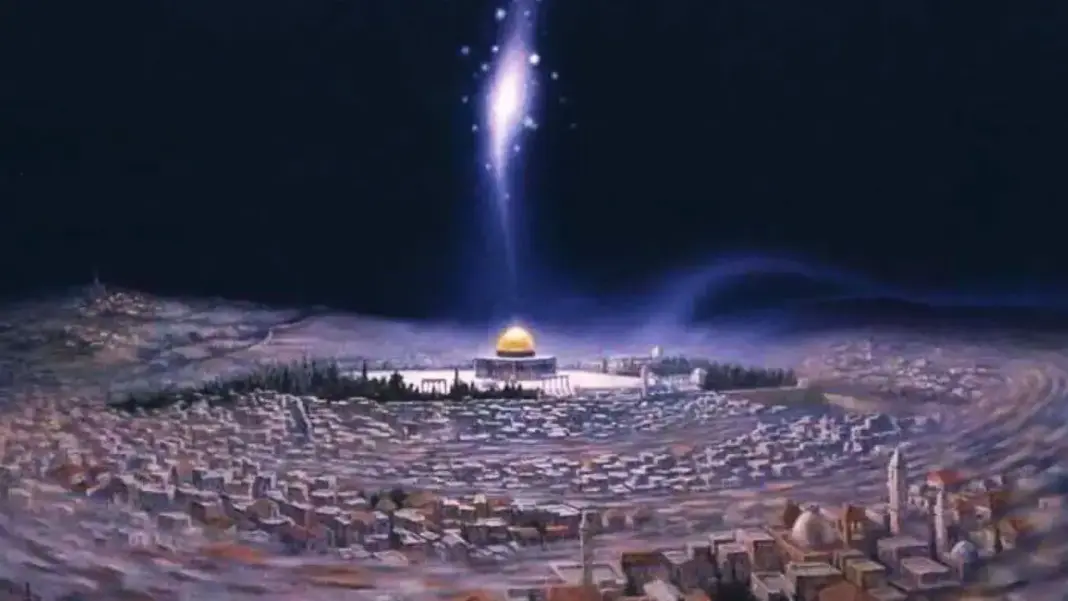


The Muslim prophet Muhammad never traveled to the city of Jerusalem in his lifetime. Yet his dream is celebrated as a spiritual transformation. The Isra and Mi‘raj story describes a spiritual or visionary experience, not a recorded historical journey. Even early Islamic scholars debated whether the event was physical or symbolic. Yet today, Muslims around the world are marking Isra and Mi‘raj as a living spiritual tradition filled with prayer, storytelling, and community rituals around the world.
The approximate date when the Prophet’s night journey occurred is the 27th of Rajab (7th month of the Islamic calendar), about 12 years after the start of revelation, which is about 1 year before the Prophet’s migration from Mecca to Medina, considered the starting point of the Islamic calendar, according to Islamic scholars.
Isra means night journey and mi’raj means ascending like on a ladder.
-
Isra = the night journey
-
Mi‘raj = the ascent
In the Old Testament at the same location, Jacob dreams of a ladder reaching from earth to heaven, with angels ascending and descending on it. The vision symbolizes a connection between the human and divine worlds, made visible during a night of spiritual revelation.
In Christianity, Jesus’ Ascension into heaven mirrors the idea of rising toward God, while Jacob’s ladder (shared with Judaism) is interpreted by Christians as a symbol of Christ connecting heaven and earth. Like Isra and Mi‘raj, these stories express the belief that humans can encounter the divine beyond ordinary physical limits.
How Isra and Mi‘raj Is Celebrated Today

Across Muslim communities, the night is observed with special mosque gatherings, Qur’an recitations, sermons, and family discussions. In many countries, the evening becomes a moment for reflection rather than public festivity. Food also plays a quiet but important role. Families prepare simple shared meals, sweets, dates, and regional dishes that vary by culture:
In Indonesia and Malaysia, communal rice dishes, sweet porridge, and traditional cakes are served after prayers.
In Turkey, families share pastries and syrup-soaked desserts.
In the Middle East, dates, flatbreads, and warm drinks accompany storytelling and prayer.
Children learn the story through songs, drawings, and school programs, while elders emphasize humility, gratitude, and discipline. The night is not about celebration in a modern party sense, but about remembering faith and spiritual responsibility.
The Isra and Mi‘raj festival commemorates not travel, but transformation — and a reminder that in Islamic tradition, spiritual elevation begins with inner struggle.