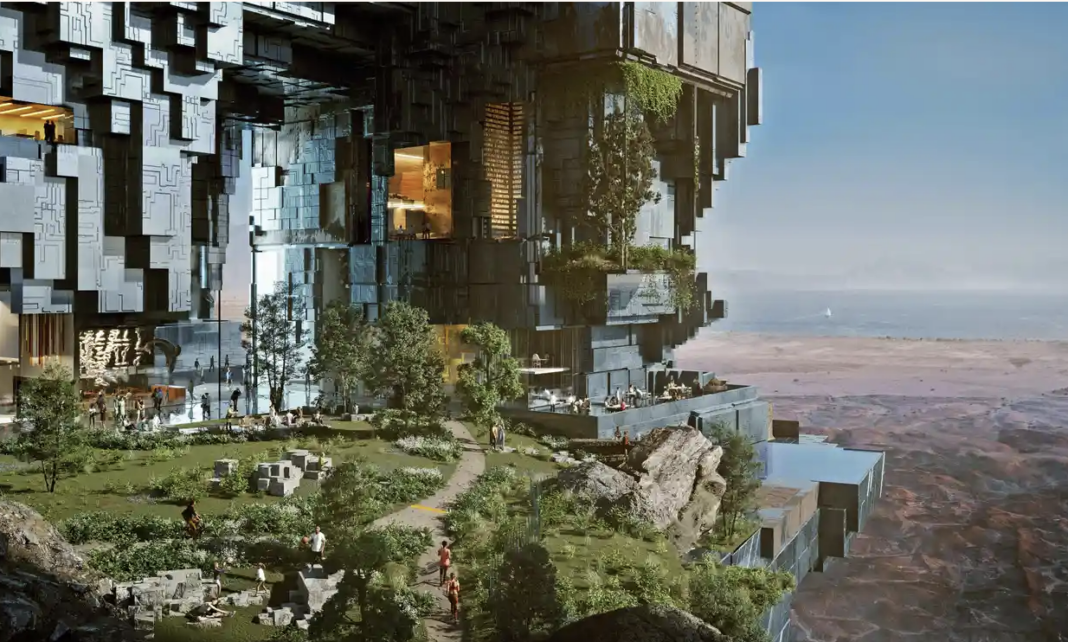

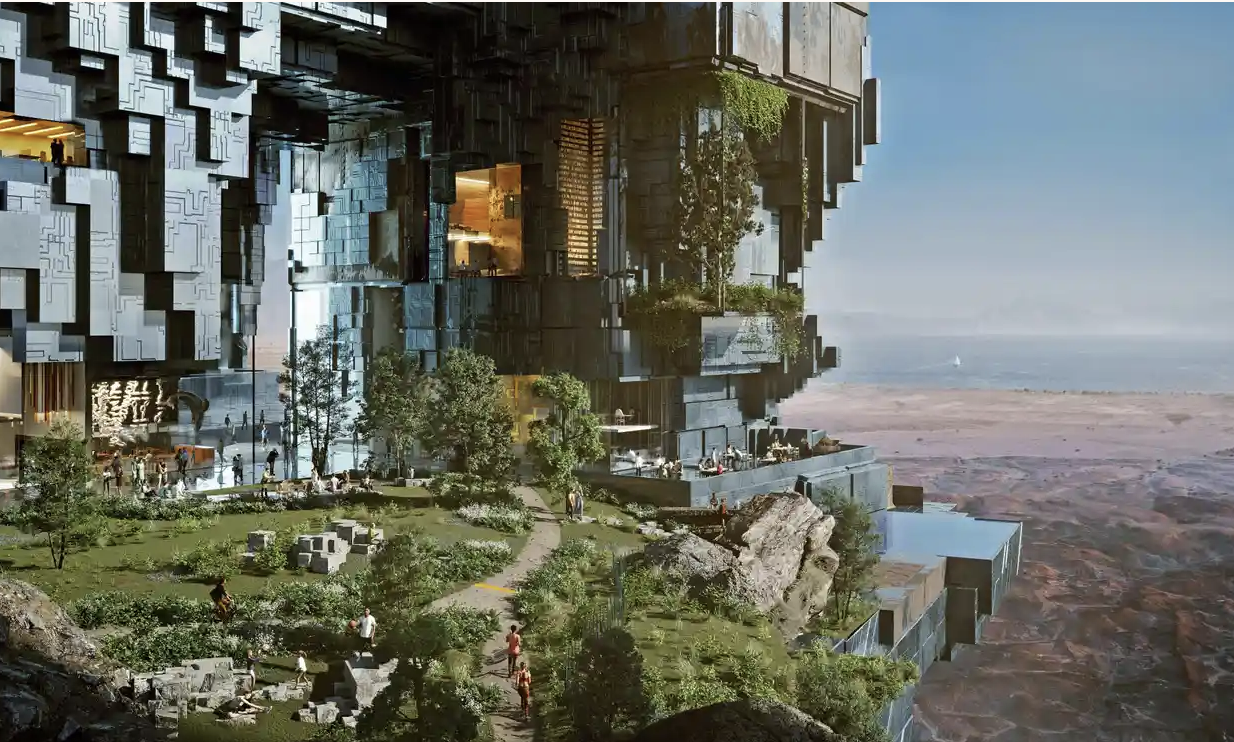
Dreaming big is good. It gives us something to strive for. But calling failed projects sustainable from the outset is pitfall that architects should avoid. For years, Saudi Arabia’s vision for The Line — a 120-mile mirrored city slicing through the desert — was marketed as the future of sustainable urban living. No cars. No emissions. Everything within five minutes. A climate-friendly city built from scratch.
But as a sweeping investigation by the Financial Times now documents, The Line has collided head-on with something no amount of ambition can override: physics, finance, and ecological reality.
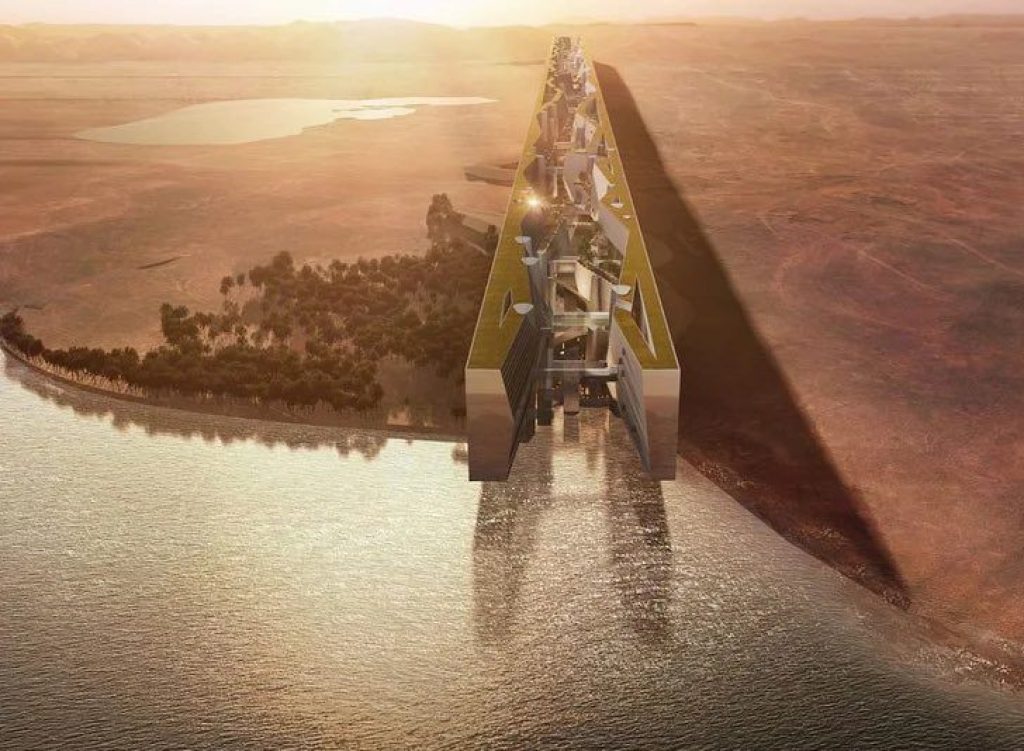
According to the FT’s reporting, based on interviews with more than 20 former architects, engineers, and executives, the project unravelled under the weight of its own contradictions. They spoke anonymously for fears of lawsuits. A quick digging into PR and you can find which ones readily took the money and tried to make the idiotic project come to life. Costs for the “eco” city ballooned into the trillions, engineering assumptions failed the most basic stress tests, and foreign investment never arrived at the scale Saudi planners expected.

One former architect recalled warning leadership that suspending a 30-storey structure upside-down above a marina could turn it into a “pendulum” — swaying, accelerating, and eventually failing by dropping into the marina. Another described sewage systems that required hundreds of shuttle cars to move waste uphill because gravity no longer worked in a vertical fantasy city. Even flushing a toilet became a design problem. That’s what happens at Burj in the UAE where poop trucks need to unload the sewage daily.
At the center of The Line and the Neom project stood Crown Prince Mohammed bin Salman, whose vision for Neom was intended to catapult the kingdom beyond oil and into a post-carbon future. Yet the investigation shows how dissent was discouraged, timelines were politically fixed, and feasibility studies were often replaced by renderings.
Green on the Surface, Fragile Underneath

From a climate perspective, the cracks run deeper. The FT reports that building just the first 20 modules of The Line would have required more cement annually than France produces, and up to 60% of global green steel capacity — a sobering reminder that “green” materials are not infinite. Cement is definitely not a sustainable building material. When a single project distorts global supply chains, sustainability claims begin to ring hollow.
Urban planners have long warned that megaprojects often fail not because of lack of technology, but because they ignore human behavior and ecological limits. The late urbanist Jane Jacobs famously argued that cities thrive through incremental complexity, not total control. The Line attempted the opposite: a sealed, pre-engineered world with no room for organic growth.
Ecologists raised additional alarms. Bird migration experts cited by BirdLife International flagged the mirrored wall as a potential mass-collision hazard for millions of birds moving along the East Africa–West Asia flyway — an issue that design tweaks like dotted glass could not realistically solve.
A Pattern We’ve Seen Before

This is not the first time a futuristic desert city promised sustainability and delivered disruption instead. From Egypt’s stalled administrative capital to past “eco-cities” in China that never filled with people, the lesson repeats: cities are living systems, not machines.
It’s a useful contrast to projects like Masdar’s eco-city experiment in Abu Dhabi, which has evolved in fits and starts over time—more incremental, less totalizing than a single, 120 mile gesture. Green Prophet covered Masdar early on, including its first 500 homes. We’ve been there, we’ve seen the spectacle.
The world needs more sustainable architects like Ronak Roshan who sees the location, the land, and the people.
The FT notes that Saudi Arabia has already spent over $50 billion, with much of the construction now slowed or paused. People already living in villages nearby have been killed, arrested for life, with a few on death row. What remains are colossal foundations, excavated deserts, displaced communities, and a scaled-down ambition that bears little resemblance to the original vision.
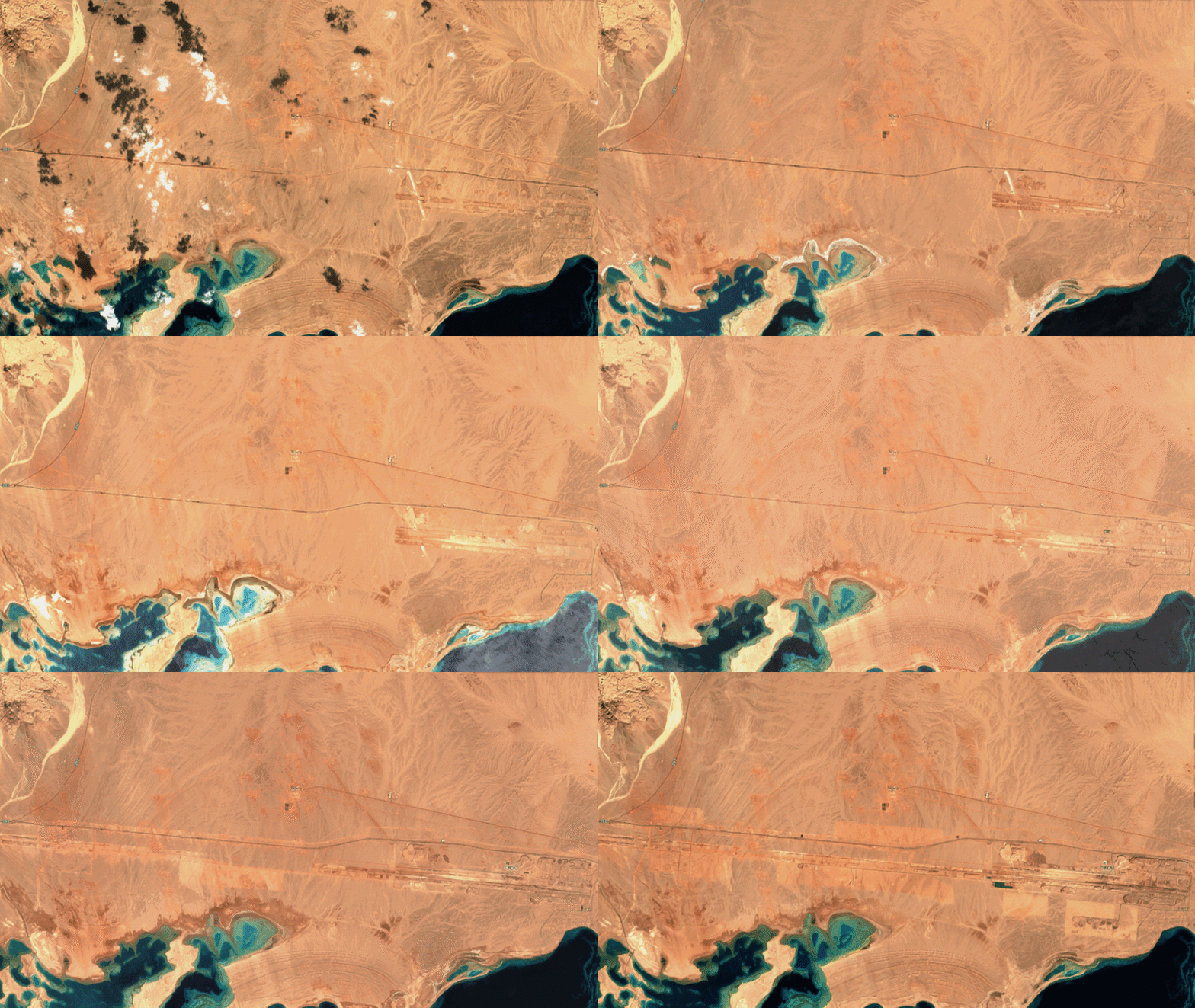
The failure of The Line is not a failure of imagination. It is a failure of restraint by western architects and planners who go along with the charade. Who is holding these firms accountable? This is actually a reasonable kind of project for the UN to take on and challenge.
Climate-resilient futures will not be built by single, monumental gestures, but by repairing existing cities, restoring ecosystems, and working with land rather than against it. The most sustainable city is rarely the one that looks most radical in a rendering.
As one urban expert quoted by the FT put it bluntly: “As a thought experiment, great. But don’t build thought experiments.
Related reading on Green Prophet:
• Saudi Arabia’s energy-water nexus meets Vision 2030 (NEOM and giga-project context)
• NEOM’s Aquellum and the weekly “fantasy” cycle of desert futurism
• A Middle East biodiversity corridor: birds helping Israel, Jordan, and Palestine cooperate