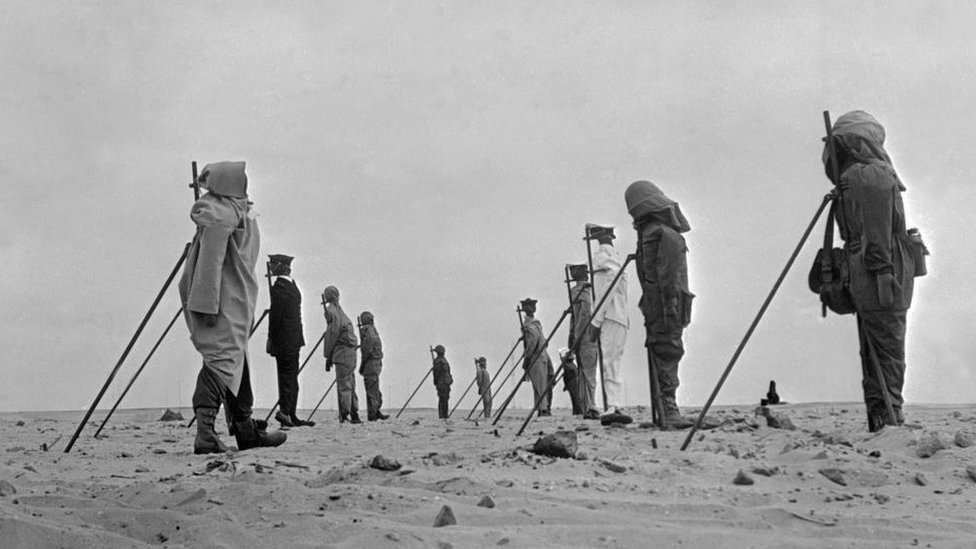
Lizard tail stew, dhub mansaf, is a favored folk dish in Saudi Arabia

Saudi Lizard Stew

Once a prized source of protein among Bedouin tribes, the Arabian spiny-tailed lizard—known locally as ḍabb or dhab—is finding new attention as a window into folk traditions, desert ecology, and sustainability in Saudi Arabia. Like locusts eaten by Jews in Egypt and Yemen (get the recipe here), lizard tails are delighting Saudi Arabians as news of this dish circles social media. The roots of lizard tails are rooted in survival, like Americans who eat prairie oysters, Gazans eating whales that swim close to shore, or pickled pigs’ feet were for slaves in the Caribbean.

In the heart of the Arabian Peninsula, long before farms and refrigeration, desert communities relied on their surroundings to survive. Among the most unusual yet enduring examples of this resilience is the tradition of eating the spiny-tailed lizard (Uromastyx aegyptia), a reptile that thrives in the arid sands of Saudi Arabia, Oman, and the UAE. Known in Arabic as ḍabb or dhab, the creature has been hunted, roasted, and stewed for generations by Bedouins who considered it a gift from the desert.
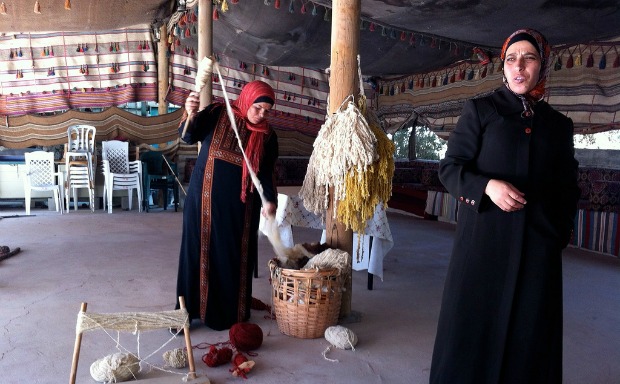
lakiya sidreh weaving workshop with bedouins
Bedouin in Israel making rugs for their tents

In many tribes, dhab stew was seen not as an exotic but as essential—a reliable protein source that could be found during long migrations. Historical accounts from travelers and early British explorers describe entire desert feasts centered on lizard meat, cooked slowly over open fires and served with flatbread. The meat, they wrote, was “white, mild, and a little like chicken.”

The Arabian spiny-tailed lizard is herbivorous, feeding on desert grasses, making it clean and permissible (halal) to many desert dwellers. The Prophet Muhammad reportedly neither ate nor forbade the consumption of ḍabb, leading Islamic scholars to conclude that while it’s not a delicacy for all, it is permissible—especially in times of need. Bedouins respected the animal for its toughness and spiritual symbolism: surviving where few other creatures could. To eat it was to honor the desert’s wisdom.

Traditionally, the lizard was hunted using snares or chased into burrows, then roasted whole or cut into chunks for dhab stew—a mix of meat, desert herbs, salt, and occasionally camel milk. The dish embodied the values of resourcefulness, adaptation, and gratitude—hallmarks of Arabian desert culture that began in what is known as Saudi Arabia today.

From a sustainability perspective, the lizard stew tradition is more than a curiosity—it’s a reflection of a closed-loop ecosystem. Bedouins hunted only what was needed, never to excess. The spiny-tailed lizard helped maintain insect and grass balance in the fragile desert biome. Understanding how traditional diets aligned with natural cycles offers modern lessons for food security in the Gulf.

Today, as Saudi Arabia reexamines its cultural identity through Vision 2030, heritage foods like dhab are being discussed not just as relics but as pathways to sustainable living. Perhaps this dhab will be a featured dish at one of the Saudi’s so-called sustainable resorts.

How do you hunt the reptiles:  “There are several ways to hunt the dabb lizard, one is to let it sink in water by pouring water into the hole and forcing it to come out, another way is by chasing it and hunting it especially if it is far from the hole, the other way of hunting it is to use a firearm,’’ said Saudi lizard hunter Majed al-Matrudi to Al Arabiya News.

This blog woldbirder provides photos and a recipe from Jordan:
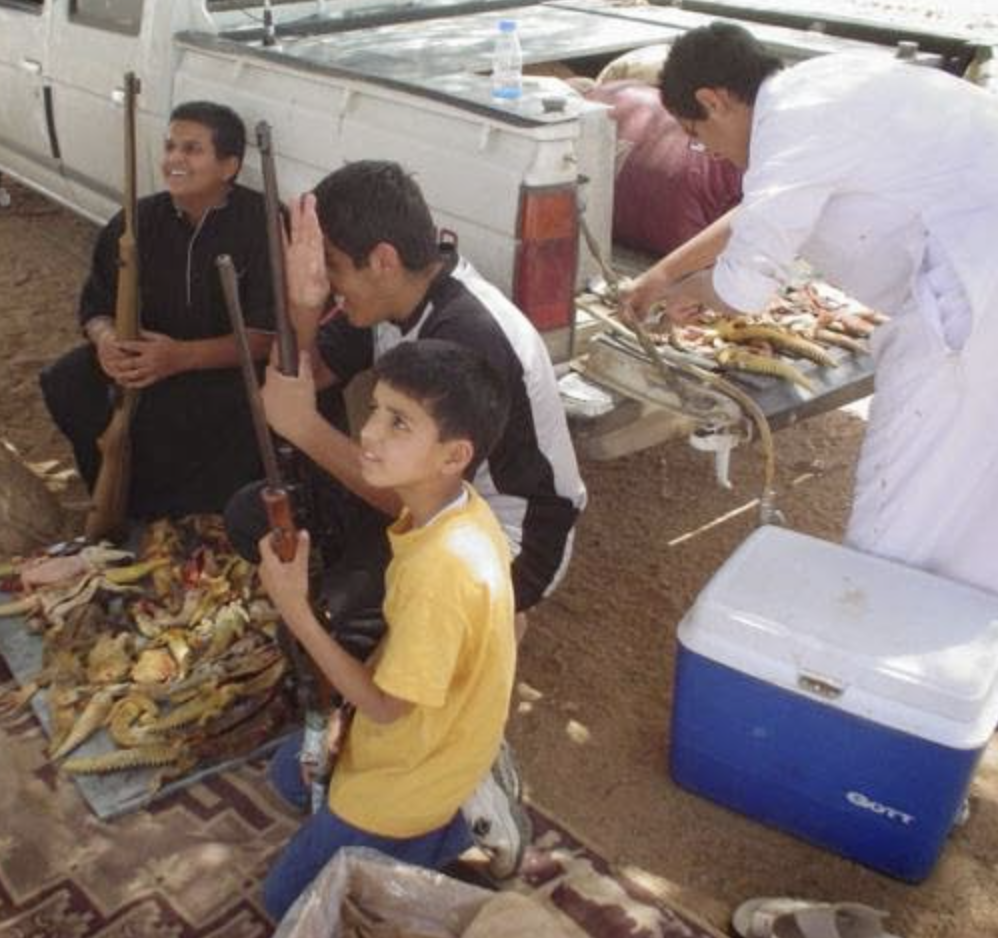
Recipe for Dhub Mansaf  (recipe from eastern Jordan)

2 whole dhubs

½ kilo rice

5 pieces Arabic bread (Khubz mashrouh)

¼ kilo laban or yoghurt

100 g ghee

50 g pine nuts

Salt, pepper, allspice, cardamom

Serves 2 to 3.

Method: Catch two adult, well-grown dhubs, skin them and remove organs (except liver). Cut the dhubs into small pieces, wash them and cook in a small amount of water together with spices until the meat is half done. Add the laban and simmer until tender. Add the browned ghee, reserving a small quantity to brown the pine nuts. Meanwhile in another saucepan cook the rice. Keeping some bread aside to dip, break open the rest over a large tray, leaving an edging around the rim.  Spread more of the laban sauce over this and pile with rice. Arrange the pieces of dhub on top of the rice. Sprinkle the entire plate of rice and dhub, with browned pine nuts.

Eat with right hand.

Dhab biryani
Dhab biryani, a classic fish from Saudi Arabia

Like the problematic hunting of birds and owls in Jordan and Saudi Arabia, modernization has made lizard hunting largely symbolic. They are a protected animal in the UAE but are still reportedly eaten in Jordan.

The ḍahb population is under pressure from habitat loss, 4×4 vehicle use, and over-hunting. Conservationists now warn that without regulation, this ancient species could disappear from Saudi sands. The Saudi Wildlife Authority has begun monitoring populations and promoting education to protect the reptile’s role in the desert ecosystem. Since there is no free press in Saudi Arabia, your guess on how that’s going is as good as mine.

Related Reads on Sustainable food:

The Birth of Bread in Jordan and Israel

The Sacred Ritual of Arabic Coffee

Saudi Vision 2030 and the Revival of Folk Culture

Sustainable Food From Desert Landscapes

UAE Green Finance and Cultural Sustainability

Eco-Tourism and Bedouin Heritage

By exploring forgotten folk dishes like lizard stew, Green Prophet continues to connect the dots between culture, ecology, and the future of sustainable living in the Middle East.

Karin Kloosterman
Karin Kloostermanhttp://www.greenprophet.com
Karin Kloosterman is an award-winning journalist, innovation strategist, and founder of Green Prophet, one of the Middle East’s pioneering sustainability platforms. She has ranked in the Top 10 of Verizon innovation competitions, participated in NASA-linked challenges, and spoken worldwide on climate, food security, and future resilience. With an IoT technology patent, features in Canada’s National Post, and leadership inside teams building next-generation agricultural and planetary systems — including Mars-farming concepts — Karin operates at the intersection of storytelling, science, and systems change. She doesn’t report on the future – she helps design it. Reach out directly to [email protected]

LEAVE A REPLY

Please enter your comment!
Please enter your name here

TRENDING

Best cheese made without cow milk

Sheep, goat, and buffalo milk create some of the world’s most flavorful cheeses. And if you are going an extra step and can find it, camel milk cheese might be one to try.

Inflatable concrete homes: a California and Ontario case study

Across Ontario and California, builders are rethinking concrete housing through inflatable-shell design—an approach that replaces wooden formwork with air and innovation. A 1,000-square-foot low-carbon concrete shell, insulated with hempcrete, can be erected in a day and cost far less than conventional construction. Over time, the savings in energy, materials, and mortgage costs make this model a realistic response to rising living expenses and climate stress. With low-carbon cement, hempcrete walls, and renewable energy, inflatable concrete homes show how even the world’s most carbon-heavy material can become part of a sustainable future—if built smartly, and within local building codes.

Biodiversity Blueprint Set for 2026

If we seize this moment, the 2026 review can catalyse a new wave of finance (see Green Finance mechanisms in the UAE), innovation and policy coherence — and move us closer to the vision of a nature-positive world by 2050. If not, the checkpoint risks becoming another missed opportunity while ecosystems, livelihoods and economies continue to degrade.

Soil has hidden antibiotics ready to be found –– and the new race to find them

Most bacteria in soil cannot be cultured in the...

EU’s CAP reform continues trend of supporting small farmers in hour of need

Despite mounting political opposition, growing scientific criticism and even the retreat of many former industrial supporters like Nestlé and Danone, certain member-states and supermarket chains continue to prop up Nutri-Score. The Commission must therefore remain vigilant to ensure these attempts do not undermine farmers, distort fair competition or compromise the integrity of the single market – particularly as other pressing threats loom on the horizon.

Qatar’s climate hypocrisy rides the London Underground

Qatar remains a master of doublethink—burning gas by the megaton while selling “sustainability” to a world desperate for clean air. Wake up from your slumber people.

How Quality of Hire Shapes Modern Recruitment

A 2024 survey by Deloitte found that 76% of talent leaders now consider long-term retention and workforce contribution among their most important hiring success metrics—far surpassing time-to-fill or cost-per-hire. As the expectations for new hires deepen, companies must also confront the inherent challenges in redefining and accurately measuring hiring quality.

8 Team-Building Exercises to Start the Week Off 

Team building to change the world! The best renewable energy companies are ones that function.

Thank you, LinkedIn — and what your Jobs on the Rise report means for sustainable careers

While “green jobs” aren’t always labeled as such, many of the fastest-growing roles are directly enabling the energy transition, climate resilience, and lower-carbon systems: Number one on their list is Artificial Intelligence engineers. But what does that mean? Vibe coding Claude? 

Somali pirates steal oil tankers

The pirates often stage their heists out of Somalia, a lawless country, with a weak central government that is grappling with a violent Islamist insurgency. Using speedboats that swarm the targets, the machine-gun-toting pirates take control of merchant ships and then hold the vessels, crew and cargo for ransom.

Leopoldo Alejandro Betancourt López Turned Ocean Plastic Into Profitable Sunglasses

Few fashion accessories carry the environmental burden of sunglasses. Most frames are constructed from petroleum-based plastics and acrylic polymers that linger in landfills for centuries, shedding microplastics into soil and waterways long after they've been discarded. Leopoldo Alejandro Betancourt López, president of the Spanish eyewear brand Hawkers, saw this problem differently than most industry executives.

Why Dr. Tony Jacob Sees Texas Business Egos as Warning Signs

Everything's bigger in Texas. Except business egos.  Dr. Tony Jacob figured...

Israel and America Sign Renewable Energy Cooperation Deal

Other announcements made at the conference include the Timna Renewable Energy Park, which will be a center for R&D, and the AORA Solar Thermal Module at Kibbutz Samar, the world's first commercial hybrid solar gas-turbine power plant that is already nearing completion. Solel Solar Systems announced it was beginning construction of a 50 MW solar field in Lebrija, Spain, and Brightsource Energy made a pre-conference announcement that it had inked the world's largest solar deal to date with Southern California Edison (SCE).

Related Articles

Popular Categories