

Years ago, when I was studying biology at the University of Toronto, the textbook example of climate-driven evolution was the case of the peppered moth. Two color forms — one white, one black — told a simple story of natural selection: in the soot-choked air of industrial England, the darker moths survived better because they were harder for predators to see.
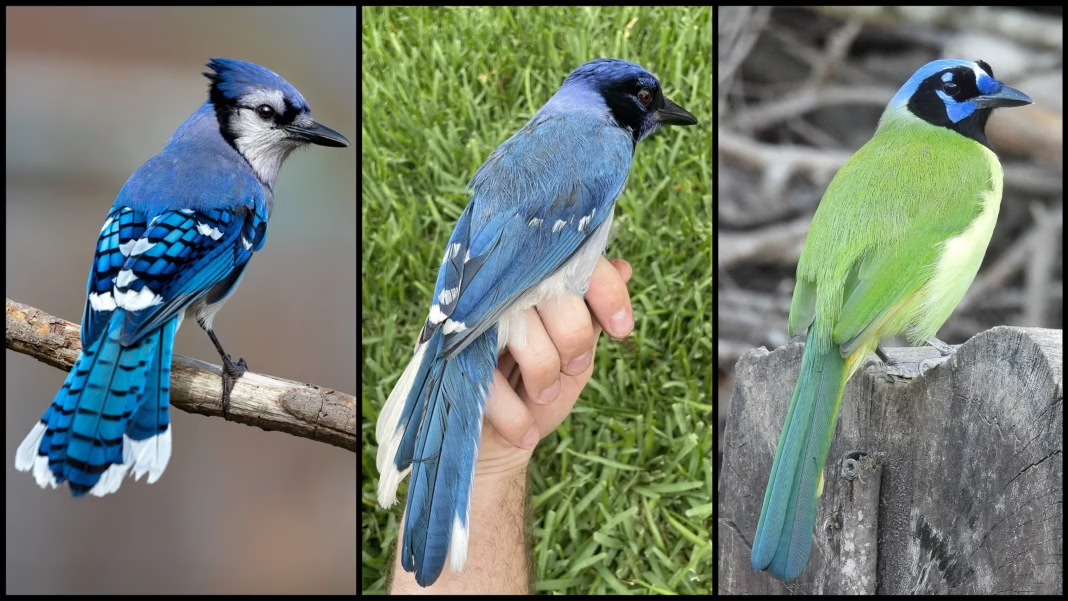
Now, in a new twist on species diversity, ornithologists are witnessing not just color changes, but the blending of entire species. In Texas, a green jay and a blue jay — birds separated by seven million years of evolution — have produced a hybrid offspring. Their unexpected creation, likely spurred by climate change as both species’ ranges expand and overlap, has earned a nickname as curious as its colors: the “grue jay.”
Related: These birds pick apart the dead at green funerals in Iran
Biologists at The University of Texas at Austin have reported discovering a wild bird that appears to be the natural hybrid of a green jay and a blue jay—a cross that may be one of the first known to result from climate-driven range shifts.

“We think it’s the first observed vertebrate that’s hybridized as a result of two species both expanding their ranges due, at least in part, to climate change,” said Brian Stokes, a graduate student in ecology, evolution and behavior at UT Austin and first author of the study published in Ecology and Evolution.
The green jay (Cyanocorax yncas), a tropical bird found across Central America and southern Texas, and the blue jay (Cyanocitta cristata), a temperate species native to eastern North America, are separated by roughly seven million years of evolution. Until recently, their ranges rarely overlapped. In the 1950s, green jays reached only the southern tip of Texas, while blue jays ranged as far west as Houston. But as climate change has warmed and dried parts of Texas, green jays have pushed north and blue jays west, their territories now overlapping around San Antonio.
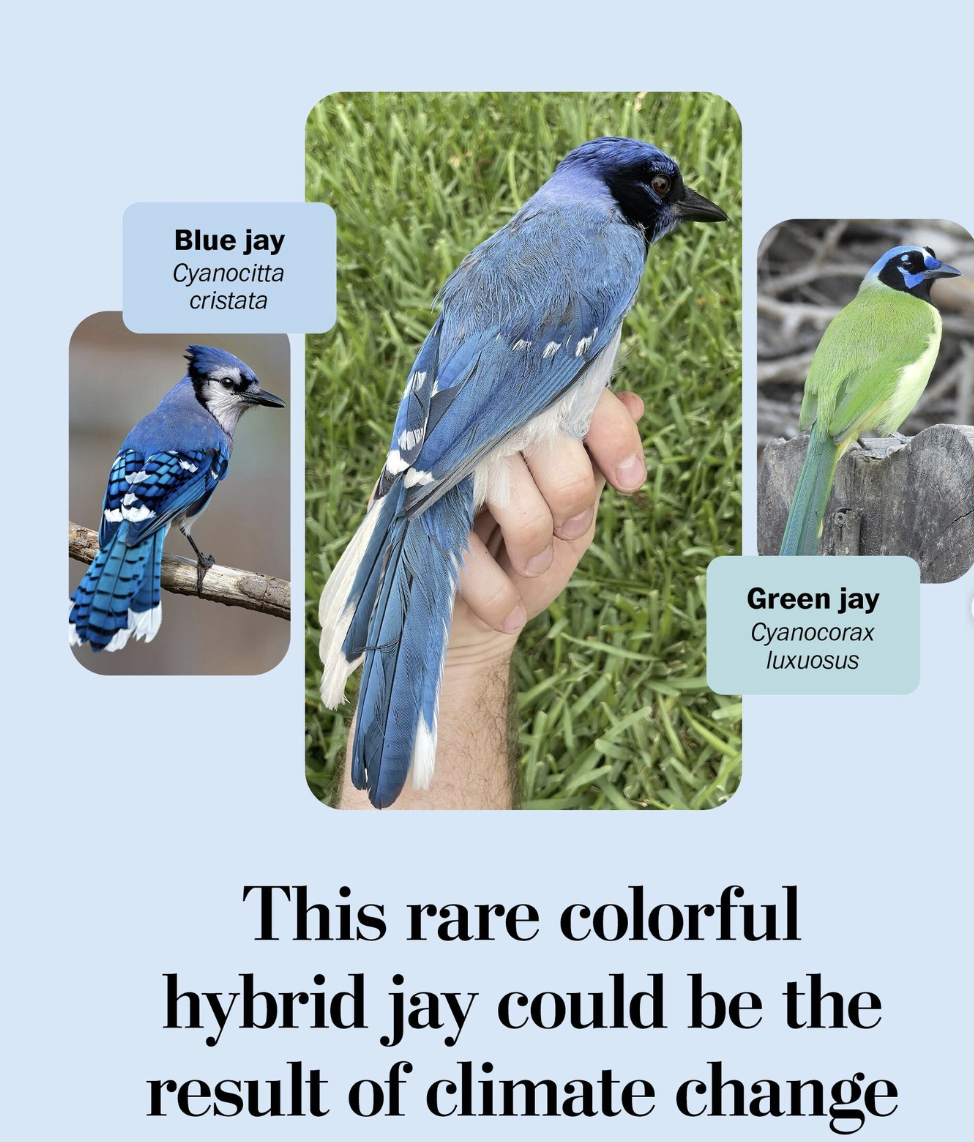
Stokes discovered the unusual bird while monitoring social media posts by birders to locate potential study sites. A homeowner northeast of San Antonio posted a photo of a mysterious blue bird with a black mask and white chest. “The first day, we tried to catch it, but it was really uncooperative,” said Stokes.
“But the second day, we got lucky.”
The bird was caught using a mist net, briefly examined, and released after a small blood sample was taken for genetic testing. Analysis by Stokes and his advisor, Tim Keitt, a professor of integrative biology at UT Austin, confirmed the bird was the male hybrid offspring of a green jay mother and a blue jay father.
Related: Arava powers up solar energy in Texas
Interestingly, a similar hybrid was created in captivity in the 1970s and preserved at the Fort Worth Museum of Science and History—and it looks nearly identical to the wild specimen observed by Stokes.
“Hybridization is probably way more common in the natural world than researchers know about because there’s just so much inability to report these things happening,” Stokes said. “And it’s probably possible in a lot of species that we just don’t see because they’re physically separated from one another and so they don’t get the chance to try to mate.”
The research was supported by a ConTex Collaborative Research Grant through the UT System, the Texas EcoLab Program, and Planet Texas 2050, a university-wide climate resilience initiative.
While the researchers didn’t name the bird, some observers have informally dubbed it the “grue jay”—a playful nod to other naturally occurring hybrids such as the grolar bear (polar bear–grizzly mix), coywolf (coyote–wolf), and narluga (narwhal–beluga).