
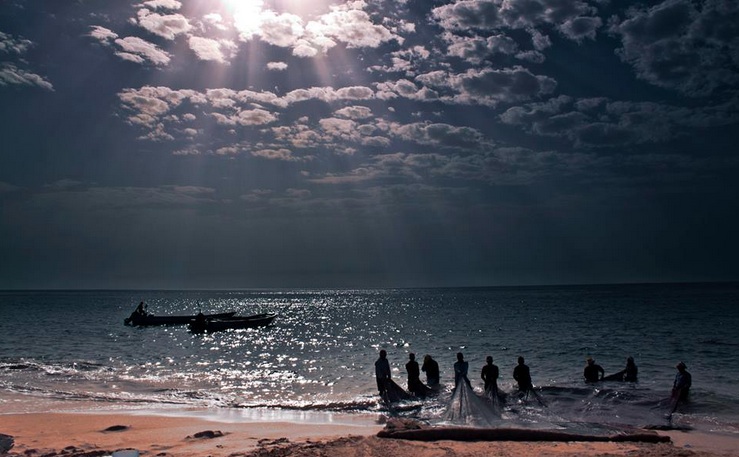
In 2012, Green Prophet sounded the alarm about depleted Gulf fish stocks and weak enforcement in Dubai. Revisit Tafline Laylin’s original piece here: Dubai Finally Gets Serious About Overfishing.
Thirteen years on, what’s changed—and what hasn’t? Regulatory frameworks are clearer. The UAE now requires licences for commercial and recreational fishing and sets rules on species, sizes, seasons, and gear. See the official portal: Regulating fishing practices (UAE).
Marine protection and monitoring have expanded. Authorities report more scientifically informed monitoring and new research capacity,including offshore survey capability and support vessels for fisheries and habitat assessment (overview at Life Below Water – UAE.)

8.9% (2018) to 97.4% (end-2024), indicating far tighter alignment with sustainable harvest targets: Abu Dhabi Media Office (2025).
Visible enforcement actions. In Feb 2025, a fisherman in Abu Dhabi was fined Dh50,000 for exceeding permitted catch limits: Gulf News: Dh50,000 fine (2025).
Where the Picture in Dubai Is Still Mixed
Catch and release fishing in Dubai
Hamour (grouper) remains severely overfished. Years of overexploitation have left adult populations
dramatically reduced and age structures truncated. Reporting highlights suggest catches far beyond sustainable thresholds and individuals rarely reaching natural lifespans: The National (2019): Overfishing is the single biggest threat
Enforcement is uneven by emirate and along the supply chain. Market controls on undersized fish have improved, but gaps persist in inspections, reporting, and sanctions.
Cultural and economic realities complicate reform. Traditional preferences (e.g., hamour),
livelihoods, and consumer demand continue to pull against tighter conservation rules.
Climate stressors add pressure. Warming seas and habitat loss make stock recovery harder even where rules are followed.
China’s Role in Global Overfishing—With Documentation
Local conservation can be undermined by global fleets operating across borders. Multiple analyses document the scale and governance challenges of distant-water fishing (DWF), especially from China: Global activity share: An Oceana analysis finds Chinese vessels account for roughly 44% of visible global fishing activity, appearing in more than 90 countries’ waters and logging millions of hours on the high seas: Oceana (2025).
IUU and governance concerns: The U.S. Congressional Research Service summarizes evidence of
illegal, unreported, and unregulated (IUU) risks, subsidy issues, and transparency gaps in China’s DWF fleet, noting
implications for stock depletion and international disputes: CRS Report R47065 (China’s Role in the Exploitation of Global Fisheries).
Policy pledges vs. practice: Scholarship reviews policy reforms and continuing implementation gaps in China’s fisheries, indicating improvements on paper that remain uneven on the water: Marine Policy review (ScienceDirect).
Bottom line: Even if the UAE tightens local rules, transboundary pressure from large DWF fleets can undermine recovery, making international monitoring, port-state measures, and supply-chain traceability essential. We were told the same by Seychellois: even if they restrict fishing in nature reserves, China boats often overfish nearby without consequence.
What Dubai (and the UAE) Can Do Next
- Harden market enforcement against undersized and out-of-season fish; expand surprise inspections and public reporting.
- Accelerate species-specific recovery plans for hamour and other priority stocks with clear biomass targets and timelines.
- Scale consumer campaigns to shift demand away from overfished species; promote certified alternatives.
- Petition to global fishing groups to enforce fishing caps and limits, especially on Chinese fishing boats.
- Deepen regional & international cooperation on IUU detection, electronic monitoring, and traceability
to address external fishing pressure. - Reform the press so that’s it’s free and so that locals and foreigners may criticize without serious consequences. There is no free press in the UAE. The UAE government prevents both local and foreign independent media outlets from thriving by tracking down and persecuting dissenting voices. Expatriate Emirati journalists risk being harassed, arrested or extradited according to Reporters Without Borders.