The Journey of Georgia’s Ancient Wheat to the Svalbard Seed Vault

seed vault, Svalbard Global Seed Vault, genetic diversity, crop preservation, heirloom seeds, Georgian wheat, climate change agriculture, traditional farming, seed conservation, food security, indigenous knowledge, gene banks, biodiversity, ancient grains, sustainable agriculture, farmer-scientist collaboration, climate-resilient crops

In Zemo Alvani, a village nestled in Georgia’s Caucasus mountains in the north of the country, Natia Matcharashvili carefully handpicks the ripest wheat grains from her fields. As a first-generation farmer, she takes pride in every harvest that will soon be milled into flour.

Natia and her husband Shota moved their family back to their village from the capital, Tbilisi, to be closer to nature, especially for the sake of their children. In fact, Shota had longed to follow in his grandfather’s footsteps and become a farmer. He felt it his calling to bring native wheat varieties back in use, as they were slowly disappearing from Georgian fields.

seed vault, Svalbard Global Seed Vault, genetic diversity, crop preservation, heirloom seeds, Georgian wheat, climate change agriculture, traditional farming, seed conservation, food security, indigenous knowledge, gene banks, biodiversity, ancient grains, sustainable agriculture, farmer-scientist collaboration, climate-resilient crops

“It’s our responsibility to protect these traditional wheat varieties that have adapted to our soil and climate over generations,” says Natia. “We wanted to share our traditions and live in harmony with nature,’’ she explains about moving back to Zemo Alvani.

For Natia and Shota, growing these traditional varieties of wheat, which are used in the fresh bread and cookies sold in their bakery, is a way to share their heritage with their customers.

“What started as a simple desire became our livelihood. Now we’ve grown a few [native varieties] and tasted them, and we want to keep going, discovering more of these forgotten Georgian varieties and bringing them back to life, ” Natia explains.

Living heritage at risk

seed vault, Svalbard Global Seed Vault, genetic diversity, crop preservation, heirloom seeds, Georgian wheat, climate change agriculture, traditional farming, seed conservation, food security, indigenous knowledge, gene banks, biodiversity, ancient grains, sustainable agriculture, farmer-scientist collaboration, climate-resilient crops

Georgia is home to remarkable wheat diversity. Of the fourteen wheat species grown in the country, five originated from Georgia itself.

Yet, without action, this living heritage risks being lost forever.

Native wheat varieties have nearly vanished from Georgia’s fields, replaced by modern varieties developed by professional breeders. Decades of centralized agriculture in the Soviet era left large, state cooperatives instead of small private farms that used to be tended to by generations of farmers.

That’s where Tamriko Jinjikhadze, an agricultural scientist at the Scientific Research Centre of Agriculture (SRCA) of Georgia, stepped in to reverse the troubling trend of genetic diversity loss.

“Some of our country’s most important crops varieties are quietly disappearing,” Tamriko explains.

With international support, Tamriko’s team launched seed collecting missions to remote areas, identifying local varieties still cultivated by small-scale farmers.

seed vault, Svalbard Global Seed Vault, genetic diversity, crop preservation, heirloom seeds, Georgian wheat, climate change agriculture, traditional farming, seed conservation, food security, indigenous knowledge, gene banks, biodiversity, ancient grains, sustainable agriculture, farmer-scientist collaboration, climate-resilient crops

It was on one such mission that she first met Natia and Shota. The couple knew that they were growing a local wheat variety, but they did not know its name or its specificities. Tamriko’s team collected seeds found on Natia and Shota’s field for identification at the SRCA.

Local varieties are important to Georgian farmers because they generally perform better in their place of origin, having adapted to specific conditions through generations of cultivation. For instance, native Georgian wheat varieties have higher resistance to fungal diseases and higher productivity than other varieties.

Georgian wheats are genetic treasures, carrying invaluable genes for local adaptation. “They serve as initial breeding material to develop resilient wheat varieties that can survive climate change and new pests and diseases,” Tamriko explains.

Journey to the Arctic

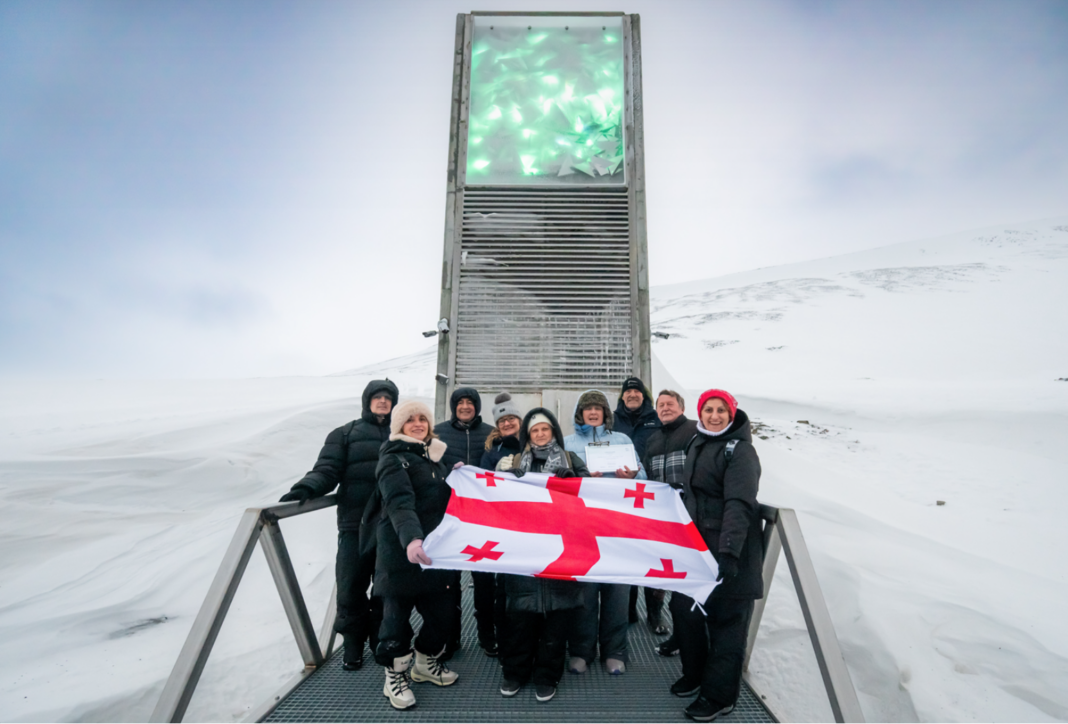
The journey of these ancient seeds didn’t end in Georgian soil. More than 200 samples of seeds of traditional Georgian varieties, such as Lagoedkhis Gdzeltavtava and Dolis Puri, the two local wheat varieties found on Natia and Shota’s fields, traveled with Tamriko from the remote Georgian mountain villages to the Arctic Circle, where the world’s largest seed reserve is based.

Located in northernmost Norway, about 2 000 kilometres north of the country’s capital, Oslo, the Svalbard Global Seed Vault maintains a constant temperature of -18°C to ensure long-term seed viability. This Vault holds seed duplicates from around the globe, safeguarding the world’s future food supply.

“It’s very comforting to know that our local varieties are safely preserved in Svalbard,” says Shota. ” This makes me feel confident about the future.”

This security couldn’t come at a more crucial time, as climate change and environmental challenges are eroding genetic diversity. As a result, preserving crop varieties through methods such as secure storage in gene banks and the Svalbard Global Seed Vault has become more important than ever.

“The journey of these seeds begins in the hands of farmers—their knowledge is as vital as the seeds themselves,” says Tamriko. “We, as scientists, are here to support them—not just to conserve seeds, but to ensure they can be used for livelihoods.’’

For Natia, this work represents both her heritage and her future. “By growing these local wheat varieties, we’re ensuring both their survival and the transmission of our knowledge,” she concludes.

When customers bite into fresh bread at Natia and Shota’s bakery, they’re tasting ancient seeds recovered by scientists, duplicated and safeguarded in the Svalbard Global Seed Vault and conserved by farmers in Georgia, ensuring that the past continues to nourish the future, one seed at a time.

LEAVE A REPLY

Please enter your comment!
Please enter your name here

TRENDING

Balanced rain for foraging walks in Israel

Israel Is Both Sick and Healthy -  In the midst of a tragic war, this winter's rains are remarkably balanced.

NASDAQ seed gene company Evogene jumps into cannabis

Evogene to Develop Next Generation Medical Cannabis Products through...

What You Need To Do Before You Call An Accident Attorney

Just about everyone has a cell phone these days that have some kind of camera attached. Just even the lowest of quality pictures could make all the difference in the world when it comes to documentation purposes. Don’t forget to take pictures of the vehicle and any injuries that you sustained in the process. This is extremely handy in the event that the insurance provider tries to haggle with you on the settlement or compensation. Sometimes insurance providers will try to claim that the accident wasn’t that severe, but these pictures could prove otherwise.

The war that forces a doomsday seed vault withdrawal

The Svalbard Global seed bank was established in February...

Tel Aviv is “Fertile Ground” for modern art and Bauhaus architecture

Looking for a novel way to celebrate Purim in...

Qatar’s climate hypocrisy rides the London Underground

Qatar remains a master of doublethink—burning gas by the megaton while selling “sustainability” to a world desperate for clean air. Wake up from your slumber people.

How Quality of Hire Shapes Modern Recruitment

A 2024 survey by Deloitte found that 76% of talent leaders now consider long-term retention and workforce contribution among their most important hiring success metrics—far surpassing time-to-fill or cost-per-hire. As the expectations for new hires deepen, companies must also confront the inherent challenges in redefining and accurately measuring hiring quality.

8 Team-Building Exercises to Start the Week Off 

Team building to change the world! The best renewable energy companies are ones that function.

Thank you, LinkedIn — and what your Jobs on the Rise report means for sustainable careers

While “green jobs” aren’t always labeled as such, many of the fastest-growing roles are directly enabling the energy transition, climate resilience, and lower-carbon systems: Number one on their list is Artificial Intelligence engineers. But what does that mean? Vibe coding Claude? 

Somali pirates steal oil tankers

The pirates often stage their heists out of Somalia, a lawless country, with a weak central government that is grappling with a violent Islamist insurgency. Using speedboats that swarm the targets, the machine-gun-toting pirates take control of merchant ships and then hold the vessels, crew and cargo for ransom.

Leopoldo Alejandro Betancourt López Turned Ocean Plastic Into Profitable Sunglasses

Few fashion accessories carry the environmental burden of sunglasses. Most frames are constructed from petroleum-based plastics and acrylic polymers that linger in landfills for centuries, shedding microplastics into soil and waterways long after they've been discarded. Leopoldo Alejandro Betancourt López, president of the Spanish eyewear brand Hawkers, saw this problem differently than most industry executives.

Why Dr. Tony Jacob Sees Texas Business Egos as Warning Signs

Everything's bigger in Texas. Except business egos.  Dr. Tony Jacob figured...

Israel and America Sign Renewable Energy Cooperation Deal

Other announcements made at the conference include the Timna Renewable Energy Park, which will be a center for R&D, and the AORA Solar Thermal Module at Kibbutz Samar, the world's first commercial hybrid solar gas-turbine power plant that is already nearing completion. Solel Solar Systems announced it was beginning construction of a 50 MW solar field in Lebrija, Spain, and Brightsource Energy made a pre-conference announcement that it had inked the world's largest solar deal to date with Southern California Edison (SCE).

Related Articles

Popular Categories