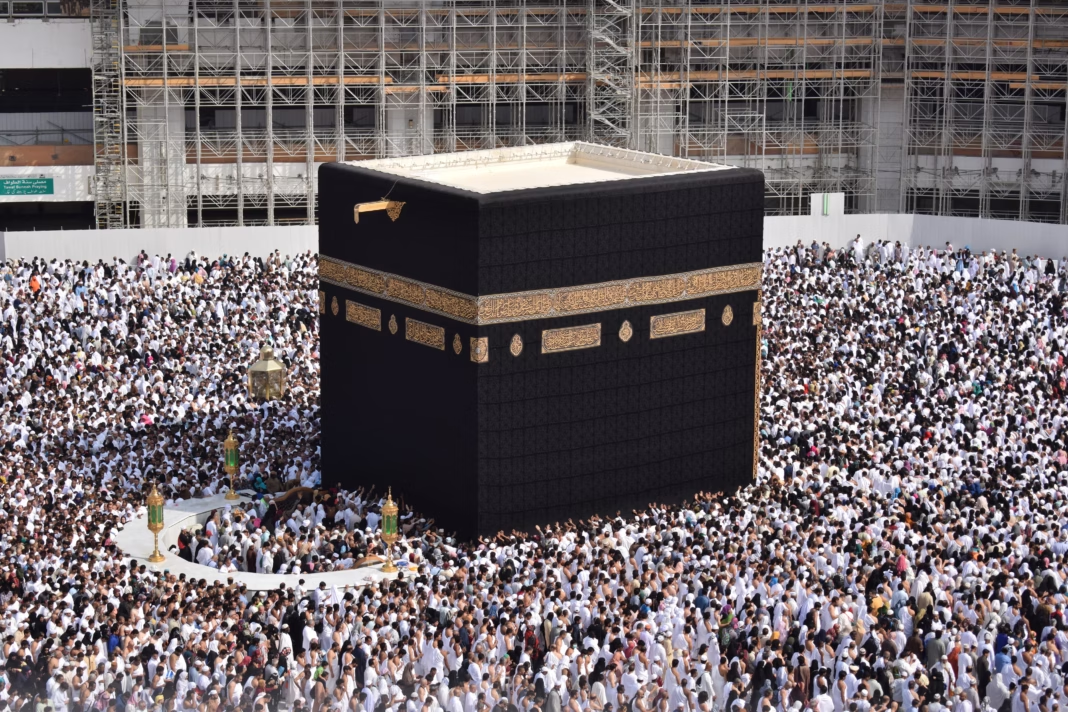


In a world that is becoming increasingly aware of the need for spiritual growth alongside ecological sustainability, many of us are drawn to ancient wisdoms that transcend time, culture, and religion. One of the most profound revelations is how spiritual concepts across different cultures and traditions share common threads that emphasize unity, interconnectedness, and balance. Today, we’ll explore the intriguing connections between Ka and Ba from Egyptian mysticism, Merkabah mysticism in Kabbalah, and the Ka’bah in Saudi Arabia, and how these ancient ideas may hold valuable lessons for a sustainable future.
The Ka and Ba: The Soul’s Journey in Ancient Egypt
In ancient Egyptian spirituality, the Ka and Ba were two aspects of the human soul. The Ka was considered the life force, the essential energy that flows through all living beings. It represented vitality and the essence of being. The Ba, on the other hand, was thought to be the personality and the soul’s ability to transcend the physical realm, allowing one to journey between worlds.
Together, the Ka and Ba formed the complete soul — the eternal, divine essence of the individual that connects to the cosmos. This union symbolized the journey of the soul towards spiritual ascension, where the individual becomes one with the divine and the universe. In a modern context, we could interpret the Ka and Ba as symbolic of the balance between mind and spirit, the physical and the spiritual — a harmony that is increasingly necessary in today’s world if we are to achieve sustainable living and holistic growth.
The Ka’bah: A Sacred Center of Unity

Fast forward thousands of years to the Ka’bah in Mecca, Saudi Arabia, one of the most sacred sites in Islam. Pilgrims from around the world visit the Ka’bah as part of the Hajj pilgrimage, a physical journey of spiritual significance. The Ka’bah is considered the metaphysical center of the universe, symbolizing the unification of all believers with the divine. Each circle made by pilgrims around the Ka’bah represents a symbolic return to the core, a reconnection to the divine source, and a reaffirmation of the interconnectedness of all things.
While it may seem far removed from ancient Egyptian ideas, the Ka’bah shares a similar theme: the Ka as the life force, and the soul’s journey toward unity with the divine. In this sense, the Ka’bah acts as a sacred, grounding point where the physical and spiritual realms meet — a place of transcendence and connection that draws people from all walks of life to experience unity with the cosmos.
Merkabah Mysticism: Divine Ascension and Sacred Geometry
The Merkabah mysticism of Kabbalah further deepens the connection between these ancient ideas. Rooted in Jewish spiritual teachings, Merkabah mysticism speaks of a divine throne chariot that connects the physical world to the divine realm. Through intense meditation and spiritual practice, the soul can ascend through various levels of consciousness, ultimately reaching a state of divine unity and enlightenment.
At the heart of Merkabah mysticism is the idea of spiritual ascent and purification. In many ways, this concept mirrors the ancient Egyptian belief in the union of the Ka and Ba. It also shares a resonance with the symbolism of the Ka’bah as a point of spiritual convergence. All these traditions emphasize a journey of personal transformation — a movement from individual consciousness to universal, divine awareness.
Additionally, the concept of sacred geometry in Merkabah mysticism and the Ka’bah shares an intriguing connection. Sacred geometry reveals that the universe operates according to certain principles of order, balance, and harmony. The shape of the Ka’bah itself, a cube, can be interpreted through the lens of sacred geometry as a symbol of unity and balance, reflecting the harmonious interconnectedness of all life.
So, what do these spiritual concepts mean for us today? In a time when sustainability and interconnectedness are paramount, these ancient teachings offer profound insights. They remind us that the physical world and the spiritual world are not separate, but deeply intertwined. Just as the Ka and Ba unite to form the complete soul, so too must we integrate our spiritual values with our actions in the physical world, particularly when it comes to caring for our planet.
The Ka’bah, as a central point of unity, teaches us that the world is interconnected — every action we take has a ripple effect. As we seek balance and harmony in our personal and collective lives, we also need to foster a sense of connection with nature, recognizing that we are part of a larger web of life. Just as the Ka and Ba reflect the union of life force and personality, our approach to sustainability must unite the needs of people with the health of the Earth.