Sudan is starving and 25 million people face famine

Sudan
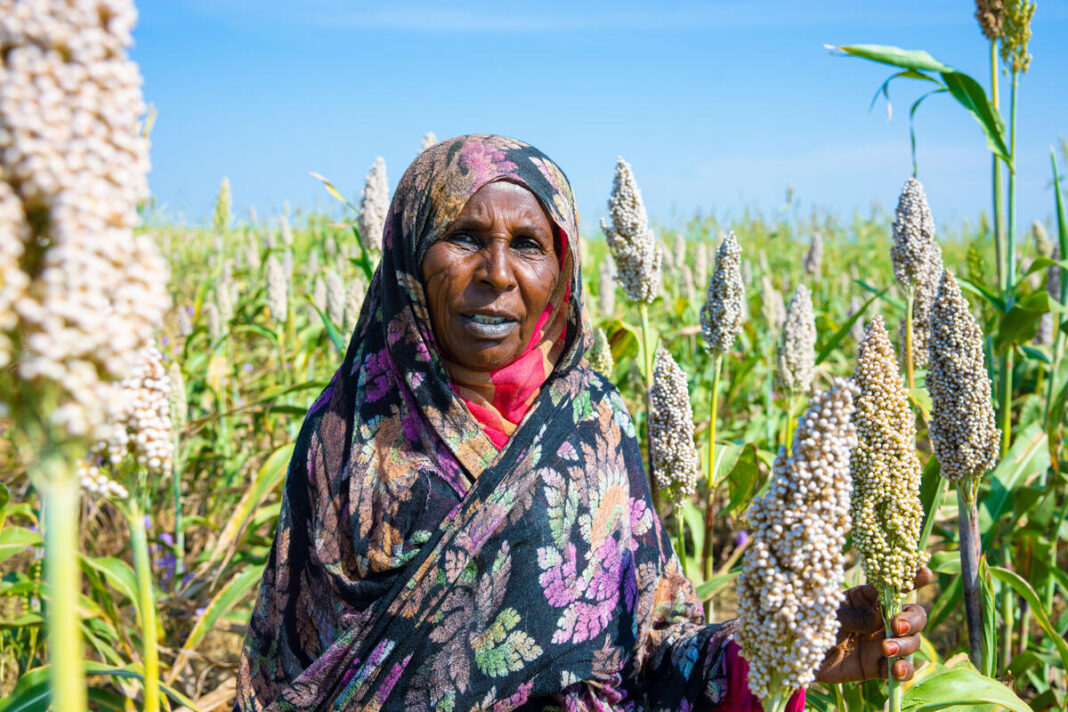
21 October 2024. Gadam Baliah village, Wasat Al Gedaref locality, Gedaref, Sudan. Hawa Ahmed, a resilient farmer from Gadam Baliah village, Gedaref, showcasing her crops’ progress.

Urgent action, in particular immediate and unimpeded humanitarian access, is required to address the widening famine in Sudan, where almost 25 million people face acute food insecurity.

According to the latest analysis from the Integrated Food Security Phase Classification (IPC), half of Sudan’s population – or 24.6 million people – are facing acute food insecurity levels. This is 3.5 million more people since June 2024.

The latest report by the IPC, a multi-partner initiative for improving food security and nutrition analysis and decision-making, is the worst in the country’s history. Widespread starvation and acute malnutrition have already resulted in tens of thousands of deaths in a country where almost two-thirds of the population depends on agriculture.

Production of key crops such as sorghum, millet and wheat during the first year of the conflict – the 2023/24 season – was down 46 percent from the previous year. This production loss could have fed approximately 18 million people for a year and represented an economic loss of between $1.3 and $1.7 billion.

Restricted humanitarian access is exacerbating the situation, while sustained violence and economic turmoil have disrupted markets, driving the price of staple goods to unaffordable levels.

This marks the fourth time that famine has been confirmed in a country over the past 15 years.

“We must take urgent action to address the famine in Sudan,” said Beth Bechdol, the Deputy Director-General of the Food and Agriculture Organization of the United Nations told a UN Security Council meeting in New York.

“If we fail to act now, collectively, and at scale, millions of lives are even further at risk, and (…) so is the stability of many nations in the region,” she added.

According to Bechdol, the following actions deserve prioritizing and require the Security Council’s support:

1) political leverage to end hostilities and bring relief to the people of Sudan;

2) immediate and unimpeded humanitarian access, as well as safe reopening of commercial supply routes to address current shortfalls in key hunger hotspots, as stated recently by FAO and its UN partner agencies;

3) the delivery of multi-sectoral humanitarian assistance, especially emergency agricultural support which is key to ensuring local food production, building resilience and preventing further humanitarian catastrophe.

The source of Sudan’s conflicts?

2020 Pew Research Center data estimates that 91 percent of the population is Muslim, 5.4 percent Christian, 2.8 percent follow Indigenous religions, and the remainder follow other religions or are unaffiliated. Some religious advocacy groups estimate non-Muslims make up more than 13 percent of the population.

Sudan ended over a quarter-century of Islamist-military rule with the 2019 overthrow of President Omar al-Bashir, whose rule was based on Islamism, Arab supremacy, and the ruthless application of military power, according to the Jameston Foundation: A joint civilian-military government was formed to lead the transition to a civilian-led democracy. However, an October 2021 coup led by Sudan’s military and security forces ended all progress toward civilian rule, severing at the same time most of Sudan’s economic and financial ties to the West.


TRENDING

Dubai sets up smart feeding stations for abandoned cats

Dubai Municipality has set up 12 AI-powered "Ehsan Stations" to safely and officially feed strays. The city also officially supports Trap-Neuter-Return (TNR) programs. 

Eco organization offices destroyed by Iran missile

Tel Aviv's eco organization, the Heschel Center, was impacted by an Iranian missile.

Jujube, the sidr tree of medicine and magic

A magic holy sidr bath to deflect the evil eye? It needs 7 powdered sidr leaves stirred into a bucket of warm water. The hadith of the Prophet Muhammad allows to repeat healing prayers and verses from the Koran to increase the water’s potency. 5 grams, or 1 tablespoon of sidr powder equals 7 leaves.

The Christ’s thorn (sidr tree) is also a well-known folk medicine

Christ’s thorn jujube (Ziziphus spina-christi) also known as the sidr tree is a real, identifiable tree native to the Middle East, and it appears—directly or indirectly—in Islam, Judaism, and later Christian tradition. The connections between the three faiths are not theological agreements but overlapping uses, names, and symbolic associations rooted in the same landscape.

The Lote Tree of the Utmost Boundary, explained

Knowing about the concept of the Lote Tree of the Utmost Boundary helps explain a core idea in Islam.

How AI Helps SaaS Companies Reduce Repetitive Customer Support Work

SaaS products are designed for large numbers of users with different levels of experience, and also in renewable energy.

Pulling Water from the Air

Faced with water shortage in Amman, Laurie digs up...

Turning Your Energy Consultancy into an LLC: 4 Legal Steps for Founders in Texas

If you are starting a renewable energy business in Texas, learn how to start an LLC by the books.

Tracking the Impacts of a Hydroelectric Dam Along the Tigris River

For the next two months, I'll be taking a break from my usual Green Prophet posts to report on a transnational environmental issue: the Ilısu Dam currently under construction in Turkey, and the ways it will transform life along the Tigris River.

6 Payment Processors With the Fastest Onboarding for SMBs

Get your SMB up and running fast with these 6 payment processors. Compare the quickest onboarding options to start accepting customer payments without delay.

Qatar’s climate hypocrisy rides the London Underground

Qatar remains a master of doublethink—burning gas by the megaton while selling “sustainability” to a world desperate for clean air. Wake up from your slumber people.

How Quality of Hire Shapes Modern Recruitment

A 2024 survey by Deloitte found that 76% of talent leaders now consider long-term retention and workforce contribution among their most important hiring success metrics—far surpassing time-to-fill or cost-per-hire. As the expectations for new hires deepen, companies must also confront the inherent challenges in redefining and accurately measuring hiring quality.

8 Team-Building Exercises to Start the Week Off 

Team building to change the world! The best renewable energy companies are ones that function.

Related Articles

Popular Categories