Morocco loses half its wheat crop this year from drought

Morocco drought leaves wheat fields untended

A prolonged drought in Morocco is causing serious problems for the agricultural sector. Local Authorities predict that the 2024 wheat harvest will be reduced by almost 50 per cent. The Arab Spring happened during a drought and raising wheat prices. Can we expect upheaval in the Magreb connected to this prolonged drought?

This image above, acquired by one of the Copernicus Sentinel-2 satellites on 3 August 2024, shows the province of Sidi Kacem, once the heart of cereal production in Morocco, but largely uncultivated this year due to a lack of water to irrigate crops.

According to the UN unit to combat desertification, Morocco is facing a severe crisis that threatens its agriculture and food security. A six-year drought, exacerbated by climate change, has deeply impacted the country’s cereal farmers, whose fields of wheat, maize, and barley once sustained both human and livestock consumption.

Sun
A solar paneled building in Morocco

The drought has not only reduced crop yields but has also transformed Morocco’s agricultural landscape, leading to significant economic and social challenges. As Morocco grapples with these difficulties, the government and agricultural sector are employing innovative strategies to combat the water crisis and safeguard the nation’s food supply.

Moroccan agricultural production consists of wheat, oranges, tomatoes, potatoes, olives, and olive oil. They also grow argan seeds for Moroccan oil.

The Impact of Drought on Morocco’s Agriculture

Morocco’s agriculture sector is highly vulnerable to changing climate patterns, especially the delayed and inconsistent rainfall that has plagued the country for years. Cereals, which occupy the majority of Morocco’s farmland, have seen a dramatic decline in both yield and acreage.

Visit a Moroccan farm:

In 2023, Morocco’s wheat harvest is projected to yield only 3.4 million tons, compared to the 6.1 million tons harvested the previous year. This decline has forced many farmers to leave their fields fallow, reducing both productivity and income.

The ongoing drought has also led to a reliance on wheat imports to meet domestic demand. Between January and June 2023, Morocco imported nearly 2.5 million tons of wheat, primarily from France.
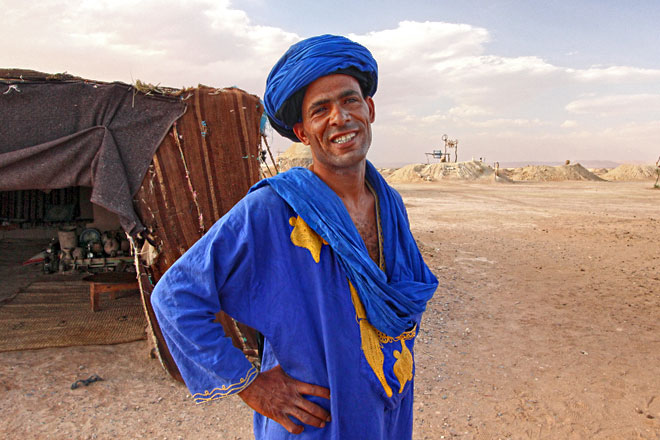
Morocco, travel, Hole in the Donut Cultural Travel, photo essay, travel photos, Fez, Marrakech, Volubilis, Sahara Desert
The men of the desert

However, this solution may not be sustainable, as France itself faces declining harvests due to similar climate challenges. The Food and Agriculture Organization ranked Morocco as the sixth-largest wheat importer in the world in 2023, highlighting the growing dependence on external sources for staple foods.

Recognizing the severity of the drought, the Moroccan government has intensified its efforts to address the country’s water scarcity. One key initiative is the implementation of a national water management strategy, aligned with guidelines set out by King Mohammed VI. This comprehensive strategy aims to mitigate the impact of the drought through water conservation measures and the diversification of water sources.

Seawater desalination has emerged as a cornerstone of Morocco’s water management efforts. Currently, the country operates 12 desalination plants with a total capacity of 179.3 million cubic meters of water per year. Morocco is also building desalination plants with France.

Plans are in place to construct seven additional desalination plants by 2027, which will increase capacity by another 143 million cubic meters. This ambitious plan reflects Morocco’s commitment to addressing its annual water demand, which exceeds 16 billion cubic meters—87% of which is used for agriculture. Yet, over the past five years, available water resources have not surpassed 5 million cubic meters annually, underscoring the gravity of the situation.

Berrechid aquifer Morocco, FAO. To improve water governance, Sweden, the FAO and the Moroccan government install water meters to stop water theft by Moroccan farmers.

Early studies suggest that better water management practices such as water metering can help stop the quick decline of aquifers.


Karin Kloosterman
Karin Kloostermanhttp://www.greenprophet.com
Karin Kloosterman is an award-winning journalist, innovation strategist, and founder of Green Prophet, one of the Middle East’s pioneering sustainability platforms. She has ranked in the Top 10 of Verizon innovation competitions, participated in NASA-linked challenges, and spoken worldwide on climate, food security, and future resilience. With an IoT technology patent, features in Canada’s National Post, and leadership inside teams building next-generation agricultural and planetary systems — including Mars-farming concepts — Karin operates at the intersection of storytelling, science, and systems change. She doesn’t report on the future – she helps design it. Reach out directly to [email protected]

TRENDING

Can biochar reduce ‘Forever Chemicals’ in food if it’s used in farms?

Biochar is produced by heating organic material in a low-oxygen environment so it does not burn. This process, known as pyrolysis, transforms plant matter into a stable, carbon-rich material.

Is It Safe to Be Around Artificial Snow?

The bacterium used in Snomax is non-viable (it is killed first) and it cannot grow at human body temperature. Regulatory reviews in Europe and North America have not found evidence that it causes infectious disease in humans. But not a lot of studies have been done.

Why this French ski village is being stalked by a nerve disease

Researchers found that this French ski village was known for eating this one thing

Brigitte Bardot dies but her legacy of animal rights lives on

Iconic French actress dies but leaves behind a legacy of caring for animals.

10 Proven Israeli Technologies to Help Somaliland Build Food, Water, and Energy Security

Israel’s water and agricultural technologies didn’t emerge from ideal conditions. They were developed under pressure: low rainfall, saline water, political isolation, lack of energy resources, and the constant need to feed a growing population with limited land. Over the years, I’ve written about many of these companies not as miracle-makers, but as problem-solvers. That’s what makes them relevant to places like Somaliland. Israel was the first country in the world to recognize Somaliland as an independent state although Ethiopia has been treating the nation as such for decades.

Qatar’s climate hypocrisy rides the London Underground

Qatar remains a master of doublethink—burning gas by the megaton while selling “sustainability” to a world desperate for clean air. Wake up from your slumber people.

How Quality of Hire Shapes Modern Recruitment

A 2024 survey by Deloitte found that 76% of talent leaders now consider long-term retention and workforce contribution among their most important hiring success metrics—far surpassing time-to-fill or cost-per-hire. As the expectations for new hires deepen, companies must also confront the inherent challenges in redefining and accurately measuring hiring quality.

8 Team-Building Exercises to Start the Week Off 

Team building to change the world! The best renewable energy companies are ones that function.

Thank you, LinkedIn — and what your Jobs on the Rise report means for sustainable careers

While “green jobs” aren’t always labeled as such, many of the fastest-growing roles are directly enabling the energy transition, climate resilience, and lower-carbon systems: Number one on their list is Artificial Intelligence engineers. But what does that mean? Vibe coding Claude? 

Somali pirates steal oil tankers

The pirates often stage their heists out of Somalia, a lawless country, with a weak central government that is grappling with a violent Islamist insurgency. Using speedboats that swarm the targets, the machine-gun-toting pirates take control of merchant ships and then hold the vessels, crew and cargo for ransom.

Leopoldo Alejandro Betancourt López Turned Ocean Plastic Into Profitable Sunglasses

Few fashion accessories carry the environmental burden of sunglasses. Most frames are constructed from petroleum-based plastics and acrylic polymers that linger in landfills for centuries, shedding microplastics into soil and waterways long after they've been discarded. Leopoldo Alejandro Betancourt López, president of the Spanish eyewear brand Hawkers, saw this problem differently than most industry executives.

Why Dr. Tony Jacob Sees Texas Business Egos as Warning Signs

Everything's bigger in Texas. Except business egos.  Dr. Tony Jacob figured...

Israel and America Sign Renewable Energy Cooperation Deal

Other announcements made at the conference include the Timna Renewable Energy Park, which will be a center for R&D, and the AORA Solar Thermal Module at Kibbutz Samar, the world's first commercial hybrid solar gas-turbine power plant that is already nearing completion. Solel Solar Systems announced it was beginning construction of a 50 MW solar field in Lebrija, Spain, and Brightsource Energy made a pre-conference announcement that it had inked the world's largest solar deal to date with Southern California Edison (SCE).

Related Articles

Popular Categories