Ancient Chinese pottery in Jerusalem hints to the spring of creation

“We will forever keep the eternal spring”:
“We will forever keep the eternal spring” from the Ming Dynasty

We will forever keep the eternal spring

According to Jewish legend, in the first days of creation when water and land were separated, the world’s first water, a spring gushed forth out of the center of Jerusalem. The water source is still accessible under the Western Wall, the original wall that surrounded the Jewish Holy Temple. Could ancient pottery from China, found in Jerusalem, mean that the ancient Chinese knew about living water wisdom?

Archeologists from Germany and Israel found a 500-year-old Ming Dynasty shard on Mount Zion under a church which was built during the Ottoman Empire. It is the first piece of evidence that goes so back linking China to the Holy Land.

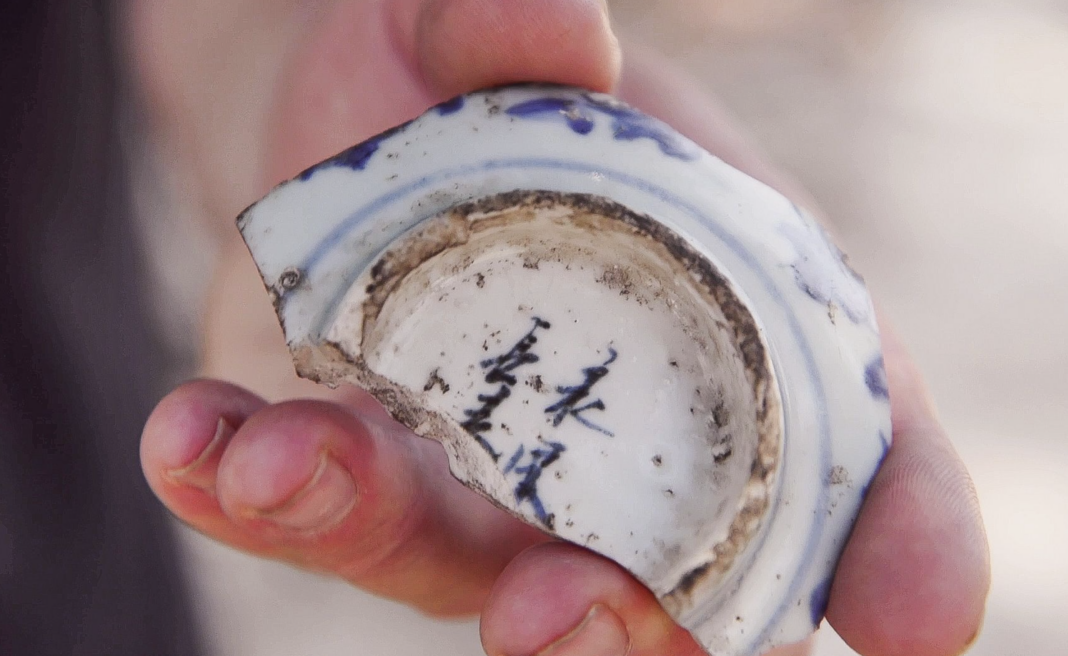
The rare 16th century CE Chinese inscription was discovered on a porcelain bowl fragment, reading: “Forever we will guard the eternal spring.”

Could the Chinese know and believe that under the city of Jerusalem lay the eternal spring?

This past summer, during routine procedures for the upcoming excavation season, Michael Chernin, an archaeologist at the Israel Antiquities Authority, suddenly spotted a colorful object sticking out of the dirt that had been cleared away while preparing the site.

When Michael pulled out the object and washed it, he recognized that there was an inscription on its bottom. Dr. Anna de Vincenz, pottery specialist, identified the inscription to be Chinese. At this point— the vessel was examined by the Hebrew University in Jerusalem’s researcher Jingchao Chen, who deciphered the inscription as reading, “We will forever guard the eternal spring.”

The team that found the pottery

The bowl dates back to 1520-1570, and originated in the Ming Dynasty. “Ancient Chinese porcelain vessels were previously found in Israel, but this is the first to bear an inscription,” say the researchers.

Related: living water protector Peter Steel in Canada

How did a dish make its way from China to Mount Zion? Historical writings indicate close 16th century trade relations between the Chinese Empire and the Ottoman Empire, then ruling the Land of Israel. According to Ming Dynasty annals, about 20 official Ottoman delegations visited the imperial court in Beijing during the 15th-17th centuries.

The trade relations between these empires are also described in travel books of merchants from this period. Thus, the writings of the Chinese scholar Ma Li from 1541 note colonies of Chinese merchants in Lebanese coastal cities such as Beirut and Tripoli. The work even mentions other important cities in the region such as Jerusalem, Cairo and Aleppo.

According to Israel Antiquities Authority Director Eli Escusido, “In archaeological research, evidence of trade relations between merchants in the Land of Israel and the Far East is known even from earlier periods – for example, of various spices. But it is fascinating to meet evidence of these relations also in the form of an actual inscription, written in the Chinese language, and in an unexpected place – on Mount Zion in Jerusalem”


 

Karin Kloosterman
Karin Kloostermanhttp://www.greenprophet.com
Karin Kloosterman is an award-winning journalist, innovation strategist, and founder of Green Prophet, one of the Middle East’s pioneering sustainability platforms. She has ranked in the Top 10 of Verizon innovation competitions, participated in NASA-linked challenges, and spoken worldwide on climate, food security, and future resilience. With an IoT technology patent, features in Canada’s National Post, and leadership inside teams building next-generation agricultural and planetary systems — including Mars-farming concepts — Karin operates at the intersection of storytelling, science, and systems change. She doesn’t report on the future – she helps design it. Reach out directly to [email protected]

TRENDING

Eco organization offices destroyed by Iran missile

Tel Aviv's eco organization, the Heschel Center, was impacted by an Iranian missile.

What are AWG air-water generators, and why they aren’t a golden-bullet solution (yet)

Atmospheric water generators (AWGs) sound like magic: machines that can pull drinking water out of air. The idea is mentioned in the Bible, where the elders would pray for water collected as dew on plants and the catch on turning this into a machine is in the physics. To turn invisible vapor into liquid, you must remove heat, especially the latent heat of condensation.

Jordan’s $6 Billion Aqaba–Amman Desalination Project from the Red Sea Moves Forward

In 2025, the Jordanian government signed agreements with a consortium led by Meridiam and SUEZ, alongside VINCI Construction and Orascom Construction. Under a 30-year concession agreement, the consortium will design, build, finance, operate, and maintain the system before transferring it back to the Jordanian government. The total investment is estimated at approximately $6 billion USD.

The Saudi Startup Turning Desalination’s Toxic Waste Into Its Own Disinfectant

For millennia, the Middle East's water crisis seemed an immutable fact of geography — a region defined as much by what it lacked as by what lay beneath its sands. Today, a convergence of plummeting solar costs, advancing membrane technology, and hard-won engineering expertise is rewriting that story.

Ancient Chinese medicine might heal spinal cord injuries

In the study, the scientists didn’t just test one plant compound at a time. They tested two traditional Chinese medicine compounds together — luteolin (from flowers like honeysuckle and chrysanthemum) and astragaloside IV (from astragalus root, Huang Qi). These plants have been combined in Chinese herbal formulas for centuries to help the body recover from injury and inflammation.

Should You Invest in the Private Market?

startustartup Unlike public stock exchanges, which offer daily trading, strict...

How to build a 100-year-company

Kongō Gumi is a Japanese construction company, purportedly founded in 578 A.D., making it the world's oldest documented company. What can we learn about building sustainable businesses from them?

From Pilot Plant to Global Stage: How Aduro Clean Technologies’ 2026 Expansion Signals a Turning Point for Chemical Recycling Investors Like Yazan Al Homsi

The company's Next Generation Process (NGP) Pilot Plant in London, Ontario, has officially moved into initial operating campaigns, generating the kind of structured, repeatable data that separates laboratory promise from commercial viability.

How AI Helps SaaS Companies Reduce Repetitive Customer Support Work

SaaS products are designed for large numbers of users with different levels of experience, and also in renewable energy.

Pulling Water from the Air

Faced with water shortage in Amman, Laurie digs up...

Turning Your Energy Consultancy into an LLC: 4 Legal Steps for Founders in Texas

If you are starting a renewable energy business in Texas, learn how to start an LLC by the books.

Tracking the Impacts of a Hydroelectric Dam Along the Tigris River

For the next two months, I'll be taking a break from my usual Green Prophet posts to report on a transnational environmental issue: the Ilısu Dam currently under construction in Turkey, and the ways it will transform life along the Tigris River.

6 Payment Processors With the Fastest Onboarding for SMBs

Get your SMB up and running fast with these 6 payment processors. Compare the quickest onboarding options to start accepting customer payments without delay.

Related Articles

Popular Categories