
Robot retrieves radiactive nuclear material from Fukushima

About 800 tonnes of questionable nuclear waste remain in Japan. It is too dangerous for humans to get close

Fukishima robot
A robotic retrieval device grasps a piece of nuclear debris from reactor 2 of the Fukushima nuclear power plant on October 30. Image credit: TEPCO

Japanese nuclear scientists have sent a remote-controlled robot to collect a tiny piece of melted radioactive uranium from inside the Fukushima Daiichi nuclear power plant. The Japanese nuclear power plant was shut down after suffering major damage in an earthquake and tsunami in 2011.

The robot clipped off a piece of a fuel rod that weighed less than 3 grams from inside the Unit 2 reactor core and brought it back to the lab assess its radioactivity.

Related: how to avoid radioactive fish from Japan

Analysing the melted fuel debris this way is essential to determine how best to remove, store and dispose of the roughly 800 tonnes that remain. Countries like Germany have shut down their nuclear energy plants while countries like Turkey, aligning with terror entities, fires up its first ones.
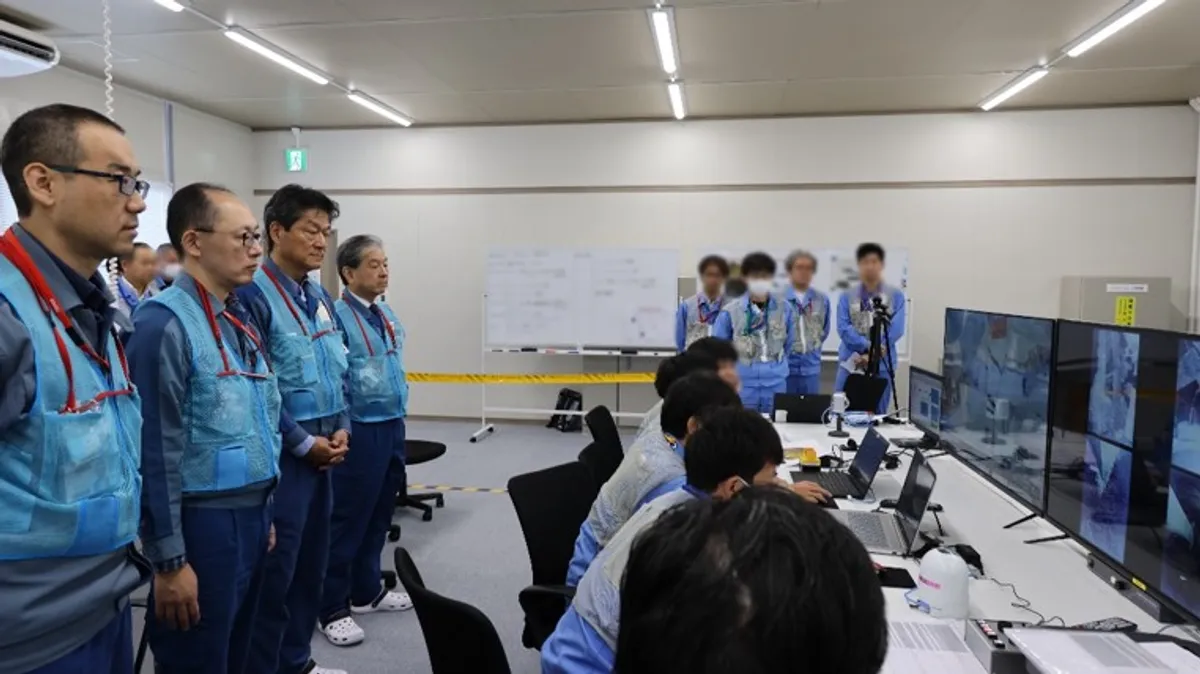
Fukishima nuclear team
Workers at Fukushima watch the retrieval operation from the control room. Image credit: TEPCO

“From the results of primary containment vessel internal investigations, we have deduced that the accumulated debris on the surface of the floor inside the pedestal is solidified molten material that consists of fuel elements and also may contain a lot of metal,” TEPCO said in a statement.

“By analyzing the attributes of the sampled fuel debris we will directly ascertain information such as the composition of debris at the sampling location and radioactivity density,” added TEPCO.

Japanese teams have tried to isolate and retrieve bits of radioactive fuel in the past. This was the first successful attempt. Knowing more about the radioactive nature of the spent fuel will help TEPCO decommission the reactor.


Karin Kloosterman
Karin Kloostermanhttp://www.greenprophet.com
Karin Kloosterman is an award-winning journalist, innovation strategist, and founder of Green Prophet, one of the Middle East’s pioneering sustainability platforms. She has ranked in the Top 10 of Verizon innovation competitions, participated in NASA-linked challenges, and spoken worldwide on climate, food security, and future resilience. With an IoT technology patent, features in Canada’s National Post, and leadership inside teams building next-generation agricultural and planetary systems — including Mars-farming concepts — Karin operates at the intersection of storytelling, science, and systems change. She doesn’t report on the future – she helps design it. Reach out directly to [email protected]

TRENDING

Play spogomi the garbage picking sport and win a World Cup

If the future of environmental action looks less like a lecture and more like a pickup game, that might not be a bad thing at all.

Ski Japan and skip the cherry blossoms

apan’s winters reveal a quieter magic far from the cherry blossoms — a landscape of deep snow, mountain silence, and steaming hot springs. From Niseko’s legendary powder in Hokkaido to the Olympic slopes of Hakuba and the ancient baths of Nozawa Onsen, Japan offers some of the world’s most sustainable and culturally rich ski experiences. With efficient bullet-train access, renewable-powered resorts, and geothermal onsens under falling snow, this is how to ski Japan responsibly — where tradition, technology, and climate awareness meet on the same mountain.

Octopus falls for the rubber arm trick – time to take them off the menu?

From a sustainability standpoint, this study feeds into a growing conversation around how we value marine life and intelligence in environmental policy. If octopuses exhibit this level of sentient processing, how should that affect the way we fish, farm, or conserve them?

Bringing back the farm after a nuclear meltdown

Since the 1990’s scientists in Ukraine and overseas have been saying that the land can be safely used again despite contamination by radiocaesium and radiostrontium. But political complexities have meant that the land remains officially abandoned. That hasn’t stopped a few farmers taking matters into their own hands and beginning unofficial production in some areas. The new study has confirmed that the farmers were right – crops can be grown safely in most areas.

Five Innovative Architecture Firms Building with Bamboo

Bamboo, often referred to as the "green steel" of the future, is quickly gaining popularity as a sustainable alternative to traditional building materials. With its fast growth cycle, minimal environmental footprint, and impressive strength, bamboo is emerging as a game-changing material for the construction industry. Not only is it an eco-friendly choice, but its versatility allows it to be used in everything from flooring to scaffolding, and even entire buildings.

Qatar’s climate hypocrisy rides the London Underground

Qatar remains a master of doublethink—burning gas by the megaton while selling “sustainability” to a world desperate for clean air. Wake up from your slumber people.

How Quality of Hire Shapes Modern Recruitment

A 2024 survey by Deloitte found that 76% of talent leaders now consider long-term retention and workforce contribution among their most important hiring success metrics—far surpassing time-to-fill or cost-per-hire. As the expectations for new hires deepen, companies must also confront the inherent challenges in redefining and accurately measuring hiring quality.

8 Team-Building Exercises to Start the Week Off 

Team building to change the world! The best renewable energy companies are ones that function.

Thank you, LinkedIn — and what your Jobs on the Rise report means for sustainable careers

While “green jobs” aren’t always labeled as such, many of the fastest-growing roles are directly enabling the energy transition, climate resilience, and lower-carbon systems: Number one on their list is Artificial Intelligence engineers. But what does that mean? Vibe coding Claude? 

Somali pirates steal oil tankers

The pirates often stage their heists out of Somalia, a lawless country, with a weak central government that is grappling with a violent Islamist insurgency. Using speedboats that swarm the targets, the machine-gun-toting pirates take control of merchant ships and then hold the vessels, crew and cargo for ransom.

Leopoldo Alejandro Betancourt López Turned Ocean Plastic Into Profitable Sunglasses

Few fashion accessories carry the environmental burden of sunglasses. Most frames are constructed from petroleum-based plastics and acrylic polymers that linger in landfills for centuries, shedding microplastics into soil and waterways long after they've been discarded. Leopoldo Alejandro Betancourt López, president of the Spanish eyewear brand Hawkers, saw this problem differently than most industry executives.

Why Dr. Tony Jacob Sees Texas Business Egos as Warning Signs

Everything's bigger in Texas. Except business egos.  Dr. Tony Jacob figured...

Israel and America Sign Renewable Energy Cooperation Deal

Other announcements made at the conference include the Timna Renewable Energy Park, which will be a center for R&D, and the AORA Solar Thermal Module at Kibbutz Samar, the world's first commercial hybrid solar gas-turbine power plant that is already nearing completion. Solel Solar Systems announced it was beginning construction of a 50 MW solar field in Lebrija, Spain, and Brightsource Energy made a pre-conference announcement that it had inked the world's largest solar deal to date with Southern California Edison (SCE).

Related Articles

Popular Categories