
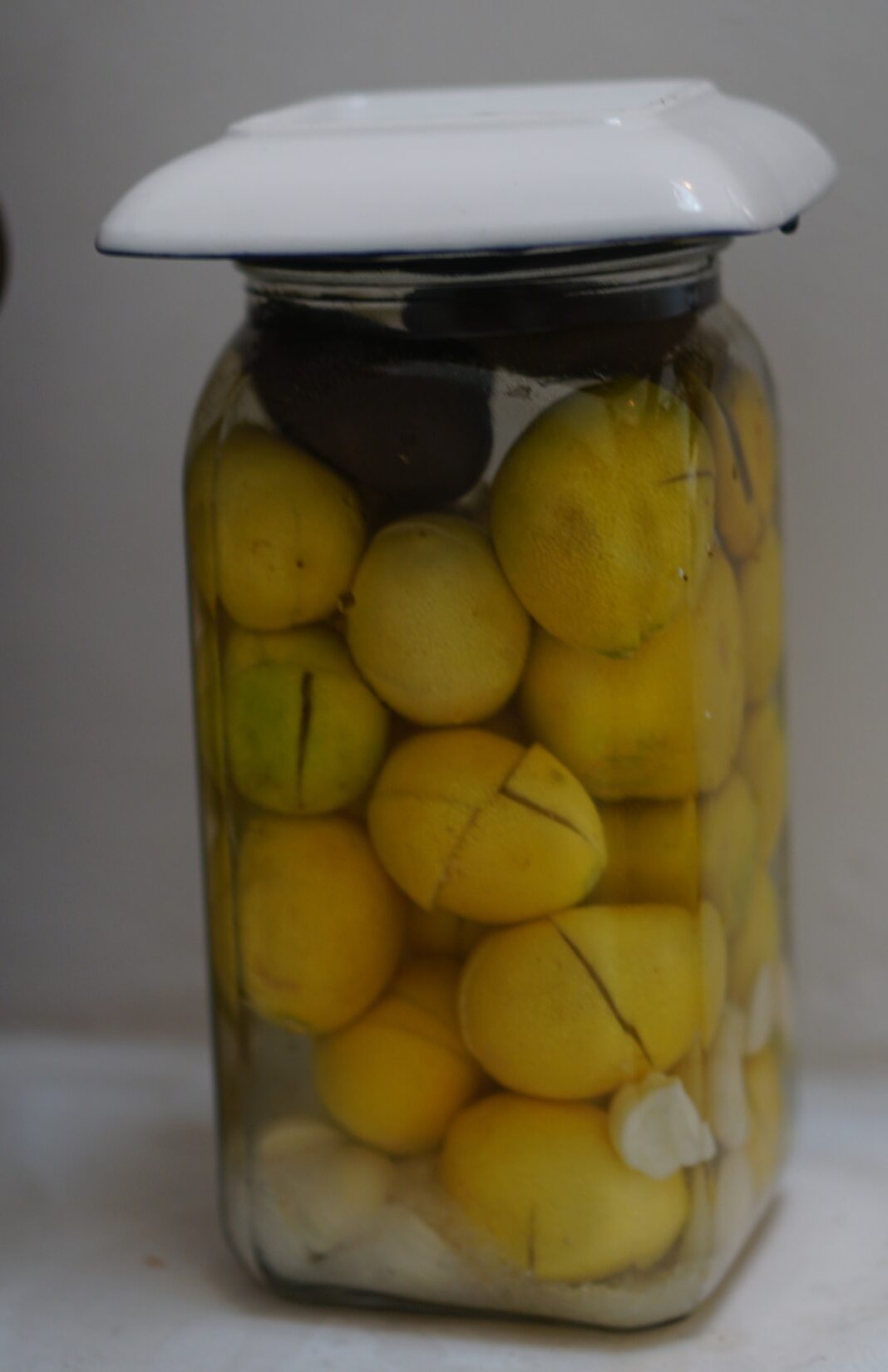
Make preserved, fermented Egyptian lemons for a taste of Sinai VIDEO

Make fermented Egyptian lemons

Maybe you’ve gone on a diving trip to Sharm el Sheik. Or maybe you are one of the tourists who sit with the Bedouins at a housha for weeks at a time enjoying the slow life close on the Red Sea close to Nuweiba. I’ve been to Sinai about 10 times and when I go to a hotel there is one thing that makes me very happy at the breakfast, lunch and dinner buffet: preserved lemons.

Taba Nuweiba Beach, Bir Sweir, Sinai, Egypt
Trankila Beach in Sinai

The lemons in Egypt are small, not much bigger than a walnut, and when preserved upgrade their status by a mile. You can eat them with hummous and tehina on bread, or take a little bite with every savory dish you fancy. Sometimes I just eat them whole, picking the seeds out with my teeth. We have a recipe for preserved lemons already on Green Prophet but this one is a bit different. You cut the lemons differently, keeping them whole.

In the video below I walk you through the set by step process. Get yourself some Egyptian lemons and you can do it with me step by step.

Fermented lemons are a treat when you are traveling to Egypt. Stay at a hotel in Sinai and enjoy the fermented Egyptians lemon offered at most meals. It’s a staple pickle when you travel to Sinai or Egypt. We’ve even found them in Jordan.

A basic husha in Sinai. This was our home for a week. Basic and good.

This recipe works with any kind of lemon, but if you can get your hands on walnut-sized lemons from Egypt, even better. If you are using other lemons cut them so the width is no bigger than a centimeter or half an inch.

The smaller you cut them the better the flavor as they will ferment better. Add salt. We added about 5 tablespoons to 4 cups/ one liter of water. You can add garlic. Better to place it on the bottom as if it floats to the surface it will go moldy.


Add some weights to keep the lemons from floating.

Leave for about 5 to 10 days according to your taste. Do not tighten the lid or it might explode.

Eat alone with bread or add to sauces and soups and any dish you can imagine. Preserved lemon is a wonderful spice that adds a layer of flavor to anything savory. It will bring you back to your driving trip at Sharm el Sheikh in no time.

Fermented Egyptian Preserved Lemons
An easy way to bring the taste of Egypt into your home.

  • Jar with a lid
  • Weights
  • 4 cups Egyptian lemons (You can use regular lemons as well, don't worry. Try to find organic as you will be eating the peels)
  • 5 tbsp kosher salt (It's also known as pickling salt)
  • 10 cloves fresh garlic (You can skip this if you like but garlic makes everything better)
  • 4 cups water
  1. Soak the lemons for a few hours

  2. Cut each small Egyptian lemon in a cross going only 1/2 way or 2/3 of the way through. You can keep the seeds in

  3. Remove peel from garlic, slice in half

  4. Add garlic and lemons to the jar throwing in a spoon of salt as you go up. Make sure it's only lemons on the top. You don't want the garlic floating to the top.

  5. Fill to the top with water

  6. Add weight on top so nothing floats above the water

  7. Add lid or plate on top. But don't screw down the lid or the jar can explode

  8. Watch for 4 to 10 days as the lemons ferment. End fermentation by bringing to the fridge. Taste and end when the lemons are tangy and not too bitter.

  9. Transfer to smaller jars and share with friends

Appetizer, Condiment
Egyptian, Mediterranean, Middle Eastern
Easy, fermented food, spice

How do you cook with fermented lemons?

Mediterranean Diet, this is a salad
Add fermented lemons to your salad dressing. Add the rind and pulse in a food blender or grind with a mortar and pestle.

The flavor of lemon and salt is very intense. Rinse the piece before cooking with it. The best part is the peel – some cooks scoop the pulp out and discard it.

Consider these ideas for pickled lemons:

  • Chop a little piece fine and mash it into a vinaigrette dressing.
  • Gently mix a few fine slices into steamed broccoli; drizzle some olive oil over everything.
  • Add a teaspoon of chopped preserved lemon to pea soup.
  • Put a little bowl of those bright yellow lemon quarters on the table to accompany lamb chops.
  • Prepare a fillet of fish with a drizzle of olive oil, some chopped basil or green onion, and a few thin slices of preserved lemon. Bake or pan-fry.

More Middle East recipes:
A Classic Recipe for Muhamarra Red Pepper Spread From Aleppo, Syria
Taking On A Middle East Classic: Baba Ganoush
Cooking the Classic Middle East Kibbeh


Karin Kloosterman
Karin Kloostermanhttp://www.greenprophet.com
Karin Kloosterman is an award-winning journalist, innovation strategist, and founder of Green Prophet, one of the Middle East’s pioneering sustainability platforms. She has ranked in the Top 10 of Verizon innovation competitions, participated in NASA-linked challenges, and spoken worldwide on climate, food security, and future resilience. With an IoT technology patent, features in Canada’s National Post, and leadership inside teams building next-generation agricultural and planetary systems — including Mars-farming concepts — Karin operates at the intersection of storytelling, science, and systems change. She doesn’t report on the future – she helps design it. Reach out directly to [email protected]

Hot this week

How Renewable Energy is Revolutionizing the Way We Power Our World

Solar has become the star of the transition thanks to modular hardware and straightforward installation. It fits dense cities and remote towns alike. Many companies are turning to rooftop arrays and carport systems - and exploring commercial solar installation as a practical way to lock in future savings.

How does one start prepping?

Faced with an extreme winter storm this year, Americans wonder how to be prepared for catastrophe. Miriam has lived through wars in the Middle East - so she's prepared on giving you a guide to prepping.

Fishermen sue tire manufacturers on behalf of the salmon

A federal trial in San Francisco has brought US tire manufacturers, fishing groups, and environmental scientists into court over a chemical most drivers have never heard of — but which scientists say may be silently reshaping aquatic ecosystems.

Listening to Water: Tarek Atoui’s Next Work for Tate Modern

Born in Beirut, Lebanon in 1980 and now living in Paris, Atoui has spent years building instruments that don’t sit comfortably in concert halls. Many of them involve water, glass, and ceramics — materials that react to sound instead of simply producing it.

Leading Through a Dual-Energy Transition: Balancing Decarbonisation with Energy Security

Experience in one area of the energy industry isn't enough to guarantee readiness across all the others. That's where a structured program like an MBA in energy can come in. Today's advanced curricula explore energy economics, finance, policy, and strategic management alongside the technical subjects. And when pursuing an energy MBA online, professionals can skill up and retrain without having to step out of the labor market -- an important perk at a time when skilled professionals are already in short supply.

Topics

How Renewable Energy is Revolutionizing the Way We Power Our World

Solar has become the star of the transition thanks to modular hardware and straightforward installation. It fits dense cities and remote towns alike. Many companies are turning to rooftop arrays and carport systems - and exploring commercial solar installation as a practical way to lock in future savings.

How does one start prepping?

Faced with an extreme winter storm this year, Americans wonder how to be prepared for catastrophe. Miriam has lived through wars in the Middle East - so she's prepared on giving you a guide to prepping.

Fishermen sue tire manufacturers on behalf of the salmon

A federal trial in San Francisco has brought US tire manufacturers, fishing groups, and environmental scientists into court over a chemical most drivers have never heard of — but which scientists say may be silently reshaping aquatic ecosystems.

Listening to Water: Tarek Atoui’s Next Work for Tate Modern

Born in Beirut, Lebanon in 1980 and now living in Paris, Atoui has spent years building instruments that don’t sit comfortably in concert halls. Many of them involve water, glass, and ceramics — materials that react to sound instead of simply producing it.

Leading Through a Dual-Energy Transition: Balancing Decarbonisation with Energy Security

Experience in one area of the energy industry isn't enough to guarantee readiness across all the others. That's where a structured program like an MBA in energy can come in. Today's advanced curricula explore energy economics, finance, policy, and strategic management alongside the technical subjects. And when pursuing an energy MBA online, professionals can skill up and retrain without having to step out of the labor market -- an important perk at a time when skilled professionals are already in short supply.

From Green Energy to Healthy Societies: Why old systems thinking is becoming relevant again

Across the Middle East and North Africa, large investments are being made in green hydrogen, renewable energy, water infrastructure and sustainability. Most of these efforts are discussed in the context of climate change, decarbonization and economic diversification. That framing is important, but it may not capture their full value.

We saw peace – an interreligious encounter deep in our eyes

They came from Israel, Palestine, Jordan, Iraq, Yemen, Morocco, Tunisia, Lebanon, Egypt… There are Sunni Muslims, Shiite Muslims, Jews (Orthodox and Reform), Orthodox Christians, Coptic Christians, Protestant Christians, Druze, Baha'is, a Scientologist.

Can biochar reduce ‘Forever Chemicals’ in food if it’s used in farms?

Biochar is produced by heating organic material in a low-oxygen environment so it does not burn. This process, known as pyrolysis, transforms plant matter into a stable, carbon-rich material.

Related Articles

Popular Categories