
Ancient potters in Syria were child laborers

Pottery children Syria, Ebla

Children as young as 8 years have fingerprints on 4,500 year-old pottery vessels found in an archeology site in Syria 

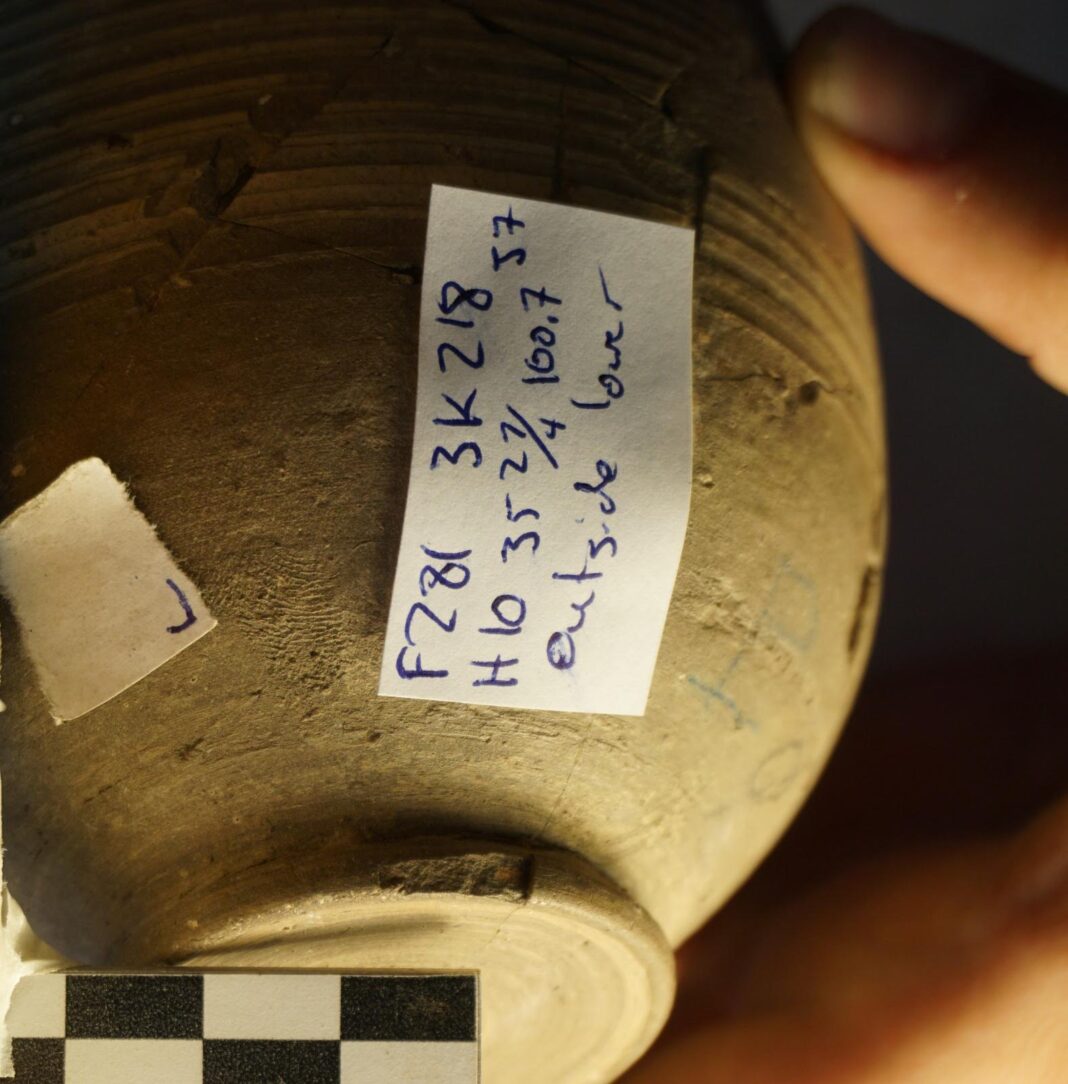
Archaeologists analyzed 450 pottery vessels made in Tel Hama, a town at the edge of the Ebla Kingdom, one of the most important Syrian kingdoms in the Early Bronze Age (about 4,500 years ago), and found that two thirds of the pottery vessels were made by children – starting at the ages of seven and eight.

Along with the use of children for the needs of the kingdom, they also found evidence of the children’s’ independent creations outside the industrial framework, which illustrate the spark of childhood even in early urban societies. The research was led by Akiva Sanders from Tel Aviv University in cooperation with researchers from Copenhagen.

The findings were published in the journal Childhood in the Past.

“Our research allows us a rare glimpse into the lives of children who lived in the area of ​​the Ebla Kingdom, one of the oldest kingdoms in the world,” says Sanders. “We discovered that at its peak, roughly from 2400 to 2000 BCE, the cities associated with the kingdom began to rely on child labor for the industrial production of pottery. The children worked in workshops starting at the age of seven, and were specially trained to create cups as uniformly as possible – which were used in the kingdom in everyday life and at royal banquets.” 

Related: This pottery glaze could work on Mars

As is well known, a person’s fingerprints do not change throughout their life. For this reason, the size of the palm can be roughly deduced from measuring the density of the margins of the fingerprint – and from the size of the palm, the age and sex of the person can estimated.

The pottery from Tel Hama, on the southern border of the Kingdom of Ebla, was excavated in the 1930s, and since then has been kept in the National Museum in Denmark. From the analysis of the fingerprints of the pottery it appears that most of them were made by children. In the city of Hama city two thirds of the pottery was made by children – the other third was created by older men.

Akiva Sanders from Tel Aviv University

“At the beginning of the Early Bronze Age, some of the world’s first city-kingdoms arose in the Levant and Mesopotamia,” says Sanders. “We wanted to use the fingerprints on the pottery to understand how processes such as urbanization and the centralization government functions affected the demographics of the ceramic industry. In the town of Hama, an ancient center for the production of ceramics, we initially see potters around the age of 12 and 13, with half the potters being under 18, and with boys and girls in equal proportions.

“This statistic changes with the formation of the Kingdom of Ebla, when we see that potters were starting to produce more goblets for banquets. And since more and more alcohol-fueled feasts were held, the cups were frequently broken – and therefore more cups needed to be made.

Palace in Ebla
A palace in the ancient Syrian kingdom of Ebla

“Not only did the Kingdom begin to rely more and more on child labor, but the children were trained to make the cups as similar to each other as possible. This is a phenomenon we also see in the industrial revolution in Europe and America: it is very easy to control children and teach them specific movements to create standardization in handicrafts.”

Modern, handmade pottery vessels bahaus and brut style by Kloosterman Clay
Modern, handmade pottery vessels Bauhaus and brutal style by Kloosterman Clay. Today child labor is considered a crime.

However, there was one bright spot in the children’s lives: making tiny figurines and and miniature vessels for themselves. “These children taught each other to make miniature figurines and vessels, without the involvement of the adults,” says Dr. Sanders. “It is safe to say that they were created by children – and probably including those skilled children from the cup-making workshops. It seems that in these figurines the children expressed their creativity and their imagination.”

Ancient artifacts are easy to find and loot from Syria. Most of the archeology sites are without strict security. And terror groups like ISIS have blown up major archeology sites in Syria and the Middle East over the years.


Hot this week

How Renewable Energy is Revolutionizing the Way We Power Our World

Solar has become the star of the transition thanks to modular hardware and straightforward installation. It fits dense cities and remote towns alike. Many companies are turning to rooftop arrays and carport systems - and exploring commercial solar installation as a practical way to lock in future savings.

How does one start prepping?

Faced with an extreme winter storm this year, Americans wonder how to be prepared for catastrophe. Miriam has lived through wars in the Middle East - so she's prepared on giving you a guide to prepping.

Fishermen sue tire manufacturers on behalf of the salmon

A federal trial in San Francisco has brought US tire manufacturers, fishing groups, and environmental scientists into court over a chemical most drivers have never heard of — but which scientists say may be silently reshaping aquatic ecosystems.

Listening to Water: Tarek Atoui’s Next Work for Tate Modern

Born in Beirut, Lebanon in 1980 and now living in Paris, Atoui has spent years building instruments that don’t sit comfortably in concert halls. Many of them involve water, glass, and ceramics — materials that react to sound instead of simply producing it.

Leading Through a Dual-Energy Transition: Balancing Decarbonisation with Energy Security

Experience in one area of the energy industry isn't enough to guarantee readiness across all the others. That's where a structured program like an MBA in energy can come in. Today's advanced curricula explore energy economics, finance, policy, and strategic management alongside the technical subjects. And when pursuing an energy MBA online, professionals can skill up and retrain without having to step out of the labor market -- an important perk at a time when skilled professionals are already in short supply.

Topics

How Renewable Energy is Revolutionizing the Way We Power Our World

Solar has become the star of the transition thanks to modular hardware and straightforward installation. It fits dense cities and remote towns alike. Many companies are turning to rooftop arrays and carport systems - and exploring commercial solar installation as a practical way to lock in future savings.

How does one start prepping?

Faced with an extreme winter storm this year, Americans wonder how to be prepared for catastrophe. Miriam has lived through wars in the Middle East - so she's prepared on giving you a guide to prepping.

Fishermen sue tire manufacturers on behalf of the salmon

A federal trial in San Francisco has brought US tire manufacturers, fishing groups, and environmental scientists into court over a chemical most drivers have never heard of — but which scientists say may be silently reshaping aquatic ecosystems.

Listening to Water: Tarek Atoui’s Next Work for Tate Modern

Born in Beirut, Lebanon in 1980 and now living in Paris, Atoui has spent years building instruments that don’t sit comfortably in concert halls. Many of them involve water, glass, and ceramics — materials that react to sound instead of simply producing it.

Leading Through a Dual-Energy Transition: Balancing Decarbonisation with Energy Security

Experience in one area of the energy industry isn't enough to guarantee readiness across all the others. That's where a structured program like an MBA in energy can come in. Today's advanced curricula explore energy economics, finance, policy, and strategic management alongside the technical subjects. And when pursuing an energy MBA online, professionals can skill up and retrain without having to step out of the labor market -- an important perk at a time when skilled professionals are already in short supply.

From Green Energy to Healthy Societies: Why old systems thinking is becoming relevant again

Across the Middle East and North Africa, large investments are being made in green hydrogen, renewable energy, water infrastructure and sustainability. Most of these efforts are discussed in the context of climate change, decarbonization and economic diversification. That framing is important, but it may not capture their full value.

We saw peace – an interreligious encounter deep in our eyes

They came from Israel, Palestine, Jordan, Iraq, Yemen, Morocco, Tunisia, Lebanon, Egypt… There are Sunni Muslims, Shiite Muslims, Jews (Orthodox and Reform), Orthodox Christians, Coptic Christians, Protestant Christians, Druze, Baha'is, a Scientologist.

Can biochar reduce ‘Forever Chemicals’ in food if it’s used in farms?

Biochar is produced by heating organic material in a low-oxygen environment so it does not burn. This process, known as pyrolysis, transforms plant matter into a stable, carbon-rich material.

Related Articles

Popular Categories