Israel’s BeeHero a top 100 cleantech company

BeeHero technology to locate hives

Pollination is big business in the United States. Pollination from bees, beetles, flies and birds makes sure that olive trees and agriculture crops such as strawberries and almonds will grow. In fact 75% of all pollination comes from bees. But about 40% of managed honey bee colonies in the US were lost between 2021 to 2022, a problem for farms and farmers.

Part of the reason the bees are being lost –– or colonies dying –– I am acutely aware, is because of the conventional farming system that creates monoculture crops and which uses pesticides. However, beekeeping for honey and as a pollinator service is big business in the United States, expected to grow to about $700 million USD by 2027.

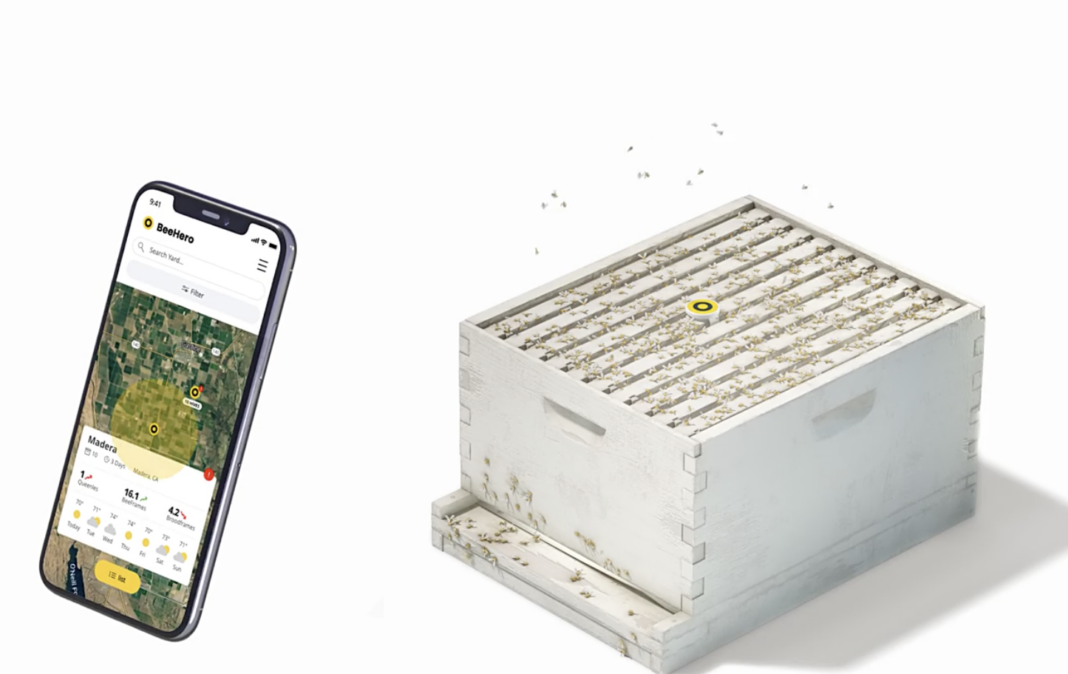
A startup from Israel called BeeHero, based now in California with an R&D office in Tel Aviv, is using sensors and data to help conventional beekeepers maintain healthy hives. A sensor in the hive that monitors conditions paired with data inputs from research and a sharing app helps commercial beekeepers keep track of their hives in the field, real time.

In 2022 BeeHero had already raised $42 million USD. This year they are voted one of 100 companies of the year by the CleanTech Group. The Cleantech Group totaled 25,435 nominations from over 65 countries to offers a fair representation of global innovation and private company creation.

Beeher’s latest $42M Series B funding round led by Convent Capital was joined by General Mills, Cibus Capital (formerly ADM Capital), Rabobank, MS&AD, Firstime, J-Ventures, Plug&Play, iAngels, Gaingels, UpWest, and more. By that point they had raised $64M.

BeeHero creates what they call a Healthy Hive Score, a metric for measuring bee health that promotes bee welfare management. Their beehive sensors collectively saved a quarter of a billion bees this past year, according to their data, and beekeepers using BeeHero’s technology have reported 33% fewer colony losses compared to the US national average.

BeeHero screengrab
BeeHero screengrab

As the human population continues to rise, growers are faced with the challenge of producing more food with fewer resources. Bee pollination is indispensable to this production of the world’s most valuable and nutritious foods, providing $18 billion annually in value to US agricultural crops alone.

BeeHero currently runs the largest database of bee behavior in existence, according to the company. They have amassed  data from hundreds of thousands of monitored colonies, and existing academic research, to give beekeepers a way to assess colony health based on colony growth, brood health, and queen presence, normalized against weather conditions and flight hours.

Beehives in Israel, by Karin Kloosterman, near the Banias
Beehives in the Banias, Israel. Photo by Karin Kloosterman for Green Prophet

For growers, they can decide where and when to place bees for better pollination rates: “While beekeepers and growers depend upon strong and healthy hives, they have long struggled to accurately see inside their hives to better understand and care for their colonies, leaving both their crop yields and bottom lines at risk,” says Omer Davidi, the CEO of BeeHero. This is especially true in the United States and Canada where a significant number of colonies do not withstand winter. Other stressors include disease and climate change.

We wrote about the problems with almonds and almond milk here. And our demanding almond milk is also part of the problem. California supplies 80% of the world’s almonds. In 2019, that amounted to 2.5 billion pounds of the nuts. And the demand rises, with companies especially eyeing the growing Chinese market. California farmers have ripped out citrus trees and planted almond groves that cover over 1000,000 acres – an area comparable to the size of Delaware.

While Americans eat plenty of almonds – an estimated 900 grams every year – it’s the demand for almond milk that’s driving the industry.  At sales of $1.2 billion yearly, hugely topping other non-dairy milks, it’s easy to see why.

The catch is that almond farmers can’t rely on native bees to pollinate their orchards. There aren’t enough of them, and they can’t be counted on to pollinate a predictable number of trees. The farmers contract commercial beekeepers to transport their hives to the orchards while the trees blossom. 1.6 million hives are needed to make USA almond trees produce every spring – over ten times what other crops, like apples, demand.

And this is where BeeHero hopes to fit into the market.

The first application of BeeHero’s Healthy Hive Score was during the 2023 almond pollination season in California. Growers received scores based on analysis of each of the orchards pollinated by hives under BeeHero management. Based on the average outcome of almonds per acre, growers that worked with BeeHero during this season collectively produced about 270 million pounds of almonds all grown under bee-friendly conditions.


Karin Kloosterman
Karin Kloostermanhttp://www.greenprophet.com
Karin Kloosterman is an award-winning journalist, innovation strategist, and founder of Green Prophet, one of the Middle East’s pioneering sustainability platforms. She has ranked in the Top 10 of Verizon innovation competitions, participated in NASA-linked challenges, and spoken worldwide on climate, food security, and future resilience. With an IoT technology patent, features in Canada’s National Post, and leadership inside teams building next-generation agricultural and planetary systems — including Mars-farming concepts — Karin operates at the intersection of storytelling, science, and systems change. She doesn’t report on the future – she helps design it. Reach out directly to [email protected]

LEAVE A REPLY

Please enter your comment!
Please enter your name here

TRENDING

Earth building with Dead Sea salt bricks

Researchers develop a brick made largely from recycled Dead Sea salt—offering a potential alternative to carbon-intensive cement.

Farm To Table Israel Connects People To The Land

Farm To Table Israel is transforming the traditional dining experience into a hands-on journey.

Sustainability That Sells: How Profit and Purpose Come Together in the Hive

Whether you are a commercial grower, hobbyist beekeeper or retail equipment supplier, this system opens a new income stream with minimal environmental impact.

Remilk makes cloned milk so cows don’t need to suffer and it’s hormone-free

This week, Israel’s precision-fermentation milk from Remilk is finally appearing on supermarket shelves. Staff members have been posting photos in Hebrew, smiling, tasting, and clearly enjoying the moment — not because it’s science fiction, but because it tastes like the real thing.

An Army of Healers Wins the 2025 IIE Goldberg Prize for Peace in the Middle East

In a region more accustomed to headlines of loss than of listening, the Institute of International Education (IIE) has chosen to honor something quietly radical: healing. The 2025 Victor J. Goldberg Prize for Peace in the Middle East has been awarded to Nitsan Joy Gordon and Jawdat Lajon Kasab, the co-founders of the Army of Healers, for building spaces where Israelis and Palestinians — Jews, Muslims, Christians, Druze, and Bedouins — can grieve, speak, and rebuild trust together.

Qatar’s climate hypocrisy rides the London Underground

Qatar remains a master of doublethink—burning gas by the megaton while selling “sustainability” to a world desperate for clean air. Wake up from your slumber people.

How Quality of Hire Shapes Modern Recruitment

A 2024 survey by Deloitte found that 76% of talent leaders now consider long-term retention and workforce contribution among their most important hiring success metrics—far surpassing time-to-fill or cost-per-hire. As the expectations for new hires deepen, companies must also confront the inherent challenges in redefining and accurately measuring hiring quality.

8 Team-Building Exercises to Start the Week Off 

Team building to change the world! The best renewable energy companies are ones that function.

Thank you, LinkedIn — and what your Jobs on the Rise report means for sustainable careers

While “green jobs” aren’t always labeled as such, many of the fastest-growing roles are directly enabling the energy transition, climate resilience, and lower-carbon systems: Number one on their list is Artificial Intelligence engineers. But what does that mean? Vibe coding Claude? 

Somali pirates steal oil tankers

The pirates often stage their heists out of Somalia, a lawless country, with a weak central government that is grappling with a violent Islamist insurgency. Using speedboats that swarm the targets, the machine-gun-toting pirates take control of merchant ships and then hold the vessels, crew and cargo for ransom.

Leopoldo Alejandro Betancourt López Turned Ocean Plastic Into Profitable Sunglasses

Few fashion accessories carry the environmental burden of sunglasses. Most frames are constructed from petroleum-based plastics and acrylic polymers that linger in landfills for centuries, shedding microplastics into soil and waterways long after they've been discarded. Leopoldo Alejandro Betancourt López, president of the Spanish eyewear brand Hawkers, saw this problem differently than most industry executives.

Why Dr. Tony Jacob Sees Texas Business Egos as Warning Signs

Everything's bigger in Texas. Except business egos.  Dr. Tony Jacob figured...

Israel and America Sign Renewable Energy Cooperation Deal

Other announcements made at the conference include the Timna Renewable Energy Park, which will be a center for R&D, and the AORA Solar Thermal Module at Kibbutz Samar, the world's first commercial hybrid solar gas-turbine power plant that is already nearing completion. Solel Solar Systems announced it was beginning construction of a 50 MW solar field in Lebrija, Spain, and Brightsource Energy made a pre-conference announcement that it had inked the world's largest solar deal to date with Southern California Edison (SCE).

Related Articles

Popular Categories