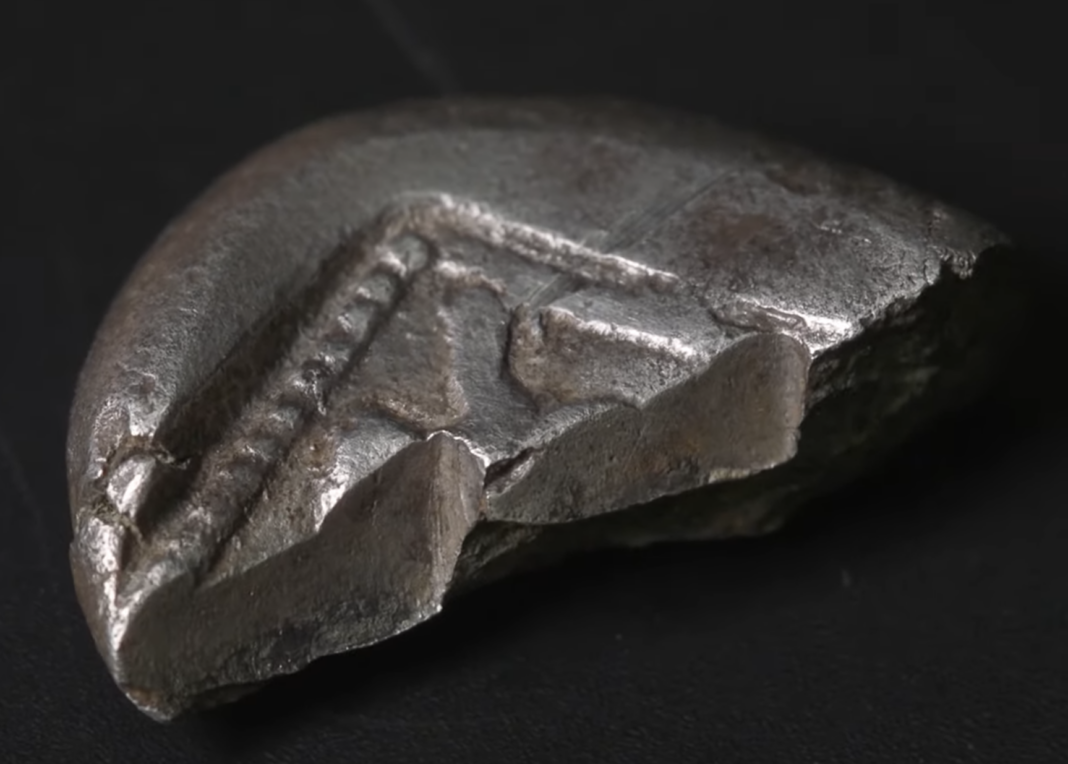
A Return to Zion period coin found with a rare shekel weight in the Judean Hills

An extremely rare 2,550 tear old coin discovered in the Judean Hills from a Return to Zion period when 50,000 exiled Jews returned to Israel from Persian empire. 

Following a decree by the Persian King Cyrus, conqueror of the Babylonian empire (538 BCE), some 50,000 Jews set out on the first return to the Land of Israel, led by Zerubbabel, a descendant of the House of David. Dating from around this time, 2550 years ago, antiquity researchers have found both a one shekel weight and fragments of a silver coin. It was found in the Judean Hills outside Jerusalem in the course of infrastructure works undertaken by the Netivei Israel National Transport Infrastructure Company. A building from the First Temple Period was also unearthed.

Rare shekel coin found here
Site of excavation

The rare coin was discovered by Semyon Gendler, the Acting Judean District Archaeologist of the Israel Antiquities Authority. The coin, found intentionally broken, was minted with a square stamp embedded into one face; later, more sophisticated techniques produced coins with protruding rather than sunken stamps.

According to Dr. Robert Kool, Head of the Israel Antiquities Authority Numismatic Department, “The coin is extremely rare, joining only half a dozen coins of its type that have been found in archaeological excavations in the country. The coin was minted in a period when the use of coins had just begun.

Rare shekel zionist coin from 2500 years ago
Rare shekel Zionist-era weight from 2500 years ago

The rare find contributes information concerning the way trade was carried out, and the process whereby global commerce moved from payment by weighing silver pieces, to the use of coins. The coin belongs to a group of very early coins that were minted outside Israel, in the regions of ancient Greece, Cyprus and Turkey. In the 6th to 5th centuries BCE, such coins began to appear at sites in the Land of Israel.

An additional indication of the gradual process is the fact that, although the silver coin was minted as a coin, it was found intentionally cut into two. This indicates that in the 4th century BCE, it was used as a weighed piece of silver, rather than as a coin, even though coins were current in this period.

According to Michal Mermelstein and Danny Benayoun, Excavation directors on behalf of the Israel Antiquities Authority, “The site was situated in the rural area of the Kingdom of Judah, whose capital was in Jerusalem. It was first settled in the First Temple period, in the 7th century BCE (2,700 years ago), during the reigns of the kings of Judah, Hezekiah, Manasseh, Amon and Josiah, a peak settlement period in the kingdom of Judah.

A characteristic ‘four-room house’ was uncovered from this period, and the sheqel weight, found on the floor of one of the rooms in the house, provides early evidence for trade. The dome-shaped stone weight would have been used for weighing metals, spices, and other expensive commodities.

The sign on the weight was an ancient Egyptian (hieratic) abbreviation for the word sheqel, and the single incised stroke represents one sheqel. The weight weighs 11.07 g. “This was in effect a standard weight in the region of the kingdom of Judah, showing that commodities were carefully weighed in the markets,” say the archaeologists.


LEAVE A REPLY

Please enter your comment!
Please enter your name here

TRENDING

Luxury tower in Jerusalem ruins its sacred heritage and eco-architects are worried

Critics of a new set of luxury towers including Israeli-Greek architect Elias Mesinas, warn that the scale of the towers, loss of public green space, and creeping luxury-led gentrification risk undermining Jerusalem’s historic skyline, community fabric, and long-standing planning principles — raising a fundamental question: not whether Jerusalem should densify, but how it can do so responsibly while preserving what makes the city unique.

Blackdot’s painless AI-based tattoos will make inked skin less taboo?

Blackdot’s AI-powered tattoo machine promises precision and less pain, but sparks debate over health risks, artistry, and spirituality. From religious prohibitions to smart tattoos, the future of ink is being rewritten by technology.

Battling the Blaze: Israel’s Wildfire Response

On a dry, windy afternoon in late April 2025,...

How SPNI is Rewilding Cities and Rebuilding Resilience

In the heart of Jerusalem, a city often defined...

From the Ka and Ba to the Ka’bah – A Universal Path of Unity and Sustainability

Today, we’ll explore the intriguing connections between Ka and Ba from Egyptian mysticism, Merkabah mysticism in Kabbalah, and the Ka'bah in Saudi Arabia, and how these ancient ideas may hold valuable lessons for a sustainable future.

Qatar’s climate hypocrisy rides the London Underground

Qatar remains a master of doublethink—burning gas by the megaton while selling “sustainability” to a world desperate for clean air. Wake up from your slumber people.

How Quality of Hire Shapes Modern Recruitment

A 2024 survey by Deloitte found that 76% of talent leaders now consider long-term retention and workforce contribution among their most important hiring success metrics—far surpassing time-to-fill or cost-per-hire. As the expectations for new hires deepen, companies must also confront the inherent challenges in redefining and accurately measuring hiring quality.

8 Team-Building Exercises to Start the Week Off 

Team building to change the world! The best renewable energy companies are ones that function.

Thank you, LinkedIn — and what your Jobs on the Rise report means for sustainable careers

While “green jobs” aren’t always labeled as such, many of the fastest-growing roles are directly enabling the energy transition, climate resilience, and lower-carbon systems: Number one on their list is Artificial Intelligence engineers. But what does that mean? Vibe coding Claude? 

Somali pirates steal oil tankers

The pirates often stage their heists out of Somalia, a lawless country, with a weak central government that is grappling with a violent Islamist insurgency. Using speedboats that swarm the targets, the machine-gun-toting pirates take control of merchant ships and then hold the vessels, crew and cargo for ransom.

Leopoldo Alejandro Betancourt López Turned Ocean Plastic Into Profitable Sunglasses

Few fashion accessories carry the environmental burden of sunglasses. Most frames are constructed from petroleum-based plastics and acrylic polymers that linger in landfills for centuries, shedding microplastics into soil and waterways long after they've been discarded. Leopoldo Alejandro Betancourt López, president of the Spanish eyewear brand Hawkers, saw this problem differently than most industry executives.

Why Dr. Tony Jacob Sees Texas Business Egos as Warning Signs

Everything's bigger in Texas. Except business egos.  Dr. Tony Jacob figured...

Israel and America Sign Renewable Energy Cooperation Deal

Other announcements made at the conference include the Timna Renewable Energy Park, which will be a center for R&D, and the AORA Solar Thermal Module at Kibbutz Samar, the world's first commercial hybrid solar gas-turbine power plant that is already nearing completion. Solel Solar Systems announced it was beginning construction of a 50 MW solar field in Lebrija, Spain, and Brightsource Energy made a pre-conference announcement that it had inked the world's largest solar deal to date with Southern California Edison (SCE).

Related Articles

Popular Categories