Gazoz: Cafe Levinsky’s delicious summer time beverage

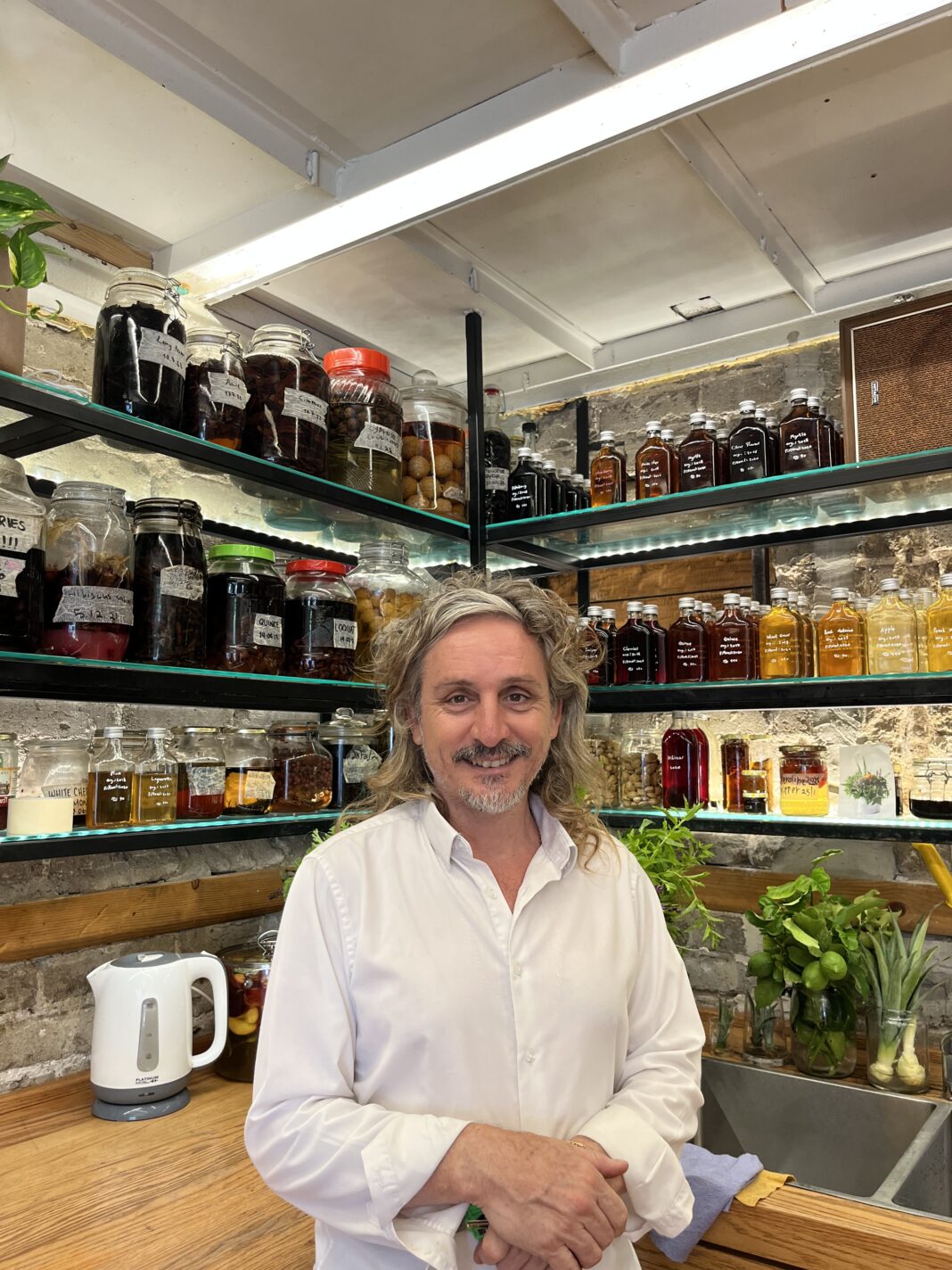
picture of Benny Briga in Cafe Levinsky
Benny Briga: the owner and founder of Cafe Levinsky

A must-try location in the Levinsky Market after Tavlinksy in Tel Aviv is Cafe Levinsky. In the heat of an Israeli summer, this is definitely a place you want to stop at. Ever heard of a gazoz? This is the drink to try at Cafe Levinsky. Ask Benny Briga about it, the founder and owner of Cafe Levinsky.

Benny Briga opened Cafe Levinsky because he loved nature. He loved how nature blooms beautiful and delicious fruits which he recalls plucking off of trees as a kid. Benny wanted to spread the pleasure of nature to others, which led him to open Cafe Levinsky.

After finishing in the military and traveling the world, Benny settled down in Tel Aviv. After exploring the hospitality industry and opening his own restaurant, Benny reevaluated his career and wanted to open a place that allowed him to invest in his childhood delights. He opened the tiny shop and bought a tank of CO2 and began storing all sorts of herbs and flowers in the tiny corner shop in Florentin in Tel Aviv. He began storing all it in jars with sugar water and making gazoz.

picture inside of Cafe Levinsky

What is gazoz?

Gazoz is a bubbly seltzer drink made by the fermentation of fruit. (Like beer, Ethiopian honey bee, wine). The gazoz that Benny sells is non-alcoholic, all-natural, and highly nutritious. Similar to soda, gazoz is refreshing and makes the perfect beverage in the heat of the summer.

Gazoz goes way back was originally invented in Tel Aviv in 1909 and has been a popular beverage ever since. Each gazoz that Benny sells includes macerated fruit, syrup, and some type of herb, depending on the gazoz of your choice. For example, the “Green Almond” gazoz is made of arugula flowers, fresh lemon verbena, lavender, and dried licorice root stick. It is fermented with green almonds and syrup, and topped by seltzer and ice.

Benny made me an apple gazoz, which tasted fresh and sweet. Once you finish your gazoz gives free seltzer refills.

picture of the apple gazoz that I got from Cafe Levinsky
The apple gazoz with sustainably made straw and spoon

Sustainable practices

Cafe Levinsky also practices sustainable measures of service. For starters, the straws are all natural because they are made from apples. You can even eat the straws after you finished your gazoz. In addition, the spoons are made free of plastic. Benny also composts at his farm in Jaffa where they grow all of the ingredients used in the cafe.

A sustainable studio

Benny took me into the studio right around the corner from the shop were the fermentation magic goes down. The beautiful studio is filled with jars filled with all kinds of things, from fruits to herbs.

One of the oldest of which is six years old: the “Quince” is from 2017. A quince is a kind of apple that when cooked becomes pink. Benny thinks it is better the longer something is fermented. Some jars are fermented with sugar and water, while others are fermented with salt and vinegar. He also uses anaerobic fermentation and aerobic fermentation.

Each day, he ferments something new for the gazoz, constantly having new and tasty things for his customers. He also has a wide array of alcohols that are available to buy from the bottle from 5% to 7% alcohol.

picture of Benny's fermentation studio which shows his alcohols in the back
Inside of Benny’s fermentation studio in the Levinsky Market showing the array of alcohols he fermented
Picture of a jar of quince that Benny has been fermenting since 2017
The Quince fermented fruit is the oldest in the studio
Danielle Meyers
Danielle Meyershttp://www.greenprophet.com
Danielle Meyers is an Environmental Science major at the University of Massachusetts Amherst interested in environmental law and policy. She took an interest in studying the environment once she learned about the worsening effects of climate change. Danielle enjoys going on adventures, the beach, shopping, and seeing friends and family. She is reporting from Tel Aviv in the Summer of 2023 to to learn, discover, and inspire change in the community and throughout the Middle East.

Hot this week

How Renewable Energy is Revolutionizing the Way We Power Our World

Solar has become the star of the transition thanks to modular hardware and straightforward installation. It fits dense cities and remote towns alike. Many companies are turning to rooftop arrays and carport systems - and exploring commercial solar installation as a practical way to lock in future savings.

How does one start prepping?

Faced with an extreme winter storm this year, Americans wonder how to be prepared for catastrophe. Miriam has lived through wars in the Middle East - so she's prepared on giving you a guide to prepping.

Fishermen sue tire manufacturers on behalf of the salmon

A federal trial in San Francisco has brought US tire manufacturers, fishing groups, and environmental scientists into court over a chemical most drivers have never heard of — but which scientists say may be silently reshaping aquatic ecosystems.

Listening to Water: Tarek Atoui’s Next Work for Tate Modern

Born in Beirut, Lebanon in 1980 and now living in Paris, Atoui has spent years building instruments that don’t sit comfortably in concert halls. Many of them involve water, glass, and ceramics — materials that react to sound instead of simply producing it.

Leading Through a Dual-Energy Transition: Balancing Decarbonisation with Energy Security

Experience in one area of the energy industry isn't enough to guarantee readiness across all the others. That's where a structured program like an MBA in energy can come in. Today's advanced curricula explore energy economics, finance, policy, and strategic management alongside the technical subjects. And when pursuing an energy MBA online, professionals can skill up and retrain without having to step out of the labor market -- an important perk at a time when skilled professionals are already in short supply.

Topics

How Renewable Energy is Revolutionizing the Way We Power Our World

Solar has become the star of the transition thanks to modular hardware and straightforward installation. It fits dense cities and remote towns alike. Many companies are turning to rooftop arrays and carport systems - and exploring commercial solar installation as a practical way to lock in future savings.

How does one start prepping?

Faced with an extreme winter storm this year, Americans wonder how to be prepared for catastrophe. Miriam has lived through wars in the Middle East - so she's prepared on giving you a guide to prepping.

Fishermen sue tire manufacturers on behalf of the salmon

A federal trial in San Francisco has brought US tire manufacturers, fishing groups, and environmental scientists into court over a chemical most drivers have never heard of — but which scientists say may be silently reshaping aquatic ecosystems.

Listening to Water: Tarek Atoui’s Next Work for Tate Modern

Born in Beirut, Lebanon in 1980 and now living in Paris, Atoui has spent years building instruments that don’t sit comfortably in concert halls. Many of them involve water, glass, and ceramics — materials that react to sound instead of simply producing it.

Leading Through a Dual-Energy Transition: Balancing Decarbonisation with Energy Security

Experience in one area of the energy industry isn't enough to guarantee readiness across all the others. That's where a structured program like an MBA in energy can come in. Today's advanced curricula explore energy economics, finance, policy, and strategic management alongside the technical subjects. And when pursuing an energy MBA online, professionals can skill up and retrain without having to step out of the labor market -- an important perk at a time when skilled professionals are already in short supply.

From Green Energy to Healthy Societies: Why old systems thinking is becoming relevant again

Across the Middle East and North Africa, large investments are being made in green hydrogen, renewable energy, water infrastructure and sustainability. Most of these efforts are discussed in the context of climate change, decarbonization and economic diversification. That framing is important, but it may not capture their full value.

We saw peace – an interreligious encounter deep in our eyes

They came from Israel, Palestine, Jordan, Iraq, Yemen, Morocco, Tunisia, Lebanon, Egypt… There are Sunni Muslims, Shiite Muslims, Jews (Orthodox and Reform), Orthodox Christians, Coptic Christians, Protestant Christians, Druze, Baha'is, a Scientologist.

Can biochar reduce ‘Forever Chemicals’ in food if it’s used in farms?

Biochar is produced by heating organic material in a low-oxygen environment so it does not burn. This process, known as pyrolysis, transforms plant matter into a stable, carbon-rich material.

Related Articles

Popular Categories