
Company A produces millions of plastic cola bottles a day. Water bottles too, and plastic wrap to hold a six-pack of these cola and water bottles together. Company A is told by consumer watchdogs and eco-organizations that enough is enough – the planet can’t hold cheap plastic waste any longer. Landfills can’t carry plastic; plastics are degrading our health and ecosystems badly, and what is consumed in a few minutes lasts hundreds and thousands of years in landfill, or at the bottom of the sea. See flip-flops in the Seychelles.
Company A decides to find a way a great solution and a way to rebrand its bad reputation and goes to companies like McKinsey to help them persuade governments and consumers that plastics aren’t so bad because they are being “recycled, you, know… chemically.” While it sounds good on paper, chemical recycling in plastics, says environmental watchdog group Gaia a terrible idea: “Our position isn’t that one is worse than the other, they’re both equally bad!”
GAIA (or the Global Alliance for Incinerator Alternatives), based in Berkeley says “the Emperor has no clothes: chemical recycling has long been touted by industry as a miracle solution, but when one looks closely these claims simply do not hold up,” says Neil Tangri, Science and Policy Director at GAIA.
“Thanks to the rigorous efforts of the scientific community and thorough investigations by media and environmental groups, the tide is turning.”
Why is chemical recycling so bad?
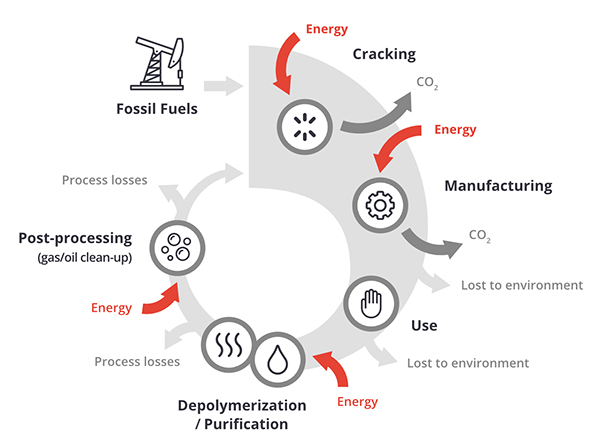
We reached out to GAIA to understand the problem with plastics recycling today in the United States, and the world. Consider that 2 from the 5 worst companies are ExxonMobil and Dow, American companies. And Claire Arkin from GAIA clarifies, “What industry calls ‘chemical recycling’ is largely incineration of plastics, the “recycling” word is misleading,” she says.
Arkin explains to Green Prophet: “The force at play here that is most dangerous is the fact that the plastics industry is ramping up plastic production exponentially in the coming years, which our planet simply cannot support without spiralling into climate catastrophe and exceeding planetary boundaries for toxic chemicals.
“Chemical recycling not only enables further plastic production, but it causes significant climate and toxic emissions.”
Is chemical recycling in plastics worse than producing new plastics? “We are definitely not saying that it’s worse than producing virgin plastic, but that one begets the other– industry is claiming that chemical “recycling” is a silver bullet solution to plastic waste, which enables them to continue with business-as-usual of ramping up plastic production,” Arkin tells Green Prophet.
“For example, the American Chemistry Council says it will invest over $4 billion in “advanced recycling.” Meanwhile, the ACC is also investing over 35 times that–$164 billion– in new infrastructure to make more plastic. It’s a bit of a bait and switch. What the world really needs is a significant decrease in virgin plastic production, not the promotion of these false technologies under the guise of “recycling.”
Why chemical recycling in plastics is so bad
Recent independent investigations have found:
-
Processing 1kg of plastic using chemical “recycling” requires nearly 7x the amount of fossil fuels needed to make a kg of virgin plastic. Read about Exxon’s chemical recycling initiatives here.
-
If a refinery turned waste into a fuel (what most “chemical recycling” facilities actually do) the air emissions would be so toxic that 1 out of 4 people exposed to it over a lifetime could get cancer. And what’s considered “bio” in biofuels is simply not true. It’s plastic.
-
According to US government research, “chemical recycling” requires a significant amount of energy and emits greenhouse gasses and chemicals like benzene.
-
According to Dow Chemical’s very own study, “chemical recycling” caused more climate emissions than landfilling or burning plastic.
-
Shell, Unilever, and Dow Chemical all have documented “chemical recycling” failures.
The top 5 plastics producing companies in the world
| Rank | Polymer Producer | No. of assets | Production of in-scope polymers | Flexible format contribution to SUP waste | Rigid format contribution to SUP waste | Location |
| 1 | ExxonMobil | 55 | 11.2 | 4.7 | 1.2 | Texas, United States |
| 2 | Sinopec | 81 | 11.5 | 4.3 | 1.3 | Nanjing, China |
| 3 | Dow | 54 | 9.3 | 4.7 | 0.9 | Michigan, United States |
| 4 | Indorama Ventures | 26 | 5.1 | 0.2 | 4.5 | Bangkok, Thailand |
| 5 | Saudi Aramco | 56 | 9.5 | 3.2 | 1.1 | Dhahran, Saudi Arabia |
According to the NGO, No Plastic Waste, there are 100 companies producing 90 per cent of all single-use plastic waste generated globally. You can get the whole list here. But who tops the list? America’s ExonMobil, Dow, and China’s Sinopec, Thailand’s Indorama Ventures, and Saudi Arabia’s Saudi Aramco. If your parents or grandparents work for these companies, it’s time to start a conversation.
Of approximately 300 polymer producers operating globally, this small fraction hold the fate of the world’s plastic crisis in their hands. Among these companies located in the region we report on in the Middle East is Saudi Arabia’s Saudi Aramco, one of the world’s richest companies now building NEOM with billions of oil and plastics dollars.

What’s happening globally to stop chemical recycling?
On May 12 an international meeting took place to handle guidelines for plastic waste. The Parties to the Basel Convention adopted most of the text of updated technical guidelines for environmentally-sound plastic waste management. Despite intensive lobbying from the petrochemicals industry in the four years of negotiations to recognize what they call “chemical” or “advanced” “recycling,” as a solution to the plastics crisis, all that was obtained in the guidelines was mostly lip service, reports GAIA.
Advanced chemical recycling, GAIA reiterates, create more hazardous waste and pollution, massive carbon emissions, and enable further exponential plastic production, breaching our planetary boundaries. The petrochemicals industry needs to be told this is nowhere near a silver bullet solution. Business models based on cheap plastics need to adapt. The Basel Convention on the Control of Transboundary Movements of Hazardous Wastes and their Disposal was created to protect against abusive trade and mismanagement of hazardous waste.
Its technical guidelines are intended to assist Parties manage wastes in an environmentally-sound manner, taking all practical steps to protect human health and the environment. Virtually all of the guidelines text on chemical recycling was moved to an appendix after countries failed to find evidence that chemical recycling is environmentally sound.

The updated guidelines also include a new section on prevention, in a much-needed shift from the previous outdated version. “Four years of petrochemical industry lobbying and all they could get was half-baked, flimsy, bracketed, appended and fundamentally non-approved text on so-called ‘chemical recycling’. I say ‘so-called’ because it is really a mismatched bundle of dubious and dirty technologies marketed as a solution to justify continued overproduction of plastics,” says Sirine Rached, GAIA plastics policy coordinator.
“But governments are finally awakening to the reality that these technologies are neither innovative nor safe, and that more toxic and carbon emissions are the last thing we need when it comes to dealing with plastic waste,” she added.
Upcoming UN-endorsed plastics treaty negotiations will take place May 29 to June 2 in Paris, where industry groups like CEFLEX (links to PDF and an industry group representing petrochemical majors like Dow, Chevron, and BASF), and the Plastics Industry Association and the US Chamber of Commerce have all provided written submissions endorsing chemical recycling.
Some governments around the world have even called for an outright ban on “chemical recycling” in the future plastics treaty, as referenced in an official document outlining options for future treaty obligations and control measures, prepared by the United Nations Environment Programme (UNEP) Secretariat ahead of the Paris negotiations.
Gaia notes that “private consulting firms like McKinsey have continued to tout chemical “recycling” in reports [even highlighting opportunities!] provided to Member States to influence their decision-making, and there is reason to believe that such efforts will intensify in upcoming plastics treaty negotiations,” they write.“We’re not out of the woods yet,” said Tangri, “but the fact that chemical ‘recycling’ was relegated to an insignificant bracket in Geneva is a promising start.”
More about GAIA
GAIA is a worldwide alliance of more than 1,000 grassroots groups, non-governmental organizations, and individuals in over 90 countries aiming to catalyze a global shift towards environmental justice by strengthening grassroots social movements that advance solutions to waste and pollution.
They envision a just, zero waste world built on respect for ecological limits and community rights, where people are free from the burden of toxic pollution, and resources are sustainably conserved, not burned or dumped. Consider jumping on board with them if you want to take action locally.
How you can act locally
- Endorse and visit Zero Waste shops that promote the circular economy.
- Avoid buying single use plastics and one-time use plastic products.
- Hold cities and governments responsible for plastic tax.
- Join eco groups and lobby alongside GAIA so the world has a better future.
- Have a talk with mom or dad or a family member who works with a plastics producer