
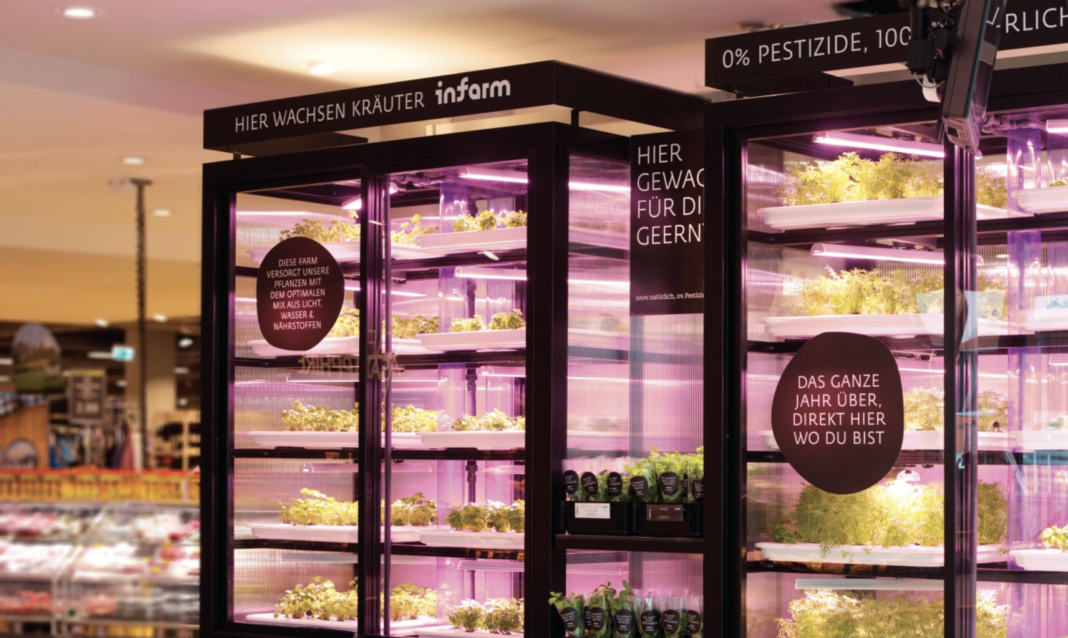
Infarm’s urban farm hydroponics lays of 50% of its team

Infarm team using hydroponics to grow food indoors
The Infarm team

They were the darlings of Europe: an Israeli team planted in Berlin turning the city’s food source from unsustainable to super local. They were building grow chambers in supermarkets for fresh herbs and lettuce and the idea spread like wildfire. Like most and maybe all urban farming projects that rely on hydroponics – growing food in water, with nutrients added, unless you are selling cannabis products (medical marijuana), vertical farming is yet to make much sense beyond education and as a social project. 

I know because I had a venture in this space (using IoT and robotics) for about 5 years and time and time again I heard from urban farm owners how difficult it was to turn a profit. Some also told me that no urban farming container project would ever make money. The amount of labor and energy inputs, not to mention set-up costs were prohibiting profitable businesses. Unless, of course, you were using the grow containers to grow weed, making it VERY profitable. The cost of weed per ounce versus the cost of lettuce? You do the math.

Back to this story: in 2020 with Covid fears for food security abounding, InFarm raised millions ($170 million USD to add “farms” to cities). The startup had farms in about 1,800 retail stores in 11 countries. Well we know they aren’t really farms because real farms have dirt and hard manual labor and manure.

Infarm also raised about $604.5 million from the Qatar Investment AuthorityLightrock and others. Like Amazon, Twitter and Meta, Infarm grew faster than it could sustainably handle.

The penny dropped in a recent letter to employees called “Infarmers”. About 50% of the staff would be let go. Could it be that cash-strapped Europeans are now buying non-organic or less local produce as they look to save money on rising fuel costs? No doubt rising fuel costs in Europe amount to higher costs for a venture that relies on electricity for food.

Infarm hydroponic grow chamber
Infarm builds hydroponics chambers in city centers


Here’s part of the letter the team sent to their staff. It is abridged.

Infarmers: In our current setup, we recognise that Infarm cannot withstand the challenging market conditions, particularly with regards to escalating energy prices and tough financial markets. We have to adapt our ambitious growth targets and increase our efficiencies to make our business profitable, and continue the pursuit of our long-term mission.

The tough reality is that this shift and the reduction of our production sites will have a significant impact on people. Exact numbers are still to be determined, but current proposals mean that over half the workforce (around 500 employees) will leave the company.

Recently, some critical market factors have worsened, these directly affect our industry and our operations. Energy prices have escalated (doubled across Europe), which puts a lot of additional pressure on our business and seriously impacts our cost of production in affected markets. This is in addition to inflation, supply chain disruptions and rising material costs. Economically, this is a difficult period across the globe and many people and businesses are impacted.

What Infarms are working

  • Frankfurt (Germany), Copenhagen (Denmark), and Toronto (Canada) will stay. In these markets, we have established strong retailer relationships and secured contracts of significant volume and can therefore achieve profitability in 2023. In addition, we will open our Growing Centre in Baltimore (Maryland, US) to serve the tri-state area,” the letter states. 
  • We are proposing to downsize our operations in the UK, France and the Netherlands.
  • We will optimise our InStore farming network to key clusters.
  • Further, by prioritising our high-yield industrial scale farming units (ACREs) we will continue to reduce production costs and resource use resulting in better-priced and more sustainable produce for consumers. We have already achieved yields of more than 100 kg/ m2/year for herbs, 150 kg for lettuce and have record breaking harvest performance of more than 95%.
  • We will relocate our modular ACRE farming units to the newly defined core markets.
  • In Japan, we are reviewing our operations.

Urban farming downturn

Infarm is just one of a series of indoor farming companies to announce layoffs and/or shutdowns. Also in November, the Netherlands-based Glowfarms stopped all activities, and the US vertical farm Fifth Season closed shop. The indoor farm robot startup Iron Ox laid off 50% of its staff and Texas’ AppHarvest reported it’s running out of cash. 

Cannabis operations or the growing of high-value nutraceutical crops may save tech greenhouses made for food at least until we have free, sustainable energy. But the move needs to happen fast.

Karin Kloosterman
Karin Kloostermanhttp://www.greenprophet.com
Karin Kloosterman is an award-winning journalist, innovation strategist, and founder of Green Prophet, one of the Middle East’s pioneering sustainability platforms. She has ranked in the Top 10 of Verizon innovation competitions, participated in NASA-linked challenges, and spoken worldwide on climate, food security, and future resilience. With an IoT technology patent, features in Canada’s National Post, and leadership inside teams building next-generation agricultural and planetary systems — including Mars-farming concepts — Karin operates at the intersection of storytelling, science, and systems change. She doesn’t report on the future – she helps design it. Reach out directly to [email protected]

Hot this week

How Renewable Energy is Revolutionizing the Way We Power Our World

Solar has become the star of the transition thanks to modular hardware and straightforward installation. It fits dense cities and remote towns alike. Many companies are turning to rooftop arrays and carport systems - and exploring commercial solar installation as a practical way to lock in future savings.

How does one start prepping?

Faced with an extreme winter storm this year, Americans wonder how to be prepared for catastrophe. Miriam has lived through wars in the Middle East - so she's prepared on giving you a guide to prepping.

Fishermen sue tire manufacturers on behalf of the salmon

A federal trial in San Francisco has brought US tire manufacturers, fishing groups, and environmental scientists into court over a chemical most drivers have never heard of — but which scientists say may be silently reshaping aquatic ecosystems.

Listening to Water: Tarek Atoui’s Next Work for Tate Modern

Born in Beirut, Lebanon in 1980 and now living in Paris, Atoui has spent years building instruments that don’t sit comfortably in concert halls. Many of them involve water, glass, and ceramics — materials that react to sound instead of simply producing it.

Leading Through a Dual-Energy Transition: Balancing Decarbonisation with Energy Security

Experience in one area of the energy industry isn't enough to guarantee readiness across all the others. That's where a structured program like an MBA in energy can come in. Today's advanced curricula explore energy economics, finance, policy, and strategic management alongside the technical subjects. And when pursuing an energy MBA online, professionals can skill up and retrain without having to step out of the labor market -- an important perk at a time when skilled professionals are already in short supply.

Topics

How Renewable Energy is Revolutionizing the Way We Power Our World

Solar has become the star of the transition thanks to modular hardware and straightforward installation. It fits dense cities and remote towns alike. Many companies are turning to rooftop arrays and carport systems - and exploring commercial solar installation as a practical way to lock in future savings.

How does one start prepping?

Faced with an extreme winter storm this year, Americans wonder how to be prepared for catastrophe. Miriam has lived through wars in the Middle East - so she's prepared on giving you a guide to prepping.

Fishermen sue tire manufacturers on behalf of the salmon

A federal trial in San Francisco has brought US tire manufacturers, fishing groups, and environmental scientists into court over a chemical most drivers have never heard of — but which scientists say may be silently reshaping aquatic ecosystems.

Listening to Water: Tarek Atoui’s Next Work for Tate Modern

Born in Beirut, Lebanon in 1980 and now living in Paris, Atoui has spent years building instruments that don’t sit comfortably in concert halls. Many of them involve water, glass, and ceramics — materials that react to sound instead of simply producing it.

Leading Through a Dual-Energy Transition: Balancing Decarbonisation with Energy Security

Experience in one area of the energy industry isn't enough to guarantee readiness across all the others. That's where a structured program like an MBA in energy can come in. Today's advanced curricula explore energy economics, finance, policy, and strategic management alongside the technical subjects. And when pursuing an energy MBA online, professionals can skill up and retrain without having to step out of the labor market -- an important perk at a time when skilled professionals are already in short supply.

From Green Energy to Healthy Societies: Why old systems thinking is becoming relevant again

Across the Middle East and North Africa, large investments are being made in green hydrogen, renewable energy, water infrastructure and sustainability. Most of these efforts are discussed in the context of climate change, decarbonization and economic diversification. That framing is important, but it may not capture their full value.

We saw peace – an interreligious encounter deep in our eyes

They came from Israel, Palestine, Jordan, Iraq, Yemen, Morocco, Tunisia, Lebanon, Egypt… There are Sunni Muslims, Shiite Muslims, Jews (Orthodox and Reform), Orthodox Christians, Coptic Christians, Protestant Christians, Druze, Baha'is, a Scientologist.

Can biochar reduce ‘Forever Chemicals’ in food if it’s used in farms?

Biochar is produced by heating organic material in a low-oxygen environment so it does not burn. This process, known as pyrolysis, transforms plant matter into a stable, carbon-rich material.

Related Articles

Popular Categories