
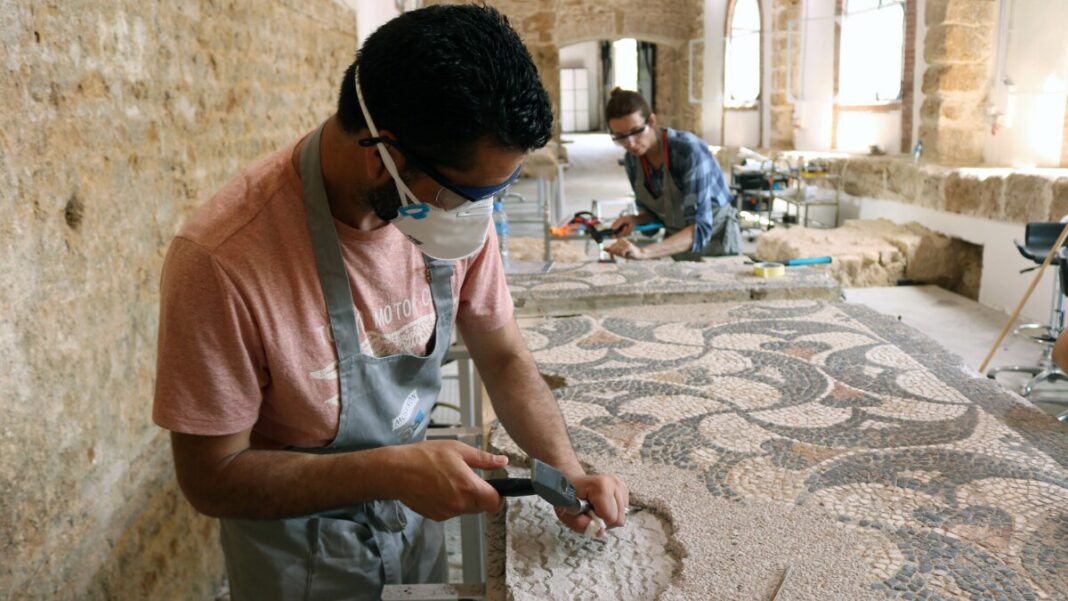
Locals learn to restore mosaics from Bible times

mosaic restoration class
Locals learn to preserve mosaics in the Middle East.

If you live in a place where the ancients roamed, like in the Middle East, it makes sense that a local from Lebanon, Iraq or Jordan will be doing their own mosaic restoration. If you live with the Taliban in Afghanistan it’s too late because your history and future has already been ransacked. But if you are in a place where ancient culture needs to be embraced and protected, you can do this in a mosaic restoration class sponsored by international grants. The classes have been ongoing for a decade and have trained over 200 people the art and craft of mosaic restoration.

Mosaic restoration is sought after speciality because ancient mosaics are uncovered regularly when builders start breaking ground for new development projects.
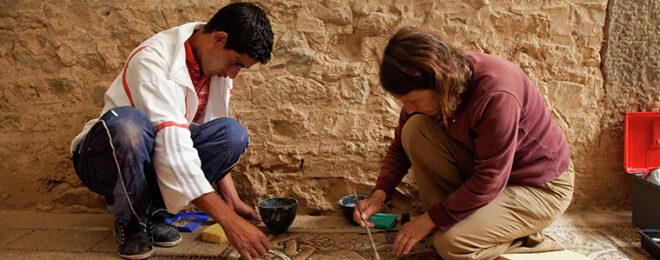
Mosaikon teaches locals restoration
Consultant Livia Alberti and technician Mondher Habachi repair mosaics in Maison de la Chasse, Bulla Regia.

The Getty Conservation Institute (GCI) and the International Centre for the Study of the Preservation and Restoration of Cultural Property (ICCROM) sent Green Prophet a memo that they will hold two advanced training courses in Jordan and Lebanon focused on the conservation of mosaics in the region.

The project is called Mosaikon. One class is currently underway and the next one happens in October. 
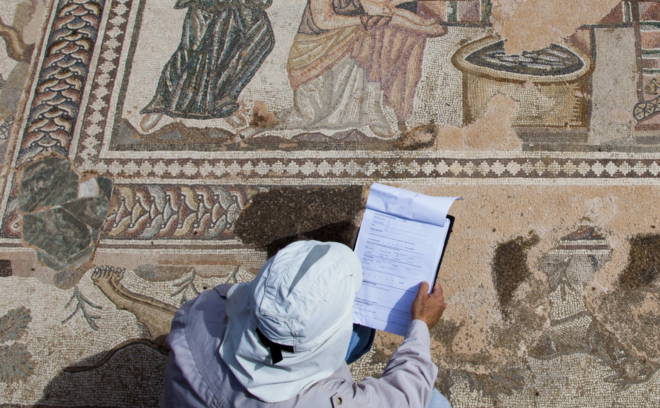
“Mosaikon was created with the principal goal of promoting best practices for mosaic conservation at archaeological sites, museums, and storage facilities throughout the Mediterranean region,” said Jeanne Marie Teutonico, associate director at the GCI.

“After over a decade of courses and field work, the initiative has established an extensive network of dedicated mosaic conservation professionals, all of whom we hope will share the knowledge and skill attained in their trainings to mentor future generations,” she adds.
 
Each course is taught by experts in the field to ensure the highest quality in theoretical and practical training.

These intensive trainings are among the courses of the Mosaikon initiative, a collaboration of the GCI, ICCROM, and the International Committee for the Conservation of Mosaics (ICCM). 

Since 2008, Mosaikon has trained over 200 conservation professionals from countries of the southern and eastern Mediterranean region, all of whom conducted research and model field projects as part of their training.

We spoke with Cole Calhoun, Communications Lead from Getty, to learn a bit more about the focus and scope of the project:

“The geographic focus of Mosaikon has largely been the Mediterranean basin and the program largely centers on countries in the southern and eastern parts of the region, where the conservation needs are the greatest for a variety of reasons including climate change, urban development, and lack of resources,” he tells Green Prophet.

“The goal of Mosaikon is to work with government authorities in each region to ensure the transmission of new knowledge and skills and to build capacity at the national level for the long-term care and conservation of mosaics.

“Mosaikon has been a 14-year project and despite the courses coming to a close, its mission and objects will continue through regional collaboration,” Calhoun assures.

Mosaic training in Jordan

The Department of Antiquities of Jordan will hold a two-week course based in Amman, Jordan that will focus on two strategic and sustainable approaches to conserving archaeological sites: the use of protective shelters and reburial.

Using the archaeological sites of Jerash, Um al Rasas, and Madaba as outdoor classrooms, and taking advantage of the wealth of mosaic heritage in Jordan, course participants will learn these complex techniques that can help achieve more stable environments for fragile historic remains, such as mosaics.
Jordan, mosaic

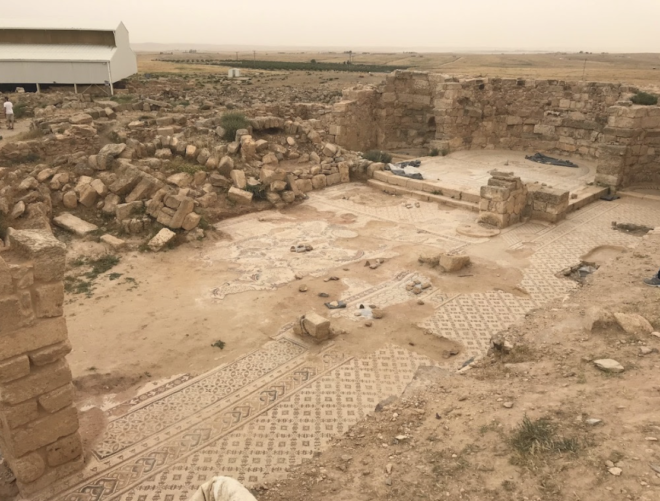
The site of Um-al-Rasas in Jordan, one of the open-air classrooms the course will be using to discuss shelters and reburial, photograph by Leslie Friedman

“Increasing the local expertise of professionals capable of managing and conserving cultural heritage, particularly archaeological sites, is of the utmost importance as we face a multitude of challenges in the field such as rapid urban development, threats from climate change, and simply not enough resources,” said Professor Fadi Bala’wi, the Director General at Department of Antiquities of Jordan.

“This course will help Jordanians and other heritage professionals from the region gain a better understanding of the complexities and opportunities of preventive practices such as sheltering and reburial, which are key to the preservation of our heritage.
mosaikon training getty
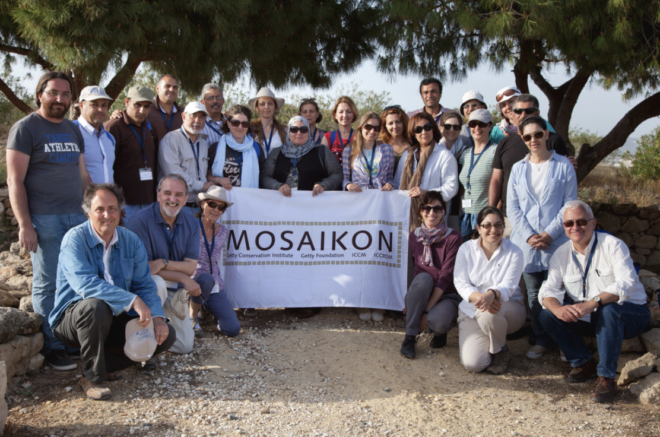
Group photo of participants and staff of a Mosaikon course at the Paphos Archeological Park, Paphos, Cyprus

While the Mosaikon project may be coming to an official end sometime soon, the lessons will be made available online through Getty here for self study. Reach out to them here for any future opportunities.

 

Karin Kloosterman
Karin Kloostermanhttp://www.greenprophet.com
Karin Kloosterman is an award-winning journalist, innovation strategist, and founder of Green Prophet, one of the Middle East’s pioneering sustainability platforms. She has ranked in the Top 10 of Verizon innovation competitions, participated in NASA-linked challenges, and spoken worldwide on climate, food security, and future resilience. With an IoT technology patent, features in Canada’s National Post, and leadership inside teams building next-generation agricultural and planetary systems — including Mars-farming concepts — Karin operates at the intersection of storytelling, science, and systems change. She doesn’t report on the future – she helps design it. Reach out directly to [email protected]

TRENDING

What are AWG air-water generators, and why they aren’t a golden-bullet solution (yet)

Atmospheric water generators (AWGs) sound like magic: machines that can pull drinking water out of air. The idea is mentioned in the Bible, where the elders would pray for water collected as dew on plants and the catch on turning this into a machine is in the physics. To turn invisible vapor into liquid, you must remove heat, especially the latent heat of condensation.

Jordan’s $6 Billion Aqaba–Amman Desalination Project from the Red Sea Moves Forward

In 2025, the Jordanian government signed agreements with a consortium led by Meridiam and SUEZ, alongside VINCI Construction and Orascom Construction. Under a 30-year concession agreement, the consortium will design, build, finance, operate, and maintain the system before transferring it back to the Jordanian government. The total investment is estimated at approximately $6 billion USD.

Earth building with Dead Sea salt bricks

Researchers develop a brick made largely from recycled Dead Sea salt—offering a potential alternative to carbon-intensive cement.

Lebanon reporting fellowship for truth-tellers

Lebanon’s environmental crisis is not abstract. It is shaped by war, neglect, corruption, and silence. Rivers carry untreated sewage and industrial waste into the Mediterranean. Dynamite fishing shatters fragile marine ecosystems along the coast. In many areas, Hezbollah’s military presence and decades of instability have made environmental accountability nearly impossible. What flows into the sea is not only pollution — it is politics, poverty, and unresolved war. And yet, these stories are rarely told with depth, care, or courage. Silat Wassel’s Environmental Justice Journalism Fellowship is opening space for exactly that. They are looking for a few brave souls. 

Slow food market Souk el Tayeb in Lebanon celebrates food and Eid El Barbara

What makes Souk El Tayeb in Lebanon remarkable is not only its insistence on local, seasonal produce, but its belief that dignity and sustainability must go hand in hand. Farmers are paid fairly. Villages are uplifted. Traditional recipes are kept alive not as nostalgia but as knowledge systems: real food is carbon-light, waste-free, and is adapted to the land.

Should You Invest in the Private Market?

startustartup Unlike public stock exchanges, which offer daily trading, strict...

How to build a 100-year-company

Kongō Gumi is a Japanese construction company, purportedly founded in 578 A.D., making it the world's oldest documented company. What can we learn about building sustainable businesses from them?

From Pilot Plant to Global Stage: How Aduro Clean Technologies’ 2026 Expansion Signals a Turning Point for Chemical Recycling Investors Like Yazan Al Homsi

The company's Next Generation Process (NGP) Pilot Plant in London, Ontario, has officially moved into initial operating campaigns, generating the kind of structured, repeatable data that separates laboratory promise from commercial viability.

How AI Helps SaaS Companies Reduce Repetitive Customer Support Work

SaaS products are designed for large numbers of users with different levels of experience, and also in renewable energy.

Pulling Water from the Air

Faced with water shortage in Amman, Laurie digs up...

Turning Your Energy Consultancy into an LLC: 4 Legal Steps for Founders in Texas

If you are starting a renewable energy business in Texas, learn how to start an LLC by the books.

Tracking the Impacts of a Hydroelectric Dam Along the Tigris River

For the next two months, I'll be taking a break from my usual Green Prophet posts to report on a transnational environmental issue: the Ilısu Dam currently under construction in Turkey, and the ways it will transform life along the Tigris River.

6 Payment Processors With the Fastest Onboarding for SMBs

Get your SMB up and running fast with these 6 payment processors. Compare the quickest onboarding options to start accepting customer payments without delay.

Related Articles

Popular Categories