
Muslim shaving: the halal and the haram

Haram and Halal hair removal

One of Green Prophet’s most-read stories ever is our how-to article on sugar-waxing, an ancient method of hair removal that predates waxing. What is it about body hair that makes for riveting reading? Come learn what I’ve picked up about dealing with body hair in the Arab Middle East.

Feedback welcome: I’ve been knocking around the region for four years, happy to hear if I’m presenting “fake news”!

The Hairline Timeline

Humans first started removing hair from men’s faces, most likely for cleanliness, and the first “razors” were rock blades made of flint. Shaving got a boost by Alexander the Great who required his soldiers to be beardless in battle so as to gain an advantage in hand-to-hand combat. Many contemporary militaries still follow this practice.

Egyptians are also credited with inventing sugaring, believed to predate shaving. It’s similar to waxing, but uses a sugar-syrup paste that gets spread onto skin. When the mixture cools, it’s quickly peeled off, yanking hair out at the roots. You can eat the sweet pre-product if you use our recipe.

arab hair removal

Hair removal by “threading” started in India 6,000 years ago using thin cotton thread to wrap and tug hair out in a rapid rolling motion. Called fatlah or khite in Arabic, Middle Eastern men and women both partake as a method to highly define brow shape. Fingers and toes also get plucked as part of the routine regime in most gender-segregated beauty salons.
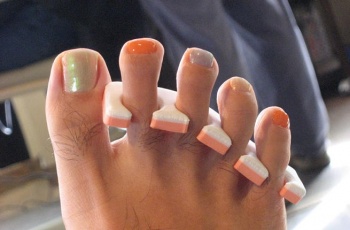
Arab hair removal
Toe plucking time. 

Below-the-chin hairlessness now seems the norm for women, while men tend towards judicious man-scaping. If you’re dealing with a forest of fur (see our lead image), electrolysis may be the answer. Performed by licensed technicians, a needle-like probe is inserted into each individual hair follicle, zaps it with heat or chemicals, and the hair is removed with tweezers. Multiple treatments are needed, but your hair will be history.

To grow a beard or shave?

According to a hadith of Ibn ‘Umar’s (a hadith is a collection of traditions containing sayings of the prophet Muhammad which, with accounts of his daily practice (the Sunna), constitute the major source of guidance for Muslims apart from the Koran), Muslim men are obligated to keep their beards as a means to differentiate them from non-believers, advising men to, “Do the opposite of what the pagans do. Keep the beards and cut the mustaches short.”

But what about all the hipster beards we see today?

beard transplant

Or those that can’t grow can knit one instead. Pattern is here.
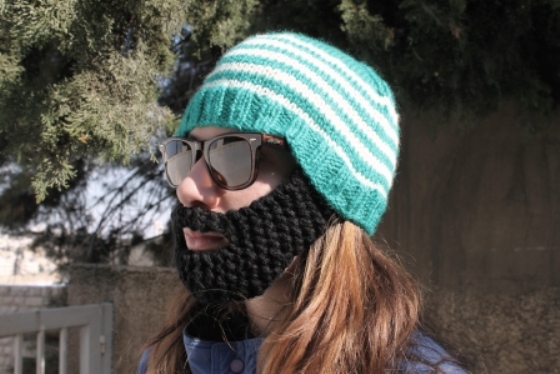
Free Hat Pattern

Most Islamic scholars agree that the mustache should be trimmed to ensure hygienic practice so the hair does not touch the lip, and that beards are kept at an appropriate length, which is generally a fist length.

What About the Hairy Head?

According to Islamic scholars, there are only several kinds of head shaving that are permissible: when performing Hajj, Umrah, shaving a child’s head on the seventh day after birth, when a man converts to Islam, and shaving the head as a remedy for disease.

hair removal Middle East

Pubic Hair and Shaving for Women

Women are not permitted to shave their heads or eyebrows, but everything else is fair game including the pubic region, armpit and forearm hair, and thighs.

When showing the above image to local Arab men in Aqaba, Jordan, they didn’t see the gorgeous face, instead recoiled from the naturally hairy arms!

Curiously, removing a unibrow is permissible as it is not exactly part of the eyebrows. Although in some countries and regions like among Bukharian Jews, a woman is revered for her unibrow.

A unibrow is a sign of beauty in Tajikistan and among Bukaran Jewish culture

It is widely advised for Muslim men and women to remove pubic hair and armpit hair as a way to remain clean; pubic hair is shaved with a razor,  while armpit hair is tweezed (ouch!), but what matters is the removal, and in modern times depilatory substances (even edibles ones like sugar wax!) are permissible.

Make your own sugar wax

In an increasingly challenging sociopolitical and geopolitical climate, the symbols and meanings attached to fatwas are rapidly changing. Which hair removal method you choose and on which part of your body seems less important in comparison to very real and pressing issues the Muslim world is facing.

Curious about a new movement to keep body here? Follow Januhairy.

Bhok Thompson
Bhok Thompsonhttp://www.greenprophet.com
Bhok Thompson is an “eco-tinkerer” who thrives at the intersection of sustainability, business, and cutting-edge technology. With a background in mechanical engineering and a deep fascination with renewable energy, Bhok has dedicated his career to developing innovative solutions that bridge environmental consciousness with profitability. A frequent contributor to Green Prophet, Bhok writes about futuristic green tech, urban sustainability, and the latest trends in eco-friendly startups. His passion for engineering meets his love for business as he mentors young entrepreneurs looking to create scalable, impact-driven companies. Beyond his work, Bhok is an avid collector of vintage mechanical watches, believing they represent an era of precision and craftsmanship that modern technology often overlooks. Reach out: [email protected]

TRENDING

Can Muslims drink kombucha?

Can Muslims drink kombucha even though it may have traces of alcohol?

The Shah’s Harem and the Subtle Grace of the Persian Mustache

Iran's Anis El Doleh was the favorite of the Shah - and wore a mustache considered a sign of beauty, strength and grace

4 Simple Swaps You Can Make to Live a More Eco-Friendly Life

Simple swaps can make a significant difference and pave the way to a greener future. Here are some easy changes you can make for a more eco-friendly lifestyle. 

Making DIY Sugar Wax!

Save money and make yourself sugar wax at home with only three ingredients.

Go to mass in a Cairo, Egypt church built out of a cave

Historically marginalized and evicted from Giza in 1970, a community of Coptic Christians took up residence at the foot of the Mokattam hills in south east Cairo.

Turning Your Energy Consultancy into an LLC: 4 Legal Steps for Founders in Texas

If you are starting a renewable energy business in Texas, learn how to start an LLC by the books.

Tracking the Impacts of a Hydroelectric Dam Along the Tigris River

For the next two months, I'll be taking a break from my usual Green Prophet posts to report on a transnational environmental issue: the Ilısu Dam currently under construction in Turkey, and the ways it will transform life along the Tigris River.

6 Payment Processors With the Fastest Onboarding for SMBs

Get your SMB up and running fast with these 6 payment processors. Compare the quickest onboarding options to start accepting customer payments without delay.

Qatar’s climate hypocrisy rides the London Underground

Qatar remains a master of doublethink—burning gas by the megaton while selling “sustainability” to a world desperate for clean air. Wake up from your slumber people.

How Quality of Hire Shapes Modern Recruitment

A 2024 survey by Deloitte found that 76% of talent leaders now consider long-term retention and workforce contribution among their most important hiring success metrics—far surpassing time-to-fill or cost-per-hire. As the expectations for new hires deepen, companies must also confront the inherent challenges in redefining and accurately measuring hiring quality.

8 Team-Building Exercises to Start the Week Off 

Team building to change the world! The best renewable energy companies are ones that function.

Thank you, LinkedIn — and what your Jobs on the Rise report means for sustainable careers

While “green jobs” aren’t always labeled as such, many of the fastest-growing roles are directly enabling the energy transition, climate resilience, and lower-carbon systems: Number one on their list is Artificial Intelligence engineers. But what does that mean? Vibe coding Claude? 

Somali pirates steal oil tankers

The pirates often stage their heists out of Somalia, a lawless country, with a weak central government that is grappling with a violent Islamist insurgency. Using speedboats that swarm the targets, the machine-gun-toting pirates take control of merchant ships and then hold the vessels, crew and cargo for ransom.

Related Articles

Popular Categories