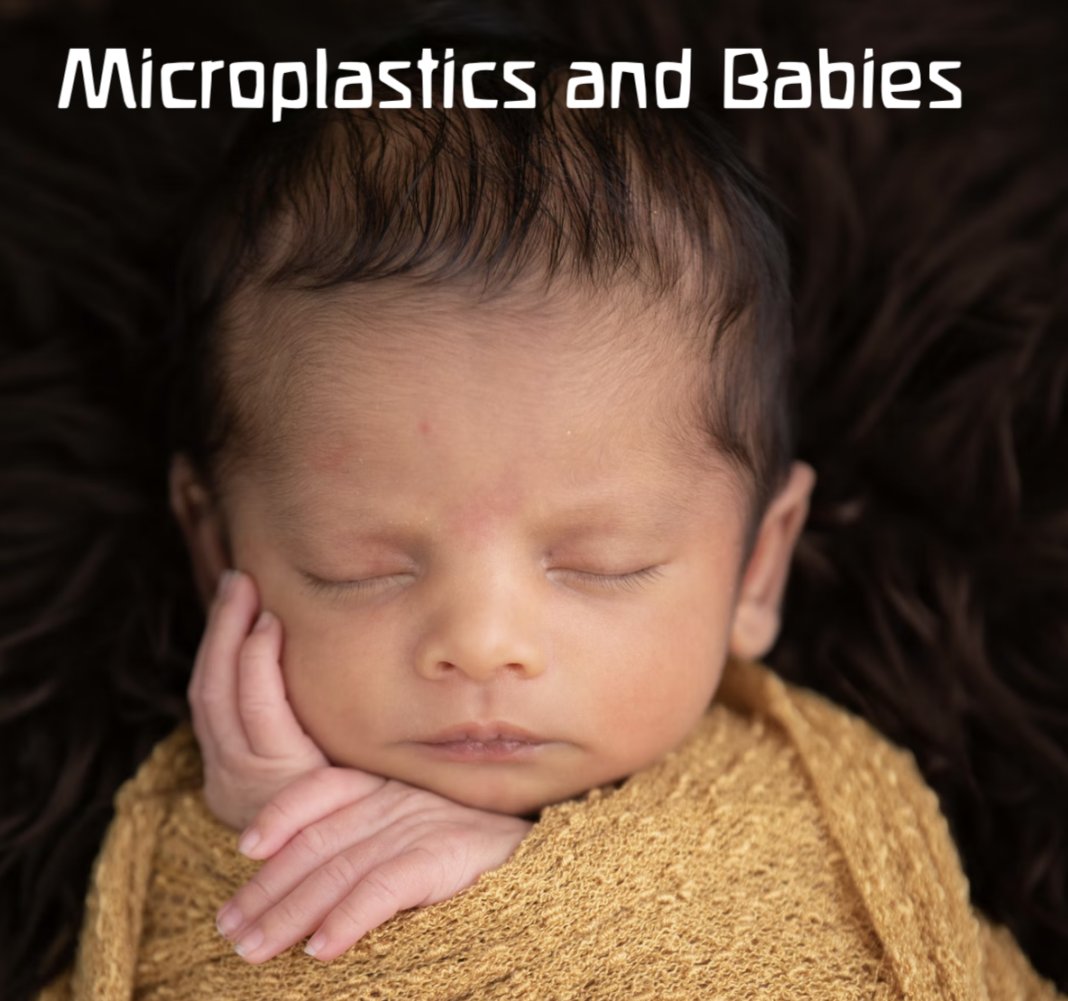
Microplastics found in baby poop

microplastics in babies, baby wrapped in yellow swaddle It started with the plastic Pacific gyre some years ago in the sea. David de Rothschild set sail with a plastic boat, The Plastiki, to document the extent of it all and we interviewed him about it, concerned obviously.

Fast forward and we have Dutchman Boyan Slat trying to clean it all up, and researchers taking stock on how many single flipflops wind up on the shores of paradise on the Seychelles

boyan slat ocean cleanup

But plastics – why should you care if you don’t care about turtles choking? It turns out microplastics are terribly bad for you if you consume them and can amplify the effects of other toxins in the environment by clinging to them, found a recent study out of Israel.

And the amount of microplastics being found in our bodies from drinking out of plastic bottles to eating fish that eat plastic, is frightening. One study has found an alarming amount of microplastics in the poop of babies. How it gets there and what will happen later in life is anyone’s guess – or your new research mission. 

Some of the microplastics were found in meconium, the first stool from a newborn, meaning they came through the mother. Some were found later and it is guessed that it is getting to the babies through teethers, water bottles, and toys. BPA-free? Probably not enough. Read below for more details on the pilot study.

What are microplastics?

Microplastics — tiny plastic pieces less than 5 mm in size — are everywhere, from indoor dust to food to bottled water. So it’s not surprising that scientists have detected these particles in the feces of people and pets. In a small pilot study, researchers reporting in Environmental Science & Technology Letters discovered that infants have higher amounts of one type of microplastic in their stool than adults. Health effects, if any, are uncertain.

Little is known about the magnitude of human exposure to microplastics or their health effects. Although microplastics were once thought to pass harmlessly through the gastrointestinal tract and exit the body, recent studies suggest that the tiniest pieces can cross cell membranes and enter the circulation system.

In cells and laboratory animals, microplastic exposure can cause cell death, inflammation and metabolic disorders. Kurunthachalam Kannan at the New York University School of Medicine and colleagues wanted to assess human exposure to two common microplastics — polyethylene terephthalate (PET) and polycarbonate (PC) — by measuring levels in infant and adult feces.

Microplasics in meconium?!?

The researchers used mass spectrometry to determine the concentrations of PET and PC microplastics in six infant and 10 adult feces samples collected from New York state, as well as in three samples of meconium (a newborn infant’s first stool).

All samples contained at least one type of microplastic. Although average levels of fecal PC microplastics were similar between adults and infants, infant stool contained, on average, more than 10 times higher PET concentrations than that of adults.

plastic soup, boy with plastic heap at sea
Plastic Soup draws an atlas of plastics and where they are accumulating around the world.

Infants could be exposed to higher levels of microplastics through their extensive use of products such as bottles, teethers and toys, the researchers say. However, they note that larger studies are needed to corroborate these findings.


Karin Kloosterman
Karin Kloostermanhttp://www.greenprophet.com
Karin Kloosterman is an award-winning journalist, innovation strategist, and founder of Green Prophet, one of the Middle East’s pioneering sustainability platforms. She has ranked in the Top 10 of Verizon innovation competitions, participated in NASA-linked challenges, and spoken worldwide on climate, food security, and future resilience. With an IoT technology patent, features in Canada’s National Post, and leadership inside teams building next-generation agricultural and planetary systems — including Mars-farming concepts — Karin operates at the intersection of storytelling, science, and systems change. She doesn’t report on the future – she helps design it. Reach out directly to [email protected]

TRENDING

Forever chemicals banned from Europe’s drinking water

The EU is taking a bold step in making sure all European Union member states worked to monitor and reduce PFAS levels in drinking water.

Microplastics Are Becoming Superbug Highways — New Study Warns Beachgoers to Wear Gloves

Prof. Pennie Lindeque added that microplastics “act as carriers for antimicrobial-resistant bacteria, enhancing their survival and spread… each particle becomes a tiny vehicle capable of transporting pathogens from sewage works to beaches, swimming areas and shellfish-growing sites.”

Toxic sea otters and the pollution they collect at sea

When otters become sick or die, entire marine ecosystems begin to unravel. Their contamination is not a side note. It is a warning.

Fine-particle pollution is now directly tied to Lewy body dementia

A new peer-reviewed study in Science connects long-term exposure to fine particulate matter (PM2.5) with higher risk of Lewy body dementia (LBD) in a dataset of 56.5 million US Medicare records, and backs it up with animal experiments that show PM2.5 triggers toxic α-synuclein clumps — the protein aggregates that define LBD. 

Australia Bans Iconic Fish-Shaped Soy Sauce Packs to Tackle Plastic Pollution

In a world-first environmental move, South Australia has enacted...

Turning Your Energy Consultancy into an LLC: 4 Legal Steps for Founders in Texas

If you are starting a renewable energy business in Texas, learn how to start an LLC by the books.

Tracking the Impacts of a Hydroelectric Dam Along the Tigris River

For the next two months, I'll be taking a break from my usual Green Prophet posts to report on a transnational environmental issue: the Ilısu Dam currently under construction in Turkey, and the ways it will transform life along the Tigris River.

6 Payment Processors With the Fastest Onboarding for SMBs

Get your SMB up and running fast with these 6 payment processors. Compare the quickest onboarding options to start accepting customer payments without delay.

Qatar’s climate hypocrisy rides the London Underground

Qatar remains a master of doublethink—burning gas by the megaton while selling “sustainability” to a world desperate for clean air. Wake up from your slumber people.

How Quality of Hire Shapes Modern Recruitment

A 2024 survey by Deloitte found that 76% of talent leaders now consider long-term retention and workforce contribution among their most important hiring success metrics—far surpassing time-to-fill or cost-per-hire. As the expectations for new hires deepen, companies must also confront the inherent challenges in redefining and accurately measuring hiring quality.

8 Team-Building Exercises to Start the Week Off 

Team building to change the world! The best renewable energy companies are ones that function.

Thank you, LinkedIn — and what your Jobs on the Rise report means for sustainable careers

While “green jobs” aren’t always labeled as such, many of the fastest-growing roles are directly enabling the energy transition, climate resilience, and lower-carbon systems: Number one on their list is Artificial Intelligence engineers. But what does that mean? Vibe coding Claude? 

Somali pirates steal oil tankers

The pirates often stage their heists out of Somalia, a lawless country, with a weak central government that is grappling with a violent Islamist insurgency. Using speedboats that swarm the targets, the machine-gun-toting pirates take control of merchant ships and then hold the vessels, crew and cargo for ransom.

Related Articles

Popular Categories