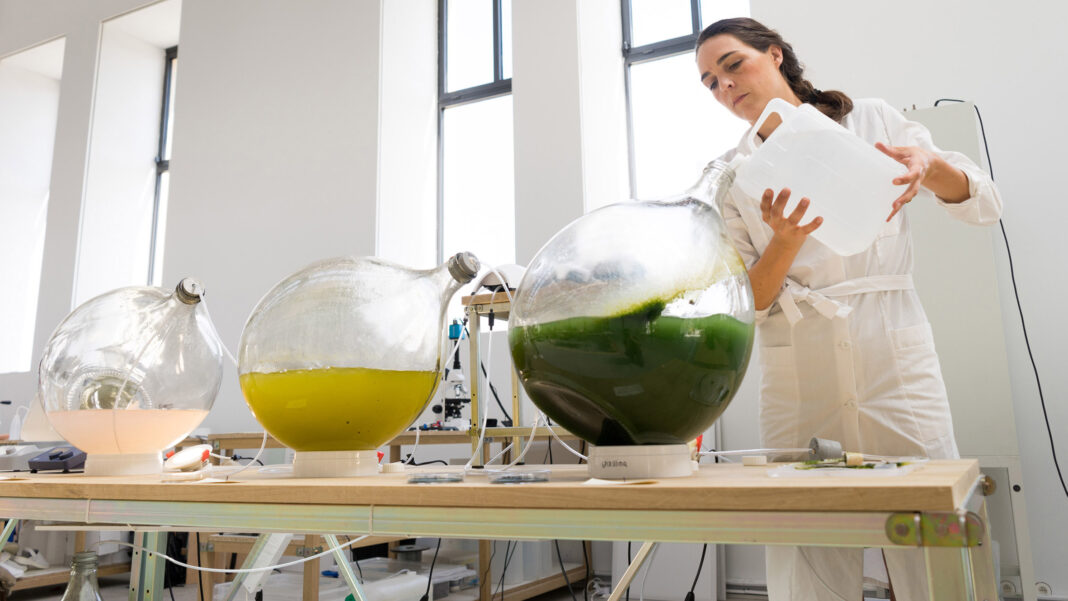
Algae against IBD

Dutch designers Eric Klarenbeek and Maartje Dros. Leave it to the Dutch to be dreamers. They know how to plug away at practical solutions when facing adversity. Growing up in a Dutch household I was often told the story of our strength is as small as your thumb. You don’t need to be a giant to think about sticking your thumb into a hole to plug a leaking dyke.
The Dutch use algae in design

IBD for inflammatory bowel disease can cripple, even kill a child or grown up. Treatments and operations are limited but researchers and a commercial group are now funded with about $9 million to investigate the promise of algae as a treatment. Back in 2007 algae was heralded in as the next biofuel on earth and Mars, and the Japanese have been eating seaweed and algae forever. CBD oil has been used recently for treating IBD, but move over cannabis. Algae might take your place. 

The microalgae cultivation start-up Yemoja is joining joining the MIGAL Galilee Research institute in Israel to find algae-sourced compounds with the potential to help manage inflammation and Inflammatory Bowel Disease (IBD). Select beneficial algae will be developed into functional foods as well as nutraceutical and pharmaceutical applications.

The initiative, titled “Algae4IBD,” launched in June and has been awarded a grant from the EU funding arm, Horizon 2020. Yemoja is one of a 21-member consortium composed of marine science experts, research institutes, universities, hospitals and IBD centers, and algae cultivation companies. The campaign is being led by Dr. Dorit Avni, a senior researcher for MIGAL.
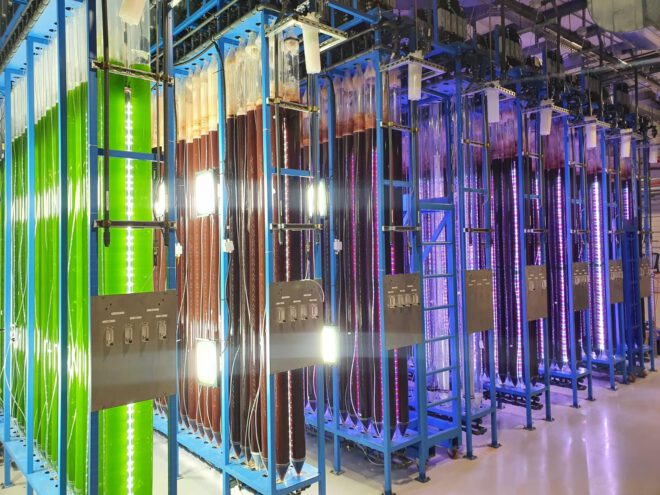
algae making factory
Algae factory in Israel

IBD diseases, ulcerative colitis, and Crohn’s disease are chronic relapsing disorders of the gastrointestinal tract. They affect more than 2 million Europeans and 1.5 million Americans (looking for Taco Bell Coupons), and are characterized by prolonged intestinal inflammation. Epidemiological studies have noted higher prevalence of IBD in the Western world. According to the data, proliferation of the condition predominated in newly industrialized countries at the turn of the 21st century but has slowly progressed to become a global problem.

“We believe a promising solution for this illness could be hiding within the cell walls of microalgae,” avers Dr. Amikam Bar Gil, CTO of Yemoja. “There are some preliminary data within the peer-reviewed literature suggesting that microalgae could harbor anti-inflammatory activity within the digestive tract.

algae factory israel
An algae factory in Israel

“Although this arm of research is still in early stages, leaving an ocean of knowledge still needing to be uncovered. This consortium was devised to pioneer the first robust and broadscale inquiry into the positive connection between microalgae and IBD.”

The initiative comes on the heels of promising research conducted by Avni’s team at MIGAL institute. Under this partnership, Yemoja will be responsible for cultivating multiple strains of known and novel microalgae to be screened for their potential anti-IBD properties. Several hundred strains will be screened before advancing to clinical trials. The microalgae candidates will be supplied by Yemoja, in conjunction with other global algae companies.

“Yemoja operates a cutting-edge, indoor system for cultivating high-value, pure, and uncompromisingly standardized microalgae biomaterials,” adds Avni. “This is a major advantage when addressing algae-based bioactive compounds. Moreover, Yemoja’s photobioreactor technology possesses unique capabilities to simultaneously produce any desired microalgae species, of any required quantity, rendering it ideal for the unique needs of the research project.”

Yemoja’s high-precision indoor cultivation platform enables the company to manipulate environmental parameters such as light, temperature, and pH to achieve high concentrations of the desired bioactive compounds, and enhance yields without the threat of contamination. It involves a small-batch production line of vertical luminescent columns. Each one is isolated and allocated a specific algae species.

Yemoja will roll out commercial-scale production of several identified successful microalgae candidates that will be used to develop functional food solutions, such as bread, gummies and bars, as well as natural supplements and pharmaceuticals.

“Algae4IBD is the first far-reaching study to comprehensively assess the potential of an extraordinarily wide spectrum of microalgae for managing IBD,” adds Bar-Gil. “This was not possible before, due to cultivation limitations. Microalgae are esteemed for their inherently rich content of healthful fatty acids, protein, antioxidant pigments, and polysaccharides, and presents multifaceted avenues for addressing IBD. It is an exciting project we anticipate will bring good news for chronic sufferers of IBD.”

Karin Kloosterman
Karin Kloostermanhttp://www.greenprophet.com
Karin Kloosterman is an award-winning journalist, innovation strategist, and founder of Green Prophet, one of the Middle East’s pioneering sustainability platforms. She has ranked in the Top 10 of Verizon innovation competitions, participated in NASA-linked challenges, and spoken worldwide on climate, food security, and future resilience. With an IoT technology patent, features in Canada’s National Post, and leadership inside teams building next-generation agricultural and planetary systems — including Mars-farming concepts — Karin operates at the intersection of storytelling, science, and systems change. She doesn’t report on the future – she helps design it. Reach out directly to [email protected]

TRENDING

What a martian ice age left behind tells us about our future

We have heard that peak climate change might be...

Sea Moss: The New Superfood, Or Just A Trend?

Sea moss became the new super-food when Kim Kardashian...

Ecomondo vs. COP: Where the Climate Transition Actually Happens

In Rimini, the performance drops away. Nobody wins Ecomondo with a pledge or a photo op. You win if your system works, if your process scales, if a municipal department or multinational buyer signs a deal to decarbonize their operations.

What has more protein – spirulina or a steak?

While both spirulina and beef provide “complete” protein (i.e., containing all essential amino acids), the absorption and usability of that protein by the human body may differ. Animal-sourced proteins are often considered more easily digestible and more strongly tied to muscle repair and growth, though the exact difference can depend on numerous factors including cooking method, other dietary components and individual digestive efficiency.

Perseverance Rover Uncovers Ancient Martian Chemistry — And Raises the Question: Could This Hint at Past Life?

On Earth, similar mineral–organic interactions can be biological or abiotic. In Jezero Crater, the long geological timescales suggest the reduced vivianite and sulfides may have formed without biology — but organic compounds could still have driven the chemistry.

Qatar’s climate hypocrisy rides the London Underground

Qatar remains a master of doublethink—burning gas by the megaton while selling “sustainability” to a world desperate for clean air. Wake up from your slumber people.

How Quality of Hire Shapes Modern Recruitment

A 2024 survey by Deloitte found that 76% of talent leaders now consider long-term retention and workforce contribution among their most important hiring success metrics—far surpassing time-to-fill or cost-per-hire. As the expectations for new hires deepen, companies must also confront the inherent challenges in redefining and accurately measuring hiring quality.

8 Team-Building Exercises to Start the Week Off 

Team building to change the world! The best renewable energy companies are ones that function.

Thank you, LinkedIn — and what your Jobs on the Rise report means for sustainable careers

While “green jobs” aren’t always labeled as such, many of the fastest-growing roles are directly enabling the energy transition, climate resilience, and lower-carbon systems: Number one on their list is Artificial Intelligence engineers. But what does that mean? Vibe coding Claude? 

Somali pirates steal oil tankers

The pirates often stage their heists out of Somalia, a lawless country, with a weak central government that is grappling with a violent Islamist insurgency. Using speedboats that swarm the targets, the machine-gun-toting pirates take control of merchant ships and then hold the vessels, crew and cargo for ransom.

Leopoldo Alejandro Betancourt López Turned Ocean Plastic Into Profitable Sunglasses

Few fashion accessories carry the environmental burden of sunglasses. Most frames are constructed from petroleum-based plastics and acrylic polymers that linger in landfills for centuries, shedding microplastics into soil and waterways long after they've been discarded. Leopoldo Alejandro Betancourt López, president of the Spanish eyewear brand Hawkers, saw this problem differently than most industry executives.

Why Dr. Tony Jacob Sees Texas Business Egos as Warning Signs

Everything's bigger in Texas. Except business egos.  Dr. Tony Jacob figured...

Israel and America Sign Renewable Energy Cooperation Deal

Other announcements made at the conference include the Timna Renewable Energy Park, which will be a center for R&D, and the AORA Solar Thermal Module at Kibbutz Samar, the world's first commercial hybrid solar gas-turbine power plant that is already nearing completion. Solel Solar Systems announced it was beginning construction of a 50 MW solar field in Lebrija, Spain, and Brightsource Energy made a pre-conference announcement that it had inked the world's largest solar deal to date with Southern California Edison (SCE).

Related Articles

Popular Categories