Three bacterial strains discovered on space station may help grow plants on Mars

eddy flux biodome grow food on mars
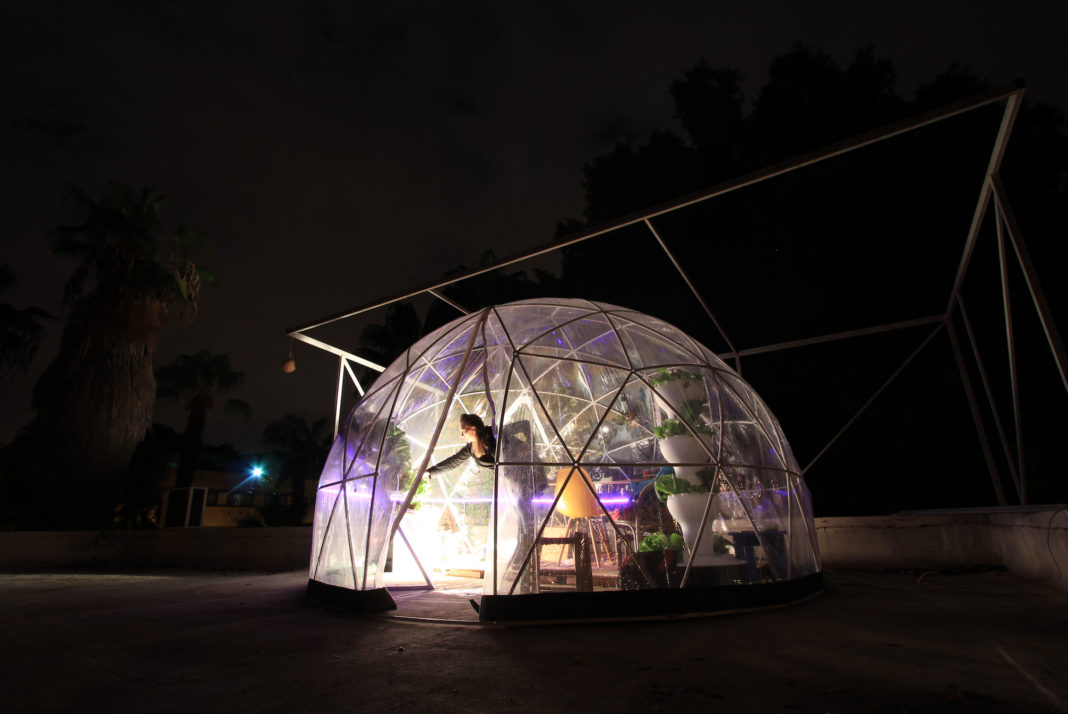
Artificial Intelligence is used by Karin Kloosterman in this biodome to grow bio-organic food with zero waste. Hydroponics and growing food this way might be the only chance for colonizers of Mars. 

In order to withstand the rigors of space on deep-space missions, food grown outside of Earth needs a little extra help from bacteria. Now, a recent discovery aboard the International Space Station (ISS) has researchers may help create the ‘fuel’ to help plants withstand such stressful situations.

Publishing their findings to Frontiers in Microbiology, researchers working with NASA described the discovery and isolation of 4 strains of bacteria belonging to the family Methylobacteriaceae from different locations aboard the ISS across two consecutive flights.

While 1 strain was identified as Methylorubrum rhodesianum, the other 3 were previously undiscovered and belong to a novel species novel. The rod-shaped, motile bacteria were given the designations IF7SW-B2T, IIF1SW-B5, and IIF4SW-B5 with genetic analysis showing them to be closely related to Methylobacterium indicum.

Methylobacterium species are involved in nitrogen fixation, phosphate solubilization, abiotic stress tolerance, plant growth promotion and biocontrol activity against plant pathogens.

Potential for Mars missions

Now, in honor of the renowned Indian biodiversity scientists Dr Ajmal Khan, the team has proposed to call the novel species Methylobacterium ajmalii.

Commenting on the discovery, Dr Kasthuri Venkateswaran (Venkat) and Dr Nitin Kumar Singh of NASA’s Jet Propulsion Laboratory, (JPL), says that the strains might possess ” biotechnologically useful genetic determinants” for the growing of crops in space.

However, further experimental biology is needed to prove that it is, indeed, a potential game-changer for space farming.

“To grow plants in extreme places where resources are minimal, isolation of novel microbes that help to promote plant growth under stressful conditions is essential,” they said.

Along with JPL, other researchers collaborating on this discovery are based at the University of Southern California, Los Angeles; Cornell University and the University of Hyderabad in India.

With NASA one day looking to take humans to the surface of Mars – and potentially beyond – the US National Research Council Decadal Survey recommends that the space agency use the ISS as a “test-bed for surveying microorganisms”, according to Venkat and Singh.

“Since our group possess expertise in cultivating microorganisms from extreme niches, we have been tasked by the NASA Space Biology Program to survey the ISS for the presence and persistence of the microorganisms,” they add.

“Needless to say, the ISS is a cleanly-maintained extreme environment. Crew safety is the number 1 priority and hence understanding human/plant pathogens are important, but beneficial microbes like this novel Methylobacterium ajmalii are also needed.”

Expanding the ISS lab

As part of an ongoing surveillance mission, 8 locations on the ISS are being monitored for bacterial growths and have been for the last 6 years. These sample areas include where the crew assembles or where experiments are conducted, such as the plant growth chamber.

While hundreds of bacterial samples from the ISS have been analyzed to date, approximately 1,000 samples have been collected from various other locations on the space station but are awaiting a trip back to Earth where they can be examined.

According to Venkat and Singh, the eventual goal is to bypass this lengthy process and potentially find new novel strains using molecular biology equipment developed and demonstrated for the ISS.

“Instead of bringing samples back to Earth for analyses, we need an integrated microbial monitoring system that collect, process, and analyze samples in space using molecular technologies,” Venkat and Singh said.

“This miniaturized ‘omics in space’ technology – a biosensor development – will help NASA and other space-faring nations achieve safe and sustainable space exploration for long periods of time.”

Bhok Thompson
Bhok Thompsonhttp://www.greenprophet.com
Bhok Thompson is an “eco-tinkerer” who thrives at the intersection of sustainability, business, and cutting-edge technology. With a background in mechanical engineering and a deep fascination with renewable energy, Bhok has dedicated his career to developing innovative solutions that bridge environmental consciousness with profitability. A frequent contributor to Green Prophet, Bhok writes about futuristic green tech, urban sustainability, and the latest trends in eco-friendly startups. His passion for engineering meets his love for business as he mentors young entrepreneurs looking to create scalable, impact-driven companies. Beyond his work, Bhok is an avid collector of vintage mechanical watches, believing they represent an era of precision and craftsmanship that modern technology often overlooks. Reach out: [email protected]

LEAVE A REPLY

Please enter your comment!
Please enter your name here

TRENDING

What a martian ice age left behind tells us about our future

We have heard that peak climate change might be...

Perseverance Rover Uncovers Ancient Martian Chemistry — And Raises the Question: Could This Hint at Past Life?

On Earth, similar mineral–organic interactions can be biological or abiotic. In Jezero Crater, the long geological timescales suggest the reduced vivianite and sulfides may have formed without biology — but organic compounds could still have driven the chemistry.

EU’s CAP reform continues trend of supporting small farmers in hour of need

Despite mounting political opposition, growing scientific criticism and even the retreat of many former industrial supporters like Nestlé and Danone, certain member-states and supermarket chains continue to prop up Nutri-Score. The Commission must therefore remain vigilant to ensure these attempts do not undermine farmers, distort fair competition or compromise the integrity of the single market – particularly as other pressing threats loom on the horizon.

Space travel sunscreen found in new fungus experiment

Moving to Mars? He's a new fungus-based sunscreen to...

Why Is the Martian Night Sky So Bright? New NASA Video Sheds Light on the Red Planet’s Glow

Another factor is sunlight scattering at high altitudes. Even though the Sun sets on Mars just as it does on Earth, light continues to scatter off the high-altitude dust, keeping the sky bright for hours. This is why astronauts may one day be able to navigate or work during the “night” without artificial lighting—at least in the early evening.

Qatar’s climate hypocrisy rides the London Underground

Qatar remains a master of doublethink—burning gas by the megaton while selling “sustainability” to a world desperate for clean air. Wake up from your slumber people.

How Quality of Hire Shapes Modern Recruitment

A 2024 survey by Deloitte found that 76% of talent leaders now consider long-term retention and workforce contribution among their most important hiring success metrics—far surpassing time-to-fill or cost-per-hire. As the expectations for new hires deepen, companies must also confront the inherent challenges in redefining and accurately measuring hiring quality.

8 Team-Building Exercises to Start the Week Off 

Team building to change the world! The best renewable energy companies are ones that function.

Thank you, LinkedIn — and what your Jobs on the Rise report means for sustainable careers

While “green jobs” aren’t always labeled as such, many of the fastest-growing roles are directly enabling the energy transition, climate resilience, and lower-carbon systems: Number one on their list is Artificial Intelligence engineers. But what does that mean? Vibe coding Claude? 

Somali pirates steal oil tankers

The pirates often stage their heists out of Somalia, a lawless country, with a weak central government that is grappling with a violent Islamist insurgency. Using speedboats that swarm the targets, the machine-gun-toting pirates take control of merchant ships and then hold the vessels, crew and cargo for ransom.

Leopoldo Alejandro Betancourt López Turned Ocean Plastic Into Profitable Sunglasses

Few fashion accessories carry the environmental burden of sunglasses. Most frames are constructed from petroleum-based plastics and acrylic polymers that linger in landfills for centuries, shedding microplastics into soil and waterways long after they've been discarded. Leopoldo Alejandro Betancourt López, president of the Spanish eyewear brand Hawkers, saw this problem differently than most industry executives.

Why Dr. Tony Jacob Sees Texas Business Egos as Warning Signs

Everything's bigger in Texas. Except business egos.  Dr. Tony Jacob figured...

Israel and America Sign Renewable Energy Cooperation Deal

Other announcements made at the conference include the Timna Renewable Energy Park, which will be a center for R&D, and the AORA Solar Thermal Module at Kibbutz Samar, the world's first commercial hybrid solar gas-turbine power plant that is already nearing completion. Solel Solar Systems announced it was beginning construction of a 50 MW solar field in Lebrija, Spain, and Brightsource Energy made a pre-conference announcement that it had inked the world's largest solar deal to date with Southern California Edison (SCE).

Related Articles

Popular Categories