Israel’s boring company maps 90 miles of underground trains

Israel boring company, with chinese contractors

Get stuck in an Israeli gridlock and you feel like you are better off in LA. The fast lane doesn’t really work. Traffic in the Mediterranean sun makes people nervous, especially when it can take you an hour to drive 3 miles. There is no wonder the dangerous but fast electric mopeds and bikes have taken the city by storm. With little oversight and supervision, kids bones are getting broken and grannies overturned as the merciless young cyclists overtake the citizens of Jaffa and Tel Aviv, day by day by day.

The idea of an Israeli subway system always seemed perilous in the height of terror attacks in Tel Aviv and Jerusalem. A bus with 20 or 50 people blowing up isn’t tolerable, but a mass transit system with an expected 2 million passengers per day, about 1/4 of the country’s population? That’s what’s being planned for Israel. We imagine the terrorist threat is either under control, or we’ve got bigger fish to fry.

The Greater Tel Aviv Metro M2 line was presented earlier this spring in Israel amidst the corona crisis. This line will be about 15 miles long and will connect the suburban cities of Petah Tikva to Holon, with Tel Aviv and Jaffa in the middle.

The overdue project is being implemented by government company NTA – Metropolitan Mass Transit Ltd. About 90 miles of subway is being planned for the country. Consider the size of Israel – about the same size as New Jersey. A nation-wide subway system wouldn’t be thought impossible.

The central M2 line will have 22 stations and among other locations will serve Bar-Ilan University, Bloomfield Stadium in Jaffa, the Carmel Market in Tel Aviv, Habimah Theater and Wolfson Hospital.

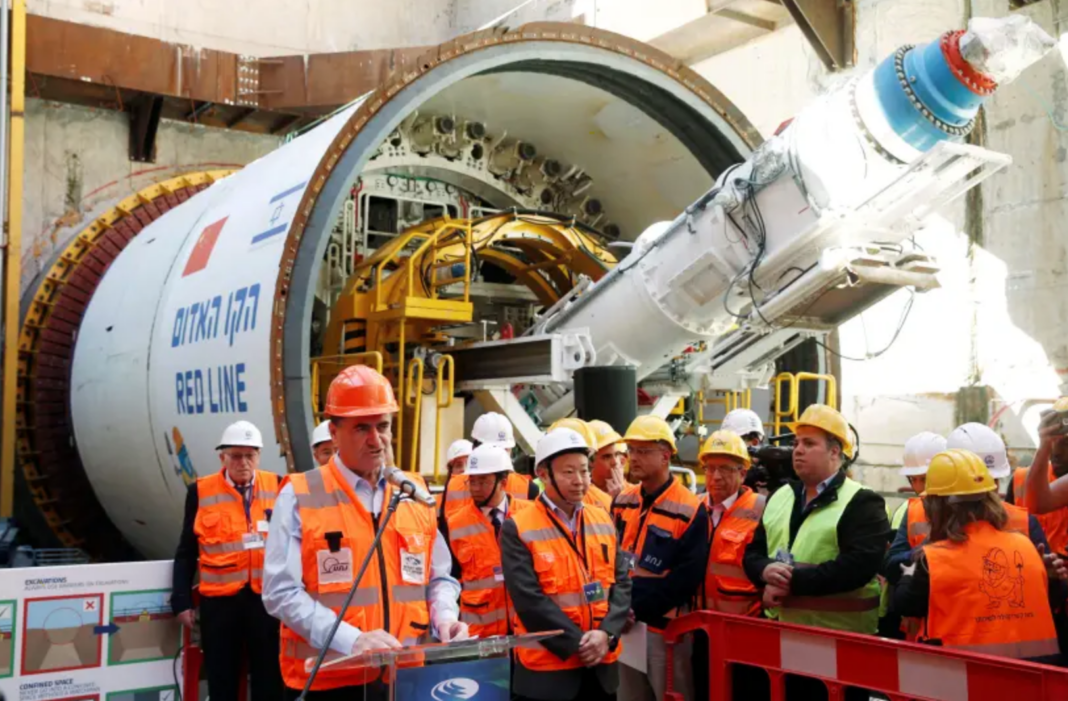
Like Elon Musk touted in California with the announcement of his Boring Company if you can’t go over traffic, you might as well tunnel below it. The Israeli system won’t be tunnels for your cars, but rather an underground train system like in New York City. Tunnel boring machines are expected to dig as much as 10 meters per day (about 11 yards) which will be about  25-40 meters or yards underground, with a diameter of 7 yards. This new subway or underground train will complement the light rail train currently being built throughout Tel Aviv and Jaffa.

Avoid a transport system collapse

With the income levels of people rising and the need to commute to work to cities like Herzliya, citizens demand a better way to get around, especially from inside the city. We also expect tourism, post covid-19 will want to enjoy a good public system.

Tel Aviv traffic
Tel Aviv traffic. Always add a half hour, just in case.

To get to another city like Jerusalem from inside Tel Aviv, expect your journey to last at least a few hours or more once there. While major transport hubs exist and are okay (actually rather loathsome and confusing), getting there is a challenge and getting to your destination – the last mile – is impossible especially in cities like Jerusalem where the bus system is complex and hard to navigate.

I used to take the train from Tel Aviv to Jerusalem years ago to get dropped off in a far away suburb that buses don’t pass through. You needed a car to take the train! Things have been improved since the creation of a new Tel Aviv to Jerusalem line.

The point of the subway system, the project builders argue, is to make cars extraneous, explained Gilad Zwebner, VP Planning and Design of NTA – Metropolitan Mass Transit Ltd., the government company implementing the metro system. Zwebner has said that 90% of traffic in the Tel Aviv Metropolitan area is from private vehicles.

“A system based on a metro could bring us to 40% usage of vehicular traffic. According to all the scenarios that were considered, without a metro, there would be a complete collapse of the transport system,” said Sharav.

One more question: will it run on solar or renewable energy? Please say yes. Israel needs to increase its commitment to solar energy. Read here.


Karin Kloosterman
Karin Kloostermanhttp://www.greenprophet.com
Karin Kloosterman is an award-winning journalist, innovation strategist, and founder of Green Prophet, one of the Middle East’s pioneering sustainability platforms. She has ranked in the Top 10 of Verizon innovation competitions, participated in NASA-linked challenges, and spoken worldwide on climate, food security, and future resilience. With an IoT technology patent, features in Canada’s National Post, and leadership inside teams building next-generation agricultural and planetary systems — including Mars-farming concepts — Karin operates at the intersection of storytelling, science, and systems change. She doesn’t report on the future – she helps design it. Reach out directly to [email protected]

LEAVE A REPLY

Please enter your comment!
Please enter your name here

TRENDING

Earth building with Dead Sea salt bricks

Researchers develop a brick made largely from recycled Dead Sea salt—offering a potential alternative to carbon-intensive cement.

Farm To Table Israel Connects People To The Land

Farm To Table Israel is transforming the traditional dining experience into a hands-on journey.

Plant trees in cities, for your heart

It seems like a no-brainer, but sometimes you need to give evidence to city councillors: A new multi-institutional study led by UC Davis Health suggests that not all green space is created equal. Living in urban neighborhoods with more visible trees is associated with a 4% lower incidence of cardiovascular disease, while areas dominated by grass or low shrubs may be linked to higher cardiovascular risk.

Remilk makes cloned milk so cows don’t need to suffer and it’s hormone-free

This week, Israel’s precision-fermentation milk from Remilk is finally appearing on supermarket shelves. Staff members have been posting photos in Hebrew, smiling, tasting, and clearly enjoying the moment — not because it’s science fiction, but because it tastes like the real thing.

An Army of Healers Wins the 2025 IIE Goldberg Prize for Peace in the Middle East

In a region more accustomed to headlines of loss than of listening, the Institute of International Education (IIE) has chosen to honor something quietly radical: healing. The 2025 Victor J. Goldberg Prize for Peace in the Middle East has been awarded to Nitsan Joy Gordon and Jawdat Lajon Kasab, the co-founders of the Army of Healers, for building spaces where Israelis and Palestinians — Jews, Muslims, Christians, Druze, and Bedouins — can grieve, speak, and rebuild trust together.

Qatar’s climate hypocrisy rides the London Underground

Qatar remains a master of doublethink—burning gas by the megaton while selling “sustainability” to a world desperate for clean air. Wake up from your slumber people.

How Quality of Hire Shapes Modern Recruitment

A 2024 survey by Deloitte found that 76% of talent leaders now consider long-term retention and workforce contribution among their most important hiring success metrics—far surpassing time-to-fill or cost-per-hire. As the expectations for new hires deepen, companies must also confront the inherent challenges in redefining and accurately measuring hiring quality.

8 Team-Building Exercises to Start the Week Off 

Team building to change the world! The best renewable energy companies are ones that function.

Thank you, LinkedIn — and what your Jobs on the Rise report means for sustainable careers

While “green jobs” aren’t always labeled as such, many of the fastest-growing roles are directly enabling the energy transition, climate resilience, and lower-carbon systems: Number one on their list is Artificial Intelligence engineers. But what does that mean? Vibe coding Claude? 

Somali pirates steal oil tankers

The pirates often stage their heists out of Somalia, a lawless country, with a weak central government that is grappling with a violent Islamist insurgency. Using speedboats that swarm the targets, the machine-gun-toting pirates take control of merchant ships and then hold the vessels, crew and cargo for ransom.

Leopoldo Alejandro Betancourt López Turned Ocean Plastic Into Profitable Sunglasses

Few fashion accessories carry the environmental burden of sunglasses. Most frames are constructed from petroleum-based plastics and acrylic polymers that linger in landfills for centuries, shedding microplastics into soil and waterways long after they've been discarded. Leopoldo Alejandro Betancourt López, president of the Spanish eyewear brand Hawkers, saw this problem differently than most industry executives.

Why Dr. Tony Jacob Sees Texas Business Egos as Warning Signs

Everything's bigger in Texas. Except business egos.  Dr. Tony Jacob figured...

Israel and America Sign Renewable Energy Cooperation Deal

Other announcements made at the conference include the Timna Renewable Energy Park, which will be a center for R&D, and the AORA Solar Thermal Module at Kibbutz Samar, the world's first commercial hybrid solar gas-turbine power plant that is already nearing completion. Solel Solar Systems announced it was beginning construction of a 50 MW solar field in Lebrija, Spain, and Brightsource Energy made a pre-conference announcement that it had inked the world's largest solar deal to date with Southern California Edison (SCE).

Related Articles

Popular Categories