
For the first time in history, researchers at Tel Aviv University tracked fruit bats from birth to maturity, in an attempt to understand how they navigate when flying long distances. The surprising results: Fruit bats, just like humans, build a visual cognitive map of the space around them, making use of conspicuous landmarks. They can remember the most iconic buildings in the world, the Leaning Tower of Pisa, the Burj Khalifa, the CN Tower and even the Empire State Building.
The Israeli bat pups from Tel Aviv University came to know Tel Aviv by looking for large unique structures such as the Azrieli Towers ot the Dizengoff Center. The groundbreaking study was conducted by Prof. Yossi Yovel at the Department of Zoology. The paper was published in July 2020 as the cover story of the prestigious Science magazine.
“How animals are able to navigate over long distances is an ancient riddle,” explains Prof. Yovel. “Bats are considered world champions of navigation: they fly dozens of kilometers in just a few hours, and then come back to the starting point. For this study we used tiny GPS devices – the smallest in the world, developed by our team, in an experiment never attempted before: tracking bat pups from the moment they spread their wings until they reach maturity, in order to understand how their navigation capabilities develop.
Such a study was done in 2011 in southern Israel and we reported on it here.
The researchers in the new study monitored 22 fruit bat pups born in a colony raised at TAU – from infancy to maturity, tracking them as they scoured the city for food. The results show that Tel Aviv bats navigate the space around them in much the same way as the city’s human inhabitants.
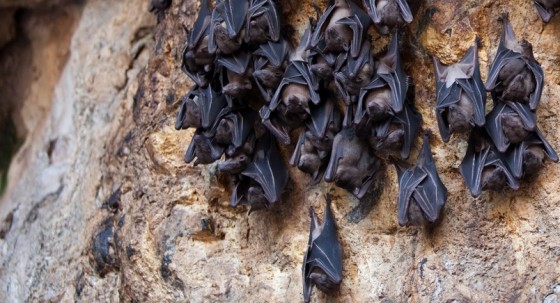
“Bats use their sonar to navigate over short distances – near a tree, for example,” says Prof. Yovel. “The sonar doesn’t work for greater distances. For this, fruit-bats use their vision. Altogether we mapped about 2000 bat flight-nights in Tel Aviv.
“We found that bats construct a mental map: They learn to identify and use salient visual landmarks such as the Azrieli Towers, the Reading Power Station and other distinct features that serve as visual indicators. The most distinct proof of this map lies in their ability to perform shortcuts. Like humans, bats at some stage get from one point to another via direct new routes not previously taken.
“Since we knew the flight history of each bat since infancy, we could always tell when a specific bat took a certain shortcut for the first time. We discovered that when taking new, unknown routes the bats flew above the buildings. Sending up drones to the altitude and location where a bat had been observed, we found that the city’s towers were clearly visible from this high angle. Here is another amazing example of how animals make use of manmade features.”