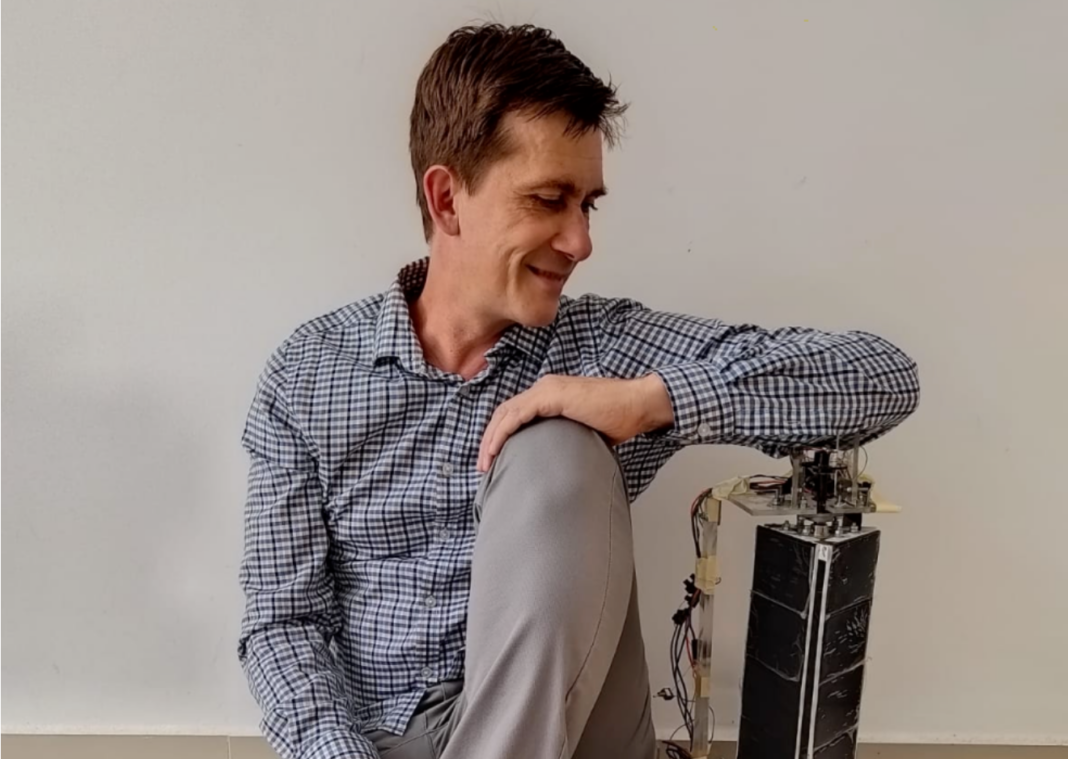

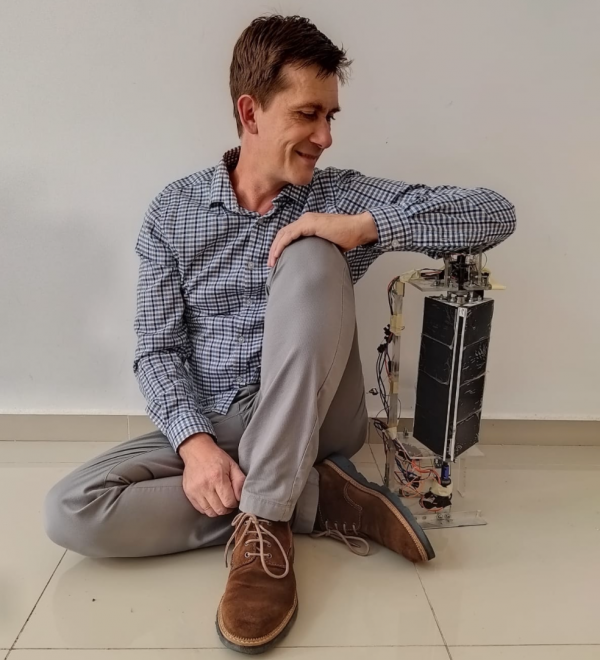
An Israeli-Russian electro-mechanical engineer has created a new mechanical solution to optimize efficiencies in solar power plants. And when you see it working on your balcony, you might wonder when you will have lift-off! The new invention spins off-the-shelf solar panels in such a way that they minimize heat exposure and dust, while capturing more angles of the sun. The solution can work off-grid and even indoors near a window.
Scientists already agree that when it comes to optimizing solar power efficiencies, two-sided solar panels are better than one. An MIT study (links to a PDF) shows major opportunities for 3D photovoltaic systems. Based on these findings, ‘it was necessary to make only one step up to create a PV helicopter,” jokes inventor Alexei Grigoriev who has devised a novel machine to capture the most sun for consumers and niche businesses.
Today, most technologies are devoted to large solar power plant builds. And in many ways this mindset slows down advances. Typically power plant operators bid for tenders, but by the time the plants get funded and built, the technology is obsolete. This is what happened at the Ashalim solar power plant in Israel. Grigoriev is well aware of the problem and as Israel touts itself as a solar energy pioneer, sees the lack of solutions beyond the industrial market.
Here’s what’s happening today
In order to make solar power cost effective, or competitive with natural gas, nuclear, or oil, researchers are constantly upgrading their solar power systems, in materials and software, to gain the ultimate goal: to capture the most sun versus the cost of the system.
Other companies work on software or inverters to squeeze a little bit more energy out of the system, basically work to optimize them, but they can’t “add energy that’s not there,” says Grigoriev, now building his rotating solar panel solution into startup called SolarAce to make solar power accessible to everyday people like us. He’s made a system that uses a rotary motor and off the shelf solar panels to collect the maximum amount of sun they can, anywhere in the world. See a video of the protype on Grigoriev’s balcony, below.
The idea came to him in 2013 when a heavy series of rains knocked out his power for 3 days. And no one seemed to care.
“If you look to what’s happening in the industry,” Grigoriev tells Green Prophet, “governments are not interested in promoting or pushing solutions for consumers, but rather they want industrial solutions to create large power plants. Energy-intensive to fund and build, the consumer market is almost completely overlooked,” he says.
The electro-mechanical engineer with a background in airplane mechanics, and who worked for 20 years on mechanics for the number of companies including the Israel Electric Company, believes he has found the ultimate win needed to help companies and communities get power lift off in situations where they are not able to access the electricity grid. Current solar panels and systems are achievable, but for every day people and companies, not entirely reliable or efficient.
Low-tech solutions from Israel like Nova Lumos has pioneered some off-grid ideas for Africa as business models, but they haven’t made leaps in technology advance. More than half of all of Africa and most of Asia in villages of China are not connected to a reliable power network. Refugees, hundreds of millions of them, are not connected to the grid. Large server farms powering blockchain and crypto operations for bitcoin now require massive server solutions, often with unreliable power solutions. Same with hospitals. And now cannabis labs in Canada and the United States growing hemp and marijuana for THC and CBD – they need power night and day to fuel the energy-intensive growing lights.
What happens if the lights go out on any of these operations? It’s unthinkable to any number of businesses. The “Helicopter” can even function inside a room collecting the sun as the rays hit the open space. See the video below working in Israel:
Grigoriev’s approach is to apply a mechanical solution, constantly moving, and which can be fixed with multiple panels, thus collecting and tracking the sun light any time of the day, in any temperature situation.
Tracking systems for single and bifacial panels do exist, says Grigoriev, but “why only optimize with 2 panels when you could use 3 or 6 or a dozen or more?” he tells Green Prophet: “In my plans I am talking about a 1 to 1 ratio between power output and ground area. That means basically 4 times more energy than traditional PV static single face systems.”
According to independent tests he has done in the field, his solution “helicopters” in the sun’s rays –– in the hot climes of the relentless desert to the snow packed fjords of Norway.
“My solution is solving three massive problems,” he explains. “One is temperature. Although panel manufacturers tell you that their panels might get an efficiency of 24% (for example) that’s only true in a lab-like, controlled setting. What if you are in a 45 degree C desert? There is no way you are getting those efficiencies and that has an important effect on your return on investment. Since we are working with a series of panels, we can move them around before they overheat. This increases efficiencies tremendously, up to 20%,” Grigoriev attests.
Don’t maintain dust or snow
“Another feature of the ‘helicopter’ solution is that the mechanical movement deflects dust and snow, constantly helping panels achieve their advertised efficiencies. My solution here isn’t in the panels, but in the way they are working to collect the energy.”
Solar panel tracking systems have been on the market for over a decade. They are mechanical supports that move along with the rising and setting sun so that the angle of incidence of solar energy is directly impacting the solar panel. Recently, innovations in two-sided or bi-facial solar panels that use tracking systems have generated even larger amounts of solar energy.
The third achievement Grigoriev is offering is freeing up space. Solar panels arranged in a series can take one-third of the space, and not sprawl out over your roof. His solution could be used on a balcony, on an electric car (are you listening Elon Musk?), or even on a solar airplane.
Grigoriev says his application might cost more, but it’s a solution that will actually work for off-grid communities that need power, or for large server farms or hospitals that can’t risk being without dependable power even for a minute a day. But mostly this product is oriented for personal clients that needs specific amounts of energy anywhere. It’s like helicopter that has to be landed with special loads on the most remote islands.
(That’s why Grigoriev –– coming from aviation –– compares his solution to a helicopter.) And off course it’s very close to the traditional generator. Except powered by the sun. This could be an excellent solution for gold mines.
Grigoriev says: “No one argues that there is no place for helicopters in aviation. They have a specific purpose and in no way do they, or can they, compete with airplanes. You can’t land an airplane in the middle of the city, or move in 3 dimensions. The same is true with my invention. Yes it will cost a bit more, but if applied where needed it will give homeowners and businesses the freedom to move, live, work and play, without interruption, using the sun.”
Grigoriev who started on the prototypes two years ago is looking for business partners to commercialize the technology. He estimates that a $1 million USD investment will advance the technology to a first run product. Of course there is marketing and all that entails, but he believes the solution will speak for itself.
And –– a big bonus Grigoriev adds –– “my system easily connects to the wind.”
For inquiries contact Alexei via email here.