Desert Kites are how ancient man trapped his kill

desert kite trap jordan
Desert kites seen by helicopter

The local Bedouin knew about them for thousands of years but in the 1920s, pilots of the Royal Air Force flying over the deserts of Israel, Jordan and Egypt saw mysterious line shapes in the ground that they named “Desert Kites” Because their outlines, as seen from the air in their planes, reminded them of airborne kites.

The Middle Eastern deserts hide many traces from the dawn of mankind. Some of them are so-called desert kites, structures used to capture game animals: gazelles, wild asses, Arabian oryxes, onagers, hartebeests, ostriches and ibexes. From the satellite images, these structures look like gigantic kites that intrigued scholars who spent years researching uninhabited areas of Eastern Jordan, Sinai, Negev Desert and Saudi Arabia.

desert kite

For many years scholars thought that some of the desert kites represented the border between the Roman and Sassanian empires in the Syrian Desert or water channels, but recently scientists reached a consensus that these structures served Neolithic nomads.

According to a French anthropologist Remy Crassard, it is possible that the “desert kites” in Jordan are some of the oldest in the world.

“Until now, we can estimate the use of the kites in Jordan and most probably in the neighboring regions to the end of the Neolithic, which was around 8000 years ago,” said Crassard in an interview for the Green Prophet. Crassard who leads the “Globalkites Project”, added that in northern Saudi Arabia, hunting traps were later constructed while in Armenia, where some 200 kites have been found, they appear to be used during the Bronze Age (around 5000 or 4000 years ago). By 2022, 6500 had been located in the Middle East.

The desert kites were found in areas far from the Middle East, like Kazakhstan where this human-made traps likely remained in use even in the medieval period.

Kites are different in shapes and sizes, the scholar continued, noting that thanks to a statistical approach, we are now able to propose groups of kites that show a real regionalization of them through time and space.  Also, kites might have been used not only for the hunting of wild animals but for their domestication in the Neolithic communities.
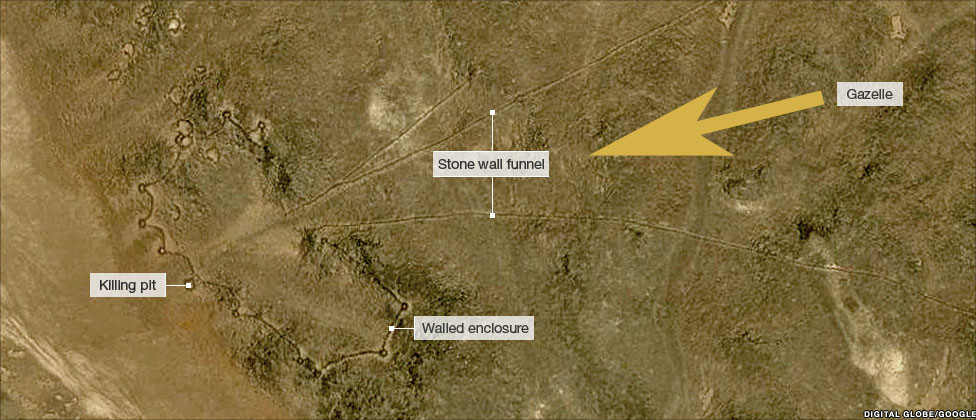
In northeastern Syria deposits of animal bones found near desert kites indicated non-selective hunting of animals whose age and sex varies. Some petroglyphs also depict scenes from gazelle and ibex hunting. The most common types of desert traps are bag-shaped kites, star-shaped kites, star-shaped kites with returned enclosures and clover –leafed kites.

In addition to the function of the desert kites, they consist of long dry-stone walls converging on a neck which opens into a confined space that ancient people used as the killing floor.  These walls can be hundreds of meters long and in more recent times, during the British and French mandate, pilots who flew over desert first spotted them in the1920s. T.E Lawrence, better known as Lawrence of Arabia, recorded desert kites in the Negev in 1913 while he explored the area before World War I.

Desert kites, ancient animal traps used by hunters

Regarding other finds, the excavations of the kites do not yield any artifacts, Crassard underlined, saying that the research team is also looking for datable elements, so that they can date the structure itself.

“During our last season of excavations in October 2019, we even found some prehistoric gazelles in one of these traps! After analyses, we will publish very soon our results in scientific journals,” Crassard noted.

Describing these enormous structures made to trap various animals by people from Neolithic period, he said that the research team recorded more than 6000 of them from Saudi Arabia to Uzbekistan in Central Asia.

“This is fascinating to study such mega-structures that were not so well understood before being excavated,” he stressed, underscoring that the new project will now provide many clarifications on the function, the dating and distribution of the desert kites that were until recently considered enigmatic structures.

In order to understand the economic and environmental impact of the desert kites, interdisciplinary studies are needed and they gather not only archaeologists but anthropologists, archaeozoologists and geo-archaeologists. The plan of the team of researchers gathered at The Globalkites is to analyze traps in different parts of the world and reconstruct the way game animals and Neolithic people interacted.


Hot this week

How Renewable Energy is Revolutionizing the Way We Power Our World

Solar has become the star of the transition thanks to modular hardware and straightforward installation. It fits dense cities and remote towns alike. Many companies are turning to rooftop arrays and carport systems - and exploring commercial solar installation as a practical way to lock in future savings.

How does one start prepping?

Faced with an extreme winter storm this year, Americans wonder how to be prepared for catastrophe. Miriam has lived through wars in the Middle East - so she's prepared on giving you a guide to prepping.

Fishermen sue tire manufacturers on behalf of the salmon

A federal trial in San Francisco has brought US tire manufacturers, fishing groups, and environmental scientists into court over a chemical most drivers have never heard of — but which scientists say may be silently reshaping aquatic ecosystems.

Listening to Water: Tarek Atoui’s Next Work for Tate Modern

Born in Beirut, Lebanon in 1980 and now living in Paris, Atoui has spent years building instruments that don’t sit comfortably in concert halls. Many of them involve water, glass, and ceramics — materials that react to sound instead of simply producing it.

Leading Through a Dual-Energy Transition: Balancing Decarbonisation with Energy Security

Experience in one area of the energy industry isn't enough to guarantee readiness across all the others. That's where a structured program like an MBA in energy can come in. Today's advanced curricula explore energy economics, finance, policy, and strategic management alongside the technical subjects. And when pursuing an energy MBA online, professionals can skill up and retrain without having to step out of the labor market -- an important perk at a time when skilled professionals are already in short supply.

Topics

How Renewable Energy is Revolutionizing the Way We Power Our World

Solar has become the star of the transition thanks to modular hardware and straightforward installation. It fits dense cities and remote towns alike. Many companies are turning to rooftop arrays and carport systems - and exploring commercial solar installation as a practical way to lock in future savings.

How does one start prepping?

Faced with an extreme winter storm this year, Americans wonder how to be prepared for catastrophe. Miriam has lived through wars in the Middle East - so she's prepared on giving you a guide to prepping.

Fishermen sue tire manufacturers on behalf of the salmon

A federal trial in San Francisco has brought US tire manufacturers, fishing groups, and environmental scientists into court over a chemical most drivers have never heard of — but which scientists say may be silently reshaping aquatic ecosystems.

Listening to Water: Tarek Atoui’s Next Work for Tate Modern

Born in Beirut, Lebanon in 1980 and now living in Paris, Atoui has spent years building instruments that don’t sit comfortably in concert halls. Many of them involve water, glass, and ceramics — materials that react to sound instead of simply producing it.

Leading Through a Dual-Energy Transition: Balancing Decarbonisation with Energy Security

Experience in one area of the energy industry isn't enough to guarantee readiness across all the others. That's where a structured program like an MBA in energy can come in. Today's advanced curricula explore energy economics, finance, policy, and strategic management alongside the technical subjects. And when pursuing an energy MBA online, professionals can skill up and retrain without having to step out of the labor market -- an important perk at a time when skilled professionals are already in short supply.

From Green Energy to Healthy Societies: Why old systems thinking is becoming relevant again

Across the Middle East and North Africa, large investments are being made in green hydrogen, renewable energy, water infrastructure and sustainability. Most of these efforts are discussed in the context of climate change, decarbonization and economic diversification. That framing is important, but it may not capture their full value.

We saw peace – an interreligious encounter deep in our eyes

They came from Israel, Palestine, Jordan, Iraq, Yemen, Morocco, Tunisia, Lebanon, Egypt… There are Sunni Muslims, Shiite Muslims, Jews (Orthodox and Reform), Orthodox Christians, Coptic Christians, Protestant Christians, Druze, Baha'is, a Scientologist.

Can biochar reduce ‘Forever Chemicals’ in food if it’s used in farms?

Biochar is produced by heating organic material in a low-oxygen environment so it does not burn. This process, known as pyrolysis, transforms plant matter into a stable, carbon-rich material.

Related Articles

Popular Categories