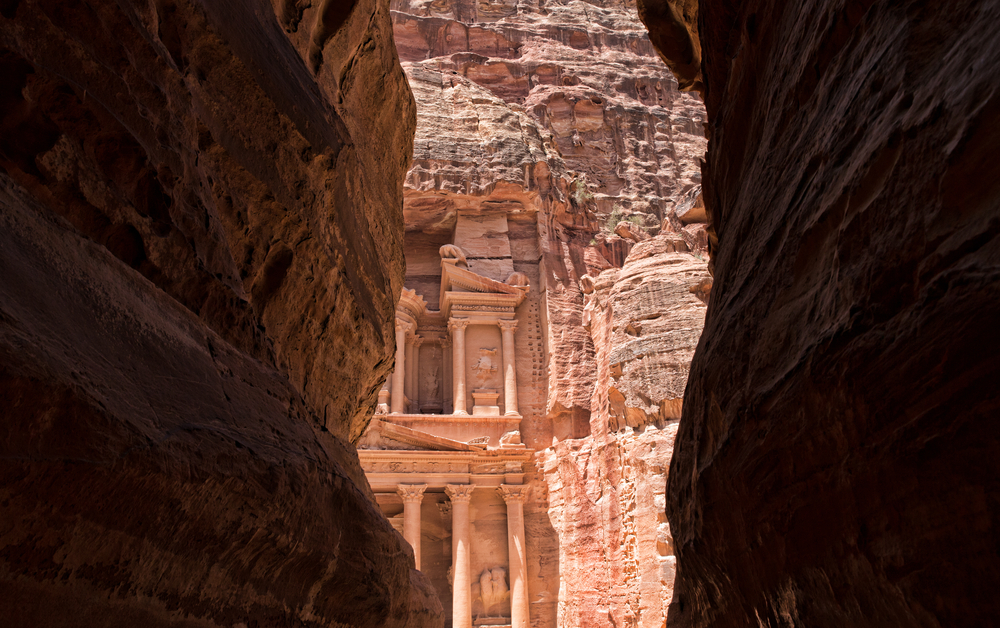
The transition between paganism and three major monotheistic religions in the southern Levant is one of themes that intrigues Professor Robert Schick from the University of Mainz in Germany. Pagans were very connected to the cycles of the earth, and like all ancient people reckoned with nature to understand why they exist and how to survive.
An American historian and archaeologist, Schick has worked in Jordan since 1980 and has participated in various scholarly projects. His major focus is the Byzantine and Islamic periods, which includes research at sites on both the East and the West Bank.
The closer look should be taken at religious affiliation of the population in southern Jordan, namely from Wadi Mujib to Aqaba (ancient Ayla) in the Byzantine and Islamic periods after the end of the Nabataen (they pushed back the desert with water know how) and Roman age when pagans switched to Christianity in 4th Century AD.

“By the mid 5th century AD the pagan population disappeared and after the Muslim conquest in the mid-7th Century AD we have a growth of Muslim community and shrinking of the Christian population, and, consequently, in the 10th century AD Muslims already became the majority,” explained Professor Schick at a lecture in Amman in December, 2019. The lecture “Religious Change in Southern Jordan” held at the American Center of Oriental Research in Amman allowed the scholar to share his research from the eastern part of the Byzantine province of the Palaestina Tertia, which included the Sinai Peninsula on the west and southern Jordan on the east.

The last major pagan temple built by the Roman empire was located in the city of Raba, he explained, and it was erected between 284 and 305 AD, during the reign of Diocletian and Maximian, the so-called Tetrarchy, while the first mention of the Christian community in southern Jordan is recorded during the final persecution of them between 303 and 311. This is when Roman authorities sent local Christians to copper mines in Faynan where many perished due to very harsh working conditions. (See Timna copper mines).
There are also accounts of Christian persecutions in Petra and ancient Zoara modern day Ghor Safi], Schick noted.

In the meantime, the first bishop was attested in Ayla in 325 AD, and it marks the start of a Church hierarchy, the scholar elaborated.
Earthquakes and epidemics of plagues were the turning points for many civilizations of the ancient world and the same can be said for the catastrophic earthquake of 363 AD that hardly hit southern Jordan.
Many pagan temples were destroyed and left in the ruinous state until in the 6th century AD when the Christians inserted churches into some of already destroyed pagan temples.
“That was a period when paganism began to fade away and Christianity became the state religion so the pagans were persecuted by the empire,” the scholar said, adding that pagans of Petra did not rebuild these temples and after the earthquake no public manifestations of paganism was recorded in the city.
The destruction done by Mar Sauma
The minority of pagans lived in the area in early 5th century AD when a famous monk Mar Sauma appeared on the horizon.
Sauma travelled through the eastern Mediterranean with the band of monks who destroyed pagan temples and synagogues in Jordan and Palestine (modern day Israel). When they arrived to Petra the population wisely did not allow them to enter the city in order to avoid the trouble.
According to the hagiographic tradition Sauma prayed to God when he and his disciples saw closed city gates and the storm broke out destroying a part of the city wall. After Petra pagans saw the outcome of his prayers they massively converted to Christianity, including pagan priests.
Of course, these are events that can’t be scientifically verified and belong to every religious narrative, however, by the end of 5th century AD everyone in Petra is Christian and the churches are excessively built in 6th century, Schick said.
Drawings and inscriptions from Wadi Rum dating from 4th to 6th centuries have no Christian symbols, except the one out of thousands of them with the cross and Jesus written in Hismaic, Schick stressed.
“It occurs to me that the reason is that nomads continued to be pagans,” he underlined.
After the Muslim conquests, the pagan nomads are directly converted to Islam in the 7th century and later, Schick said, adding that in 634-636 Udruh and Ayla were the earliest Muslim settlements in southern Jordan.
Humayma (280 km south of Amman) is important as Abassid family lived there and from that site, which was previously occupied by the Nabataeans and had a huge Roman fortress, Abbasides plotted to overthrow the Ummayad dynasty in 749/50.
“Also the first two Abassis khalifs were born there,” Schick underlined.
“There were five Christian churches but they didn’t survive as temples, instead they were turned into houses for servants, which indicated that Christians did not live in that area anymore,” Schick emphasised.
On the other hand, the monastery near Lot’s cave (ancient Zoara, modern Ghor Safi) functioned until the beginning of the 9th century as a Christian shrine before it was abandoned, the scholar explained, while the tomb of Aaron is another site in Petra and this pilgrimage monastery was in use in 9th century” but not rebuilt.
“The 9th century is the end of Christian thriving in southern Jordan,” Schick noted, adding that Crusaders met local Orthodox Christians in Petra, Karak and Shobak.
During Mamluk period Christian communities in Karak and Shobak existed and prosper as merchants, Schick said, concluding that Ottoman census from first decades of their rule confirms the number of households.
In Karak Christians remained majority in the early Ottoman period, while in Shobak they already became minority, Schick underscored.