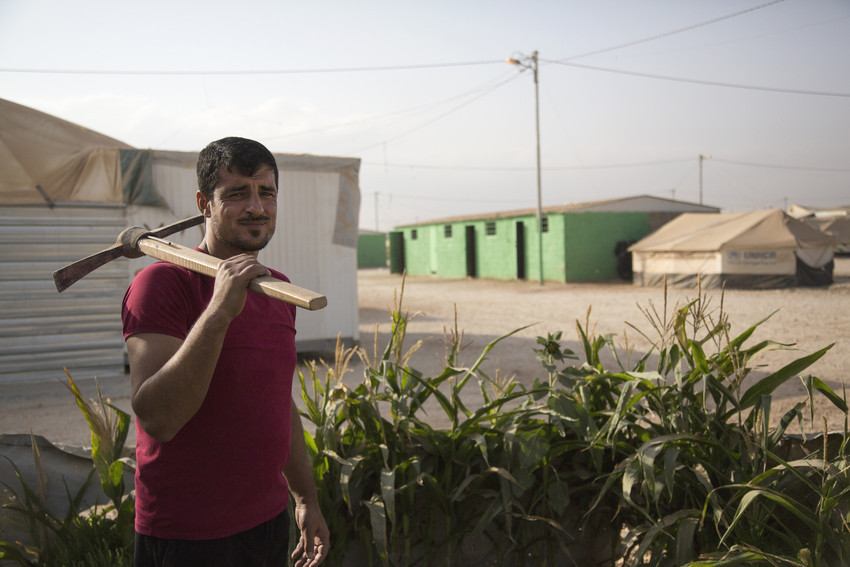
If you look to what was brewing before the Syrian civil war, it was clear that people there were suffering from the effects of climate change. Environmentalists warned that extended droughts there would cause hunger, poverty and unrest.
The conditions were right about a decade ago for the poor conditions to foment to a very unfavourable civil war with millions of Syrians displaced to Jordan, Turkey, Lebanon, Europe and even Canada. It is much less than ideal to have to resettle your family in other countries and lose loved ones in the turmoil and countries around the world can learn from Syria what will happen if the climate change crisis continues. We will see Syria’s problems all over the Middle East. (See also their solutions like the Syrian beehive house).

Last year rains were plentiful in the Middle East, giving hope to United Nations bodies overlooking food and poverty.
Favourable rains in Syria’s agricultural areas, coupled with improved overall security, have boosted harvests compared to last year, but higher food prices are putting more strain on many Syrians, a new United Nations report has found.
Wheat production is estimated at 2.2 million metric tonnes, compared to last year’s 29-year low of 1.2 million tonnes, but is still far below the pre-crisis average of 4.1 million tonnes (2002-2011), according to the latest Crop and Food Security Assessment Mission (CFSAM) report, produced jointly by the UN Food and Agriculture Organization (FAO) and the World Food Programme (WFP).
The estimated production of barley, at 2 million metric tonnes, is more than five times that of 2018 and more than 150 percent higher than the average production levels achieved prior to the crisis.

However, food prices have been gradually increasing over the past 12 to 14 months largely as a result of increased domestic fuel prices and a continuous depreciation of the Syrian Pound on the informal exchange market.
Food security remains a serious challenge due to continued localized hostilities, new and protracted displacements, increased numbers of recent returnees and the sustained erosion of communities’ resilience after almost nine years of conflict.
Time to support Syrian farmers world!
“Despite the good rains, farmers in rural areas are still facing many challenges including a lack of access to seeds and fertilizers, high transport costs, the presence of unexploded ordnance in some of their fields, and limited marketing opportunities,” said FAO Representative in Syria, Mike Robson. “Unless there is increased support for agricultural livelihoods, particularly those of Syria’s most vulnerable families, the reliance on food assistance will remain,” he said.
“After nine years of crisis, the people of Syria, including those returning to their villages, continue to face great challenges,” said Corinne Fleischer, Country Director of WFP in Syria. “Many struggle to feed and educate their children. WFP remains committed to delivering assistance which helps them to survive and eventually to rebuild their lives.”
Passive cooling for Syria’s beehive houses
Between June and July 2019, the joint FAO/WFP mission team visited ten of the country’s 14 governorates, but was not able to reach Raqqa and Idleb governorates due to insecurity. Based on interviews, surveys, field visits, national data and satellite information, the report provides estimates on crop production for 2019 and assesses the country’s overall food security situation.
Families struggling to make ends meet
Around 6.5 million people in Syria are estimated to be food insecure and in need of food and livelihoods support. An additional 2.5 million people are at risk of food insecurity and need livelihoods support to strengthen their resilience.
Lack of employment opportunities and increased fuel and commodity prices limited households’ purchasing power, causing more families to adopt negative coping strategies such as consuming less preferred and less expensive food, cutting the number of daily meals or withdrawing children from school in order to work, the report stated. Returnees in Aleppo, Homs and Deir-ez-Zor governorates reported that, in most households, adults went without eggs and dairy products so that their children could eat the micronutrient-rich foods instead.
Farmers’ challenges
Some areas received more than double their yearly rainfall average in 2018-19. For example, Tartous, a high-rainfall governorate with a yearly average of about 900 mm of rain, recorded 2 200 mm over the season. The plentiful rains saw increased fruit and vegetable production, the report states, but some of the produce was lost to spoilage because high fuel prices, localized insecurity and a lack of refrigerator trucks hampered access to urban markets.
Field fires, not unusual during harvesting, were more frequent and intense in 2019, with the Government estimating that about 85 000 hectares of crops were burnt. The report states that, while accidental fires are common, there is evidence to suggest that some fires were started maliciously, particularly in areas with active conflict.
Concerns that last year’s poor harvest would result in seed shortages were eased by access to a small supply from the national General Organization for Seed Multiplication (GOSM), as well as purchasing on the market, borrowing seeds and using some saved seeds from last year. In a joint FAO/WFP project, 14 450 of the poorest farmers in Hasakeh, Raqqa, Deir-ez-Zor, Aleppo and Hama governorates were supplied with wheat seed, enabling them to cultivate.
Beekeeping, which used to be a prolific traditional industry in the country, has suffered during the crisis and concerns prevail about bee mortality resulting from the misuse of pesticides, and a lack of marketing channels for honey and bee products to guarantee viable livelihoods.
Responding to the crisis
The report concludes with a list of actionable recommendations to overcome the crisis and restore the agricultural sector and livelihoods, covering the short-, medium- and long-terms.
FAO is working with partners to increase agricultural production and restore or create livelihoods to save and sustain vulnerable Syrians’ lives. FAO is also working with partners to rehabilitate vital agricultural infrastructure and support services. So far in 2019, FAO has reached 31,000 farming families (186,000 people) across Syria.
Currently, WFP provides food assistance to more than 4 million food-insecure people every month across all 14 governorates in Syria, including conflict-affected areas like the north-west of the country.
As conditions on the ground change, WFP is establishing programmes designed to increase the self-reliance of communities recovering from years of war. WFP uses electronic food vouchers to assist people engaged in livelihood-enabling activities as well as pregnant and nursing women and out-of-school children. The aim is to provide choice and dietary diversity while supporting local traders and small-scale producers.