Khirret, A Vanishing Iraqi Sweet Made from Cattails

A rare sweet pollen based candy pulled out from the marshes of ancient Iraq.

Khirret, an old-fashioned sweet made in southern Iraq, is concocted from male cattail reed pollen. It’s intriguing as an historical relict, but not so much for its taste. People who still remember the flavor and texture of khirret agree that it tasted faintly-sweet and felt like chalk in the mouth. Best known in Iraqi culinary history, it might be one of those foods best left to history altogether.

khirret-iraqi-sweet

Cattail reeds are a useful plant that has helped sustain indigenous people wherever it grows, around the globe. Native Americans have many uses for all of its parts.Traces of cattail tubers have been found in crumbs of Neolithic bread found in Jordan. Those long-ago people wasted nothing they found nutritious.
pollen-cattail-reed

And Iraqi tradition, according to food historian Nawal Nassralah, knew the value of khirret well:

Khirret as medicine

“Khirret is a nutritious food high in protein, and its medicinal benefits are believed to be many. People eat it to relieve indigestion. It is said to be good for the colon and respiratory tract. It is used to cleanse the urinary system and stop diarrhea. The raw pollen is put on wounds to heal them. It is also popular among women during the early stages of pregnancy. Moreover, it come in very handy for bee-keepers, who use it to feed their bees.”

An Indian blogger at sindhirasoi.com also has memories of khirret, which she knows as bhuri. As she recalls, eating it was less than pleasant. She describes the flavor as fermented-floral. But her parents encouraged the family to eat it, presumably because it was cheap and nutritious.  It has almost disappeared in her culture as well. 
Recipe for khirret

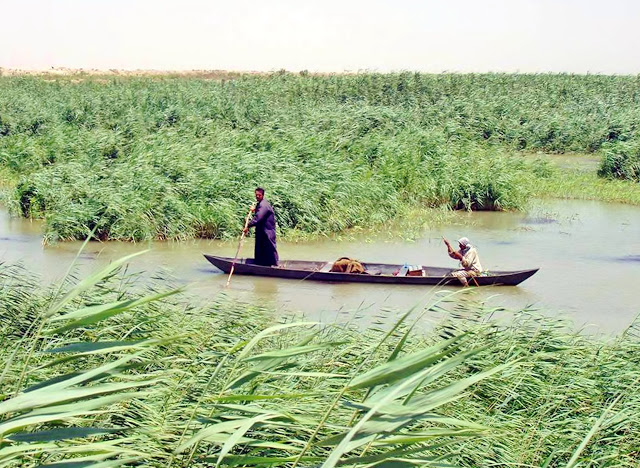
To make khirret, you first need to row out to where the reeds grow in a marsh and gather cattail reeds plump with bright yellow pollen. Back on dry land, you strip the pollen off the stalks with your hands, sieve the collected material to separate any insects, and set it out to dry in the sun. A video below shows how it’s done.

Mixed with sugar, the pollen is then steamed inside a cloth until solid, traditionally over a boiling pot whose edges are sealed with mud. There must be a point in which the experienced khirret cook knows it’s ready, but that’s information no one has provided. Someone wants to take on the challenge?

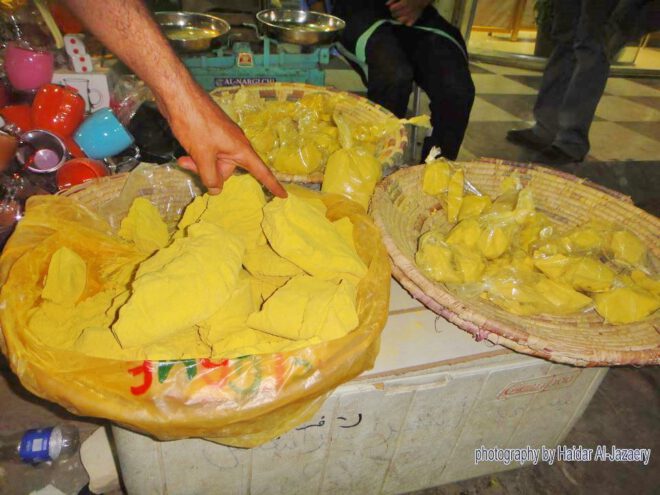
It’s then broken up  into irregular chunks and is ready to eat. 
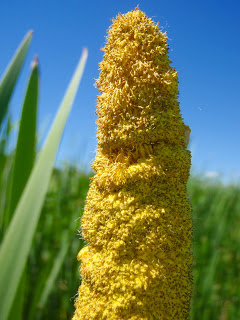
pollen-male-cattail reed
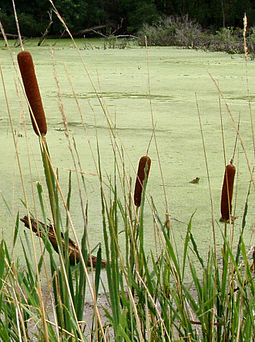
Male cattail full of pollen

What brought Nasrallah’s attention to khirret was a memoir of life in Bagdad in the 1920s by the scholar Abbas Baghdadi. He recollects khirret as being a street food manufactured only by Jewish vendors.  He says that the Jews of Bagdad ate it especially at the festival of Purim, which occurs in March/April – just when the male cattail reeds are loaded with pollen and ready for processing.

I asked food historian and chef Moshe Basson,  69 years-old and himself a descendant of Iraqi Jews, if he had memories of eating khirret. He doesn’t recall eating it, although he knew what it was from hearing of it at home: perhaps his parents mentioned it at around Purim.

There’s no folklore or connection with Biblical stories about the candy that Basson is aware of. Presumably it was simply a seasonal treat whose golden color was appropriate to the general air of festivity at the time. He does recall that his childhood Purim treats included a coconut candy that was also bright yellow; maybe a reference to the khirret tradition left behind.

Iraqi Jews abandoned khirret when they left Iraq for Israel. There’s very little marshland in Israel, and that located in two nature reserves. They took to agricultural work and small businesses, and so the tradition in Israel has died away. 

Khirret is still made in southern Iraq and other parts of the Middle East, but it’s appreciated for its rarity, rather than a sweet that stands in competition with commercial candies. But as for its medicinal value? Worth exploring more.

Photos of khirret and reed with pollen from Nawal Nasrallah’s blog, In My Iraqi Kitchen.
Miriam Kresh
Miriam Kreshhttps://www.greenprophet.com/
Miriam Kresh is an American ex-pat living in Israel. Her love of Middle Eastern food evolved from close friendships with enthusiastic Moroccan, Tunisian and Turkish home cooks. She owns too many cookbooks and is always planning the next meal. Miriam can be reached at miriam (at) greenprophet (dot) com.

Hot this week

Why Health Systems Are Reaching a Turning Point

Health emerges from a continuous energy and material flow from water through food to human physiology. Technical energy systems support this cycle through water treatment, agriculture, and infrastructure.

Sustainability That Sells: How Profit and Purpose Come Together in the Hive

Whether you are a commercial grower, hobbyist beekeeper or retail equipment supplier, this system opens a new income stream with minimal environmental impact.

The Fitness App Revolution: Building the Future of Wellness Through Strategic Development

In an era where smartphones are ubiquitous and health consciousness is at an all-time high, the fitness industry has undergone a radical digital transformation. Fitness applications have moved far beyond simple pedometers, evolving into comprehensive wellness platforms that serve as personal trainers, nutritionists, and community hubs right in our pockets.

A Brief History of Basil From India to Italy

Beloved, fortunate, sweet, and royal; an herb with a long and storied history in Asia and across the world. Called by many names, basil has featured in previous Green Prophet articles, so enjoy another serving, a brief history of basil.

How Renewable Energy is Revolutionizing the Way We Power Our World

Solar has become the star of the transition thanks to modular hardware and straightforward installation. It fits dense cities and remote towns alike. Many companies are turning to rooftop arrays and carport systems - and exploring commercial solar installation as a practical way to lock in future savings.

Topics

Why Health Systems Are Reaching a Turning Point

Health emerges from a continuous energy and material flow from water through food to human physiology. Technical energy systems support this cycle through water treatment, agriculture, and infrastructure.

Sustainability That Sells: How Profit and Purpose Come Together in the Hive

Whether you are a commercial grower, hobbyist beekeeper or retail equipment supplier, this system opens a new income stream with minimal environmental impact.

The Fitness App Revolution: Building the Future of Wellness Through Strategic Development

In an era where smartphones are ubiquitous and health consciousness is at an all-time high, the fitness industry has undergone a radical digital transformation. Fitness applications have moved far beyond simple pedometers, evolving into comprehensive wellness platforms that serve as personal trainers, nutritionists, and community hubs right in our pockets.

A Brief History of Basil From India to Italy

Beloved, fortunate, sweet, and royal; an herb with a long and storied history in Asia and across the world. Called by many names, basil has featured in previous Green Prophet articles, so enjoy another serving, a brief history of basil.

How Renewable Energy is Revolutionizing the Way We Power Our World

Solar has become the star of the transition thanks to modular hardware and straightforward installation. It fits dense cities and remote towns alike. Many companies are turning to rooftop arrays and carport systems - and exploring commercial solar installation as a practical way to lock in future savings.

How does one start prepping?

Faced with an extreme winter storm this year, Americans wonder how to be prepared for catastrophe. Miriam has lived through wars in the Middle East - so she's prepared on giving you a guide to prepping.

Fishermen sue tire manufacturers on behalf of the salmon

A federal trial in San Francisco has brought US tire manufacturers, fishing groups, and environmental scientists into court over a chemical most drivers have never heard of — but which scientists say may be silently reshaping aquatic ecosystems.

Listening to Water: Tarek Atoui’s Next Work for Tate Modern

Born in Beirut, Lebanon in 1980 and now living in Paris, Atoui has spent years building instruments that don’t sit comfortably in concert halls. Many of them involve water, glass, and ceramics — materials that react to sound instead of simply producing it.

Related Articles

Popular Categories