

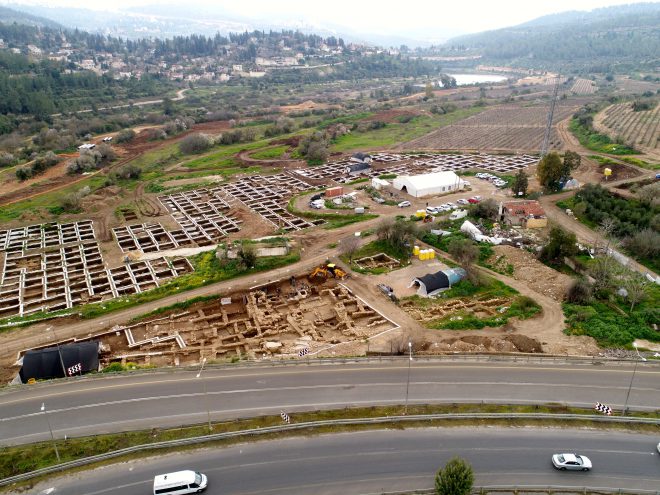
Enormous Neolithic Site Near Jerusalem Reveals 9000-Year-Old Secrets

neolithic site Jerusalem

Conventional thought among archaeologists was that Neolithic people didn’t settle in the area around the Judean Hills. Yet Motza, 5 kilometers west of Jerusalem, was always within easy distance of fresh water from the Sorek river, and near good agricultural ground. A trail coming from the southern foothills allowed access to traders and emigrants. All those were good reasons for past people to settle in the area.

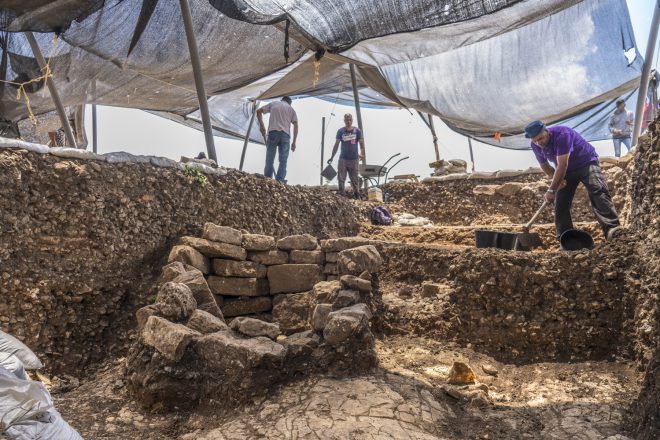
Recent excavations by the Israel Antiquities Authority at the Motza junction uncovered a huge settlement from the Neolithic Period (New Stone Age). It’s the largest known in Israel from that period, and one of the largest of its kind in the region. See also our post about the oldest-known bread, discovered in Jordan.

Dr. Hamoudi Khalaily and Dr. Jacob Vardi, Antiquities Authority excavation directors at Motza say,

“This is the first time that such a large-scale settlement from the Neolithic Period – 9,000 years ago – has been discovered in Israel. Until now, it was believed that the Judea area was empty, and that sites of that size existed only on the other bank of the Jordan river, or at the Northern Levant.”

The researchers estimate that 2000-3000 people lived and worked in the area until now considered barren.  They excavated large buildings with alleys running between them, and found house spaces, storage sheds, public spaces, tombs,and places of worship. Uncovered burial offerings made of materials from Anatolian volcanic glass, and sea shells from the Red Sea and the Mediterranean Sea, show that the inhabitants traded with foreigners. Artistic figurines were found (presumably house idols).
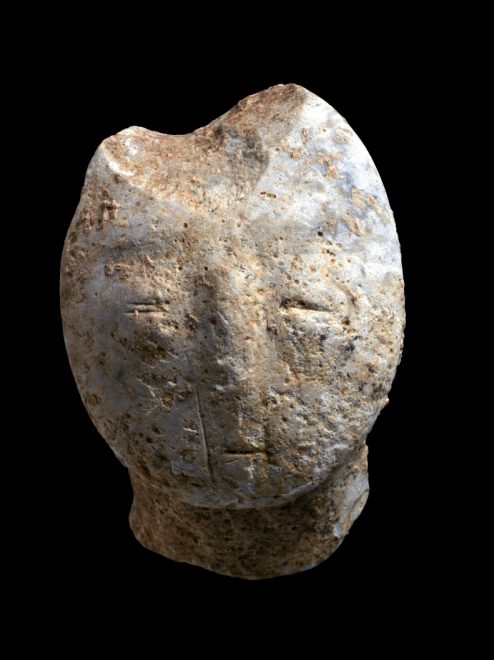
Jewelry for everyday was also uncovered: bracelets and medallions made of alabaster beads and mother of pearl, and carefully crafted stone-bead bracelets for children to wear.
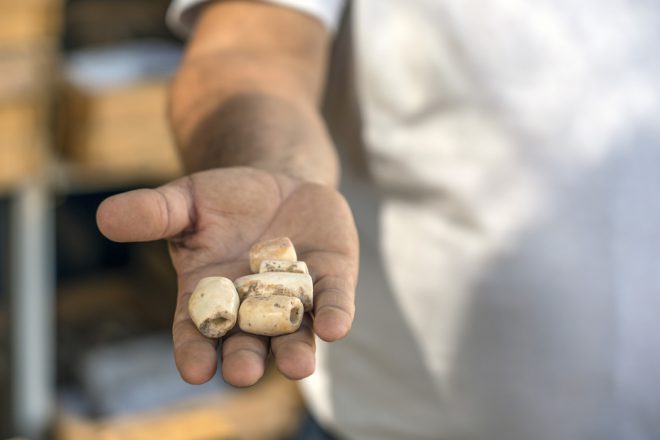
Neolithic jewelry

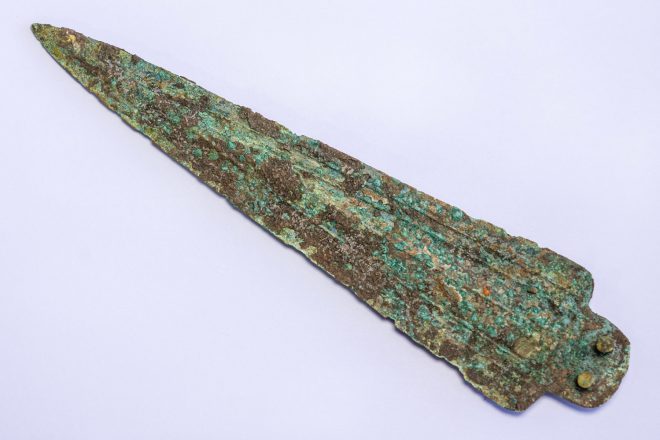
Judging from the thousands of flint arrowheads found, hunting was part of everyday subsistence, and warlike defense was well understood. The remains of axes, sickles and knives show that the inhabitants made and used tools for agriculture. Indeed, huge quantities of identifiable pulses, especially lentils, were found in the storage sheds. Yet it seems that the people of the settlement were turning away from hunting, as large quantities of sheep bones found indicate a preference for home-raised meat instead.
The excavations were initiated and financed by the Netivei Israel Company (the National Transport Infrastructure company), after the Highway 16 Project revealed archaeological remains. The project is constructing a new entrance road to Jerusalem from the west, connecting the National Highway 1 from the Motza area to the southern part of Jerusalem including two double tunnels. It is considered vital to access to Jerusalem.

Gilad Naor, Head of Projects Department at the Netivei Israel Company says, “It is a huge privilege for us, as the Israel National Transport Infrastructure Company, that tomorrow’s transportation infrastructure projects facilitate such special discoveries in the splendid history of our country.”

In preparation for the release of the excavated area, the entire site was documented using advanced 3D technology that will enable research of every detail digitally. A large part of the prehistoric site around the excavation will be preserved. In addition, there will be an exhibition showing the site’s history built by the Israel Antiquities Authority. At Tel Motza, adjacent to this excavation, archaeological remains are being preserved for the public. Conservation and accessibility works are underway in nearby Tel Bet Shemesh and Tel Yarmut.

Miriam Kresh
Miriam Kreshhttps://www.greenprophet.com/
Miriam Kresh is an American ex-pat living in Israel. Her love of Middle Eastern food evolved from close friendships with enthusiastic Moroccan, Tunisian and Turkish home cooks. She owns too many cookbooks and is always planning the next meal. Miriam can be reached at miriam (at) greenprophet (dot) com.

TRENDING

Ancient Clay Jug with Camel Art Unearthed in Israel’s Yatir Forest

The striking red-painted jug was found in a cave that had once been an underground olive press before being repurposed as a dwelling. Researchers believe the cave was in use during the Abbasid period (9th-10th centuries CE), when camels dominated trade routes, helping to move goods across vast distances.

Mysterious Minoan palace found on Greek island hilltop

Archaeologists have unearthed a unique and mysterious Minoan monument on a hilltop on the island of Crete and which is overlooking the newly planned airport, the Greek Culture Ministry announced recently. The new discovery in Crete may be legendary Minotaur labyrinth, from the time of King Minos.

Ancient mosque found in the Holy Land

A luxurious estate and a rare rural mosque – among the earliest known worldwide (over 1200 years old) - was recently discovered outside the Bedouin city of Rahat in the Negev Desert, Israel. 

Archeologists unearth ancient winery in Israel

Children and adults alike used to drink wine in the Holy Land and from this winery just unearthed in Yavne, that made at least half a million gallons of wine a year. 

Chinless, missing “source” between humans and Neandrethals found in Israel

The Nesher Ramla Homo type was an ancestor of both the Neanderthals in Europe and the archaic Homo populations of Asia

Turning Your Energy Consultancy into an LLC: 4 Legal Steps for Founders in Texas

If you are starting a renewable energy business in Texas, learn how to start an LLC by the books.

Tracking the Impacts of a Hydroelectric Dam Along the Tigris River

For the next two months, I'll be taking a break from my usual Green Prophet posts to report on a transnational environmental issue: the Ilısu Dam currently under construction in Turkey, and the ways it will transform life along the Tigris River.

6 Payment Processors With the Fastest Onboarding for SMBs

Get your SMB up and running fast with these 6 payment processors. Compare the quickest onboarding options to start accepting customer payments without delay.

Qatar’s climate hypocrisy rides the London Underground

Qatar remains a master of doublethink—burning gas by the megaton while selling “sustainability” to a world desperate for clean air. Wake up from your slumber people.

How Quality of Hire Shapes Modern Recruitment

A 2024 survey by Deloitte found that 76% of talent leaders now consider long-term retention and workforce contribution among their most important hiring success metrics—far surpassing time-to-fill or cost-per-hire. As the expectations for new hires deepen, companies must also confront the inherent challenges in redefining and accurately measuring hiring quality.

8 Team-Building Exercises to Start the Week Off 

Team building to change the world! The best renewable energy companies are ones that function.

Thank you, LinkedIn — and what your Jobs on the Rise report means for sustainable careers

While “green jobs” aren’t always labeled as such, many of the fastest-growing roles are directly enabling the energy transition, climate resilience, and lower-carbon systems: Number one on their list is Artificial Intelligence engineers. But what does that mean? Vibe coding Claude? 

Somali pirates steal oil tankers

The pirates often stage their heists out of Somalia, a lawless country, with a weak central government that is grappling with a violent Islamist insurgency. Using speedboats that swarm the targets, the machine-gun-toting pirates take control of merchant ships and then hold the vessels, crew and cargo for ransom.

Related Articles

Popular Categories