
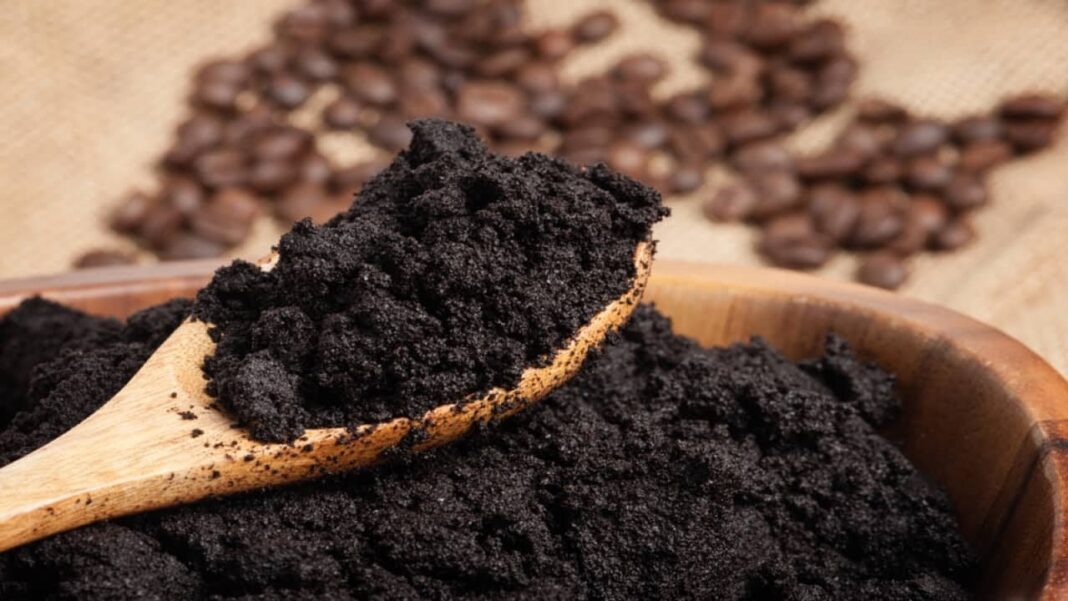

 According to the International Coffee Organization, people wordwide consumed more than 11 million US tons* of coffee beans between October 2015 and September 2016. (Consumption is far outpacing production, due to climactic fluctuations.) Those beans depend on a sea of fresh water to convert them into the beverages we love. Now a team of Italian scientists have developed a new use for spent coffee grounds that helps decontaminate lead-laden drinking water.
According to a study published in the journal ACS Sustainable Chemistry & Engineering, Despina Fragouli and her colleagues at the Italian Institute of Technology found that mixing spent coffee grounds with silicone created a rubbery foam that is capable of separating lead and mercury from water (image below).
The team combined pulverized espresso coffee grounds with silicone and sugar, which they baked into brown, foam-like blocks that act as water filters. The all-natural blocks are made of up to 70 percent recycled coffee grounds, and are fully biodegradable. Fragouli told Water Online. “The porous composites can be safely and easily utilized and disposed of, making possible large-scale utilization.”
 During 30-hour testing in still water, the filter removed 99 percent of lead and mercury traces. When water was permitted to actively flow through the foam, it removed 67 percent of lead. “We are investigating if we can arrive to the acceptable limits for lead and mercury for drinkable water,” Fragouli said. “In order to arrive to a commercial product, we need to make further studies based on the exact application on which this material can be used.” The team envisions that the foam blocks could be installed at industrial water sites and urban wastewater processing plants.
Earlier studies had shown that powdered coffee can also extract metals from water, but often require the use of synthetic additives to do so. Fragouli’s method is cheaper and more sustainable compared to other systems whch deploy synthetic materials.
The World Health Organization has identified lead as 1 of 10 chemicals of major public health concern, needing action by Member States to protect the health of workers, children and women of reproductive age.
A naturally occuring toxic metal found in the earth’s crust, it is a cumulative toxicant that affects multiple body systems and is particularly harmful to young children.
- Lead in the body is distributed to the brain, liver, kidney and bones. It is stored in the teeth and bones, where it accumulates over time. Human exposure is usually assessed through measuring lead levels in blood.
- Lead in bone is released into blood during pregnancy and becomes a source of exposure to the developing fetus.
- There is no known level of lead exposure that is considered safe.
- Lead exposure is preventable.
The Institute for Health Metrics and Evaluation (IHME) has estimated based on 2015 data that worldwide lead exposure accounted for 494,550 deaths and loss of 9.3 million disability-adjusted life years due to long-term effects on health. The highest burden is in low- and middle-income countries. IHME also estimated that lead exposure accounted for 12.4% of the global burden of idiopathic developmental intellectual disability, 2.5% of the global burden of ischaemic heart disease and 2.4% of the global burden of stroke.
According to the Centers for Disease Control and Prevention, there are an estimated 4 million Amaerican households with children that are being exposed to high levels of lead.
Currently, much of the world’s used grounds go to landfills. Some are applied as fertilizer, used as a biodiesel source, or mixed into animal feed. This newest repurposing tackles water remediation, perhaps the largest contemporary environmental problem.
*151.3 million 60 kg bags of coffee consumed in coffee year 2015/16
Image of coffee grounds from Youtube; Despina Fragouli and her foam block from the Italian Institute of Technology



[…] Read More… […]