Satellite Points finger to Persian Gulf for Emissions Under-Reporting

so2-emissions-map

You can run but you can’t hide.

Canadian researchers have found a new, satellite-based technology that -accurately- detects polluters from outer space, and caught 39 large polluters red-handed for non-reporting of their emissions.

Fourteen of those were located in the Persian Gulf, with total contribution to global sulphur dioxide emissions of staggering 6 to 12%.

The study, published this week in the journal Nature Geoscience, used a satellite-based simultaneous detection, mapping, and emission-quantifying procedure to locate pollution ‘hot spots’ across the globe, and compile an inventory of pollutants. The results were then compared with three conventional state-of-the-science inventories, including the Hemispheric Transport of Air Pollutants, which depend on bottom-up approach for quantifying emissions. This latter approach, however, might not mirror actual emissions, especially from developing nations that might lack comprehensive reporting requirements and infrastructure. Enter the satellite detective.

Seven to 14 million metric tons of sulphur dioxide emissions, which have gone missing from inventories, came from polluters in the Persian Gulf, accounting for 6 to 12% of global sulphur dioxide emissions. Most of the hotspots turned out to be large oil refinery complexes.

The plot thickens.

Not only sulphur dioxide from remote oil facilities, but also nitrogen dioxide and nitrogen oxides were revealed to be emitted in large quantities and under-reported. Those latter two pollutants correspond to combustion sources in urban areas, which also happen to be the same sources of carbon dioxide. And yet, some of these missing nitrogen dioxide sources were also missing from the carbon dioxide inventories, as per the study.
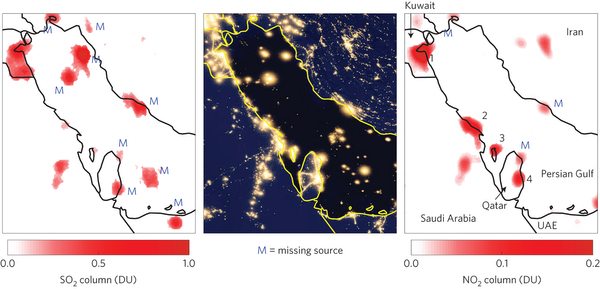
Guld-map

In a nutshell, polluters in and around the Persian Gulf are under-reporting all sulphur dioxide, nitrogen oxides, and carbon dioxide. That’s a 3-strikes.

These pollutants have deadly effects on human health, the environment, and the economies. It’s worth noting that countries on the shores of the Persian Gulf are way up on the list of nations with highest carbon dioxide emissions per capita.

More insights on Canadian-Gulf environment bilateral dynamics, here

Photos sourced from cbc.ca and nature.com

Basel Ismaiel
Basel Ismaielhttp://www.greenprophet.com
Raised in Abu Dhabi, and made a living in Calgary. The lowest common denominator? Oil. Nothing against compressed corpses of the clade Dinosauria, per se, but Basel guesses that the industry might have accelerated the predictably grim Anthropocene. He consults in sustainability out of Ottawa, Canada. Basel runs marathons & hikes mountains. He plays football too. Talk to Basel at [email protected]
1 COMMENT

Comments are closed.

TRENDING

Key Rules Recreational Cannabis Users Must Follow in Pittsburgh

Adults who are 21 or older can carry up to 30 grams. This amount applies to personal use within Pittsburgh’s limits. Carrying more could lead to confiscation or legal action. Staying under the limit avoids problems during any public stop.

Turning Your Energy Consultancy into an LLC: 4 Legal Steps for Founders in Texas

If you are starting a renewable energy business in Texas, learn how to start an LLC by the books.

Ancient Chinese medicine might heal spinal cord injuries

In the study, the scientists didn’t just test one plant compound at a time. They tested two traditional Chinese medicine compounds together — luteolin (from flowers like honeysuckle and chrysanthemum) and astragaloside IV (from astragalus root, Huang Qi). These plants have been combined in Chinese herbal formulas for centuries to help the body recover from injury and inflammation.

Luxury meets the textile waste stream with Coach – Bank & Vogue

A new collaboration between luxury brand Coach and textile reuse pioneer Bank & Vogue attempts to stitch those two worlds together: high fashion and the global textile waste stream.

EU startup aiming to generate energy on moon villages

Stepping up to democratize the moon is an EU-funded company, Deep Space Energy, which has just raised more than $1 million USD as a seed fund to help it create energy generators on the moon.

Turning Your Energy Consultancy into an LLC: 4 Legal Steps for Founders in Texas

If you are starting a renewable energy business in Texas, learn how to start an LLC by the books.

Tracking the Impacts of a Hydroelectric Dam Along the Tigris River

For the next two months, I'll be taking a break from my usual Green Prophet posts to report on a transnational environmental issue: the Ilısu Dam currently under construction in Turkey, and the ways it will transform life along the Tigris River.

6 Payment Processors With the Fastest Onboarding for SMBs

Get your SMB up and running fast with these 6 payment processors. Compare the quickest onboarding options to start accepting customer payments without delay.

Qatar’s climate hypocrisy rides the London Underground

Qatar remains a master of doublethink—burning gas by the megaton while selling “sustainability” to a world desperate for clean air. Wake up from your slumber people.

How Quality of Hire Shapes Modern Recruitment

A 2024 survey by Deloitte found that 76% of talent leaders now consider long-term retention and workforce contribution among their most important hiring success metrics—far surpassing time-to-fill or cost-per-hire. As the expectations for new hires deepen, companies must also confront the inherent challenges in redefining and accurately measuring hiring quality.

8 Team-Building Exercises to Start the Week Off 

Team building to change the world! The best renewable energy companies are ones that function.

Thank you, LinkedIn — and what your Jobs on the Rise report means for sustainable careers

While “green jobs” aren’t always labeled as such, many of the fastest-growing roles are directly enabling the energy transition, climate resilience, and lower-carbon systems: Number one on their list is Artificial Intelligence engineers. But what does that mean? Vibe coding Claude? 

Somali pirates steal oil tankers

The pirates often stage their heists out of Somalia, a lawless country, with a weak central government that is grappling with a violent Islamist insurgency. Using speedboats that swarm the targets, the machine-gun-toting pirates take control of merchant ships and then hold the vessels, crew and cargo for ransom.

Related Articles

Popular Categories