

 Much of the Levant is under siege from a large dust storm right now covering Jordan, Lebanon, Palestine and Israel with parts of Cyprus and Turkey also affected. Meteorologists pin the poor weather on a low-pressure system that’s blanketing the region, and sands blown in from the east. The storm has prompted public health warnings, sending dozens of people to the hospital, and so far killing at least five. But – according to a recent report Nature Climate Change – this is not the most extreme weather heading our way.
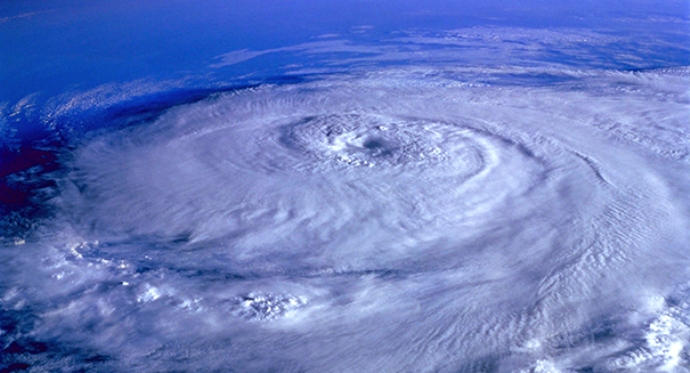
Some weather conditions are predictable. Others come as a complete surprise. In the case of hurricanes, scientists have tagged storms that arise without warning as “black swans”, while “grey swans” are catastrophic storms that could potentially be predicted.
New modelling techniques that correlate historical weather data with evolving physical attributes of a specific area (such as rising sea levels, local geography, and changing weather) show that climate change may heighten risks of experiencing a 10,000-year hurricane on certain coastal cities such as Tampa, Florida; Cairns, Australia and Doha, Dubai and Abu Dhabi on the Persian Gulf – sometime in the next century.
Academics Ning Lin of Princeton University and Kerry Emmanuel of Massachusetts Institute of Technology assessed the statistical likelihood of hurricanes occurring in these areas and then calculated associated storm surges, which are often the most fatal aspect of tropical cyclones.
Their model predicts that Tampa could experience hurricane storm surges of about 20 feet today and 36 feet by the end of the century. Cairns, with a history of tropical cyclones, is at risk of grey swans due to its proximity to areas that have experienced some of the most destructive storms in the Southern Hemisphere. They predicts that the next major Aussie storm could produce surges approaching 19 feet.
The waters of the Persian Gulf are hot, shallow, and highly saline, creating a perfect environment for extreme tropical cyclones. Rapid coastal urbanization in areas ringed by low-lying land sets a stage for high storm surges. Their new model predicts that a strong storm could create surges near 13 feet today and up to 23 feet by the end of the century, with devastating impacts to infrastructure and environment. As this region has yet to record tropical cyclones, any storm that hits this highly susceptible coast would be considered a grey swan.
Lin and Emmanuel also predict that climate change will cause grey swan storm surges to increase in strength and frequency in the coming decades. “We are considering extreme cases,” said Lin. “These are relevant for policy making and planning, especially for critical infrastructure and nuclear power plants.”
And, for the rapidly growing Arab Gulf cities, this is the main message emerging from their modeling. How is new development catering for climate change? What protective or preventative technologies are added to building codes to mitigate damage caused by extreme flooding? And, for these cities that rely on desalination for potable water (and, by extension, depend on utility-scale power plants to keep desalination working), what measures are in planning – and in place – to protect essential services?
Green Prophet doesn’t have the answers, and the Gulf municipalities haven’t figured it out either. And that is the most worrisome sentence of this story.



Comments are closed.