Saudi Arabian women are planting a million mangroves

Saudi Arabian mangrove forests

Not so long ago, forests of majestic mangrove trees fringed the eastern shores of Saudi Arabia. Official stats now estimate that only 10% of the forest remains. Decades of landfill operations in support of growing urbanization destroyed the rest. Now a group of female environmental activists are battling to protect what remains.

Mangrove trees (also called shura, qurm and Ibn Sina) are evergreens that thrive in saline tidal areas along the tropical and subtropical coastlines. They range from one to five meters in height, and anchor to tidal ground with an elaborate system of exposed root structures which provide essential habitat for many marine species. including shrimp. They also provides a welcome environment for marine organisms to reproduce, particularly the Caridea. These species represent an important part of the coastal ecosystem, supplying and important feedstock for birds and fish.

mangrove walk, abu dhabi
Mangroves in Abu Dhabi have become a feature and the backdrop to a park

Mangrove trees provide other benefits. They increase levels of oxygen and cut levels of carbon dioxide in the atmosphere, helping to reduce global warming. The trees absorb some of the chemical contaminants in their micro-environment, including oil pollution. Further, they increase green spaces, especially in the desert regions, and absorb high energy wave action and storm surge.
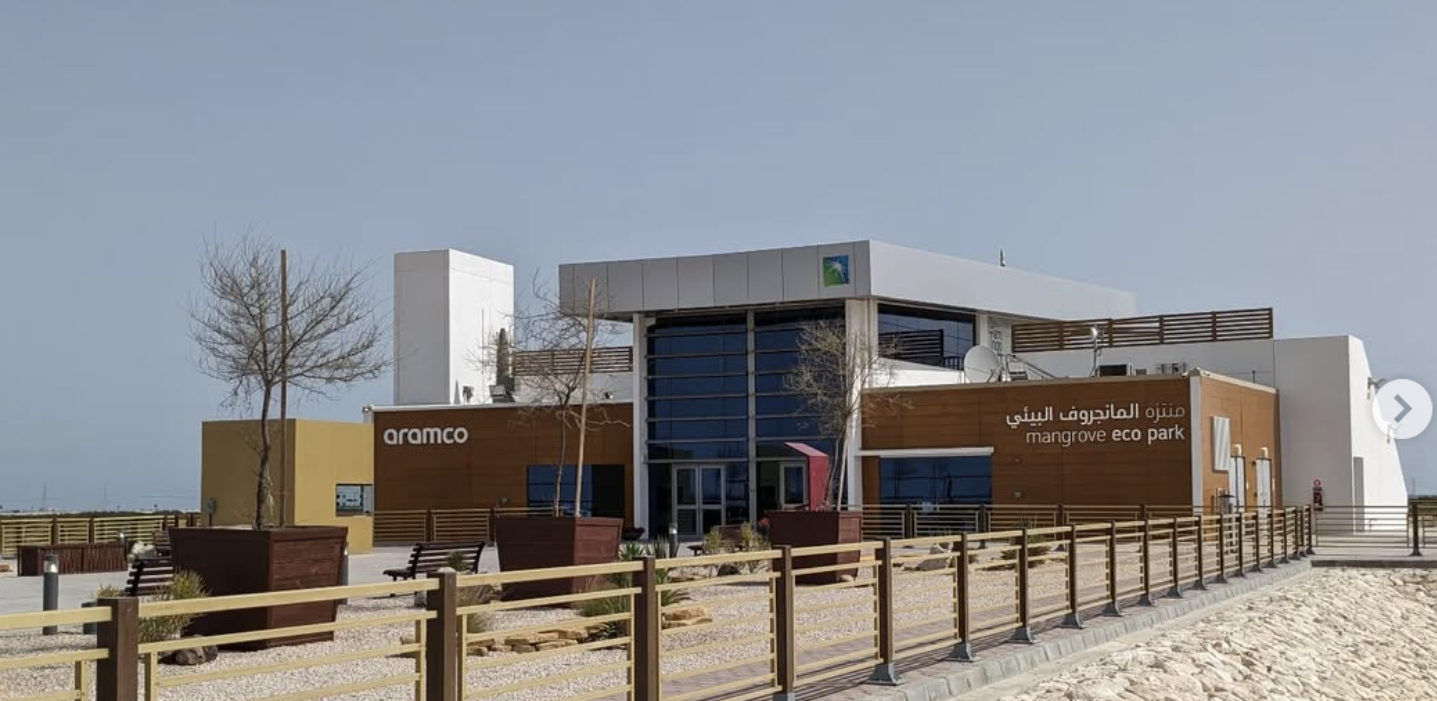
Women activists, spearheaded by Najwa Mohammed Bukhari, have been underpinning the cause to “save the mangroves” on the coast of al-Qatif governorate. She and the female members of Supporters of the Environment and Volunteers Association, consider mangrove protection key in the wider mission to protect Saudi’s waterfront. They’ve teamed up with the al-Ataa Charity Association for Women, working to meet their common goals.

Dalal al-Awami, head of al-Ataa’s health and environment team, told Al-Hayat,“We are making strenuous efforts to protect the environment through our communication with supporters. We got in touch with the Saif Association at Saudi Aramco and they agreed to cooperate.”

Just five women took part in the first campaign, but she stressed that “there has been an unexpected change” in the second and third campaigns. There are now over a hundred female volunteers spanning all ages and backgrounds.

“Everyone is working toward the same goal. Parents (have) encouraged their sons and daughters to join in this work with the aim of instilling in them the importance of volunteering, a concept generally absent from society, particularly in the fields of agriculture and environment,” Awami added, “By raising awareness we elevate the level of culture among people of the region. This might be done by organizing lectures, distributing leaflets and through social networking sites. This is how we manage to attract hundreds of volunteers and receive positive feedback.”

In the two years since the campaign launch, the women have made an enormous impact. Volunteers have attracted political support, which has led to a reduction in practices harmful to the forests. Their actions prompted Saudi Aramco to announced a plan to plant 1.2 million mangrove trees on the coast of the kingdom over the next four years.

In Saudi, it looks like behind every thriving mangrove, there’s a strong woman.

LEAVE A REPLY

Please enter your comment!
Please enter your name here

TRENDING

Seaweed fashion brands can source from Saudi Arabian sea

From Red Sea seaweed to runway-ready fabric, Saudi Arabia is quietly reshaping fashion’s material future. KAUST scientists, designers, and textile innovators are proving that sustainability can begin in local ecosystems. As seaweed becomes wearable, fashion is learning to grow not from fields — but from tides.

The Line’s 15 minute city failure and the limits of green futurism

The failure of The Line is not a failure of imagination. It is a failure of restraint by western architects and planners who go along with the charade. Who is holding these firms accountable? This is actually a reasonable kind of project for the UN to take on and challenge. 

Musk’s Saudi Mega-Data Center Signals a Desert Arms Race for AI

For now, Musk’s partnership signals a deepening alignment between Silicon Valley and Riyadh — and a new chapter in the Middle East’s data-powered future. The satellites and robots may come later. The energy footprint, however, is already here.

Green finance in Saudi Arabia, can “Davos in the Desert” change the planet?

As world leaders and billionaires descend on Riyadh for this year’s Future Investment Initiative — better known as “Davos in the Desert” — we wonder where the planet fairs in all this political business talk. Saudi Arabia’s Vision 2030 plan has turned the kingdom into an unlikely global stage for innovation and investment, drawing over 20 heads of state, 50 ministers, and hundreds of financiers, tech executives, and policy shapers.

Qatar’s climate hypocrisy rides the London Underground

Qatar remains a master of doublethink—burning gas by the megaton while selling “sustainability” to a world desperate for clean air. Wake up from your slumber people.

How Quality of Hire Shapes Modern Recruitment

A 2024 survey by Deloitte found that 76% of talent leaders now consider long-term retention and workforce contribution among their most important hiring success metrics—far surpassing time-to-fill or cost-per-hire. As the expectations for new hires deepen, companies must also confront the inherent challenges in redefining and accurately measuring hiring quality.

8 Team-Building Exercises to Start the Week Off 

Team building to change the world! The best renewable energy companies are ones that function.

Thank you, LinkedIn — and what your Jobs on the Rise report means for sustainable careers

While “green jobs” aren’t always labeled as such, many of the fastest-growing roles are directly enabling the energy transition, climate resilience, and lower-carbon systems: Number one on their list is Artificial Intelligence engineers. But what does that mean? Vibe coding Claude? 

Somali pirates steal oil tankers

The pirates often stage their heists out of Somalia, a lawless country, with a weak central government that is grappling with a violent Islamist insurgency. Using speedboats that swarm the targets, the machine-gun-toting pirates take control of merchant ships and then hold the vessels, crew and cargo for ransom.

Leopoldo Alejandro Betancourt López Turned Ocean Plastic Into Profitable Sunglasses

Few fashion accessories carry the environmental burden of sunglasses. Most frames are constructed from petroleum-based plastics and acrylic polymers that linger in landfills for centuries, shedding microplastics into soil and waterways long after they've been discarded. Leopoldo Alejandro Betancourt López, president of the Spanish eyewear brand Hawkers, saw this problem differently than most industry executives.

Why Dr. Tony Jacob Sees Texas Business Egos as Warning Signs

Everything's bigger in Texas. Except business egos.  Dr. Tony Jacob figured...

Israel and America Sign Renewable Energy Cooperation Deal

Other announcements made at the conference include the Timna Renewable Energy Park, which will be a center for R&D, and the AORA Solar Thermal Module at Kibbutz Samar, the world's first commercial hybrid solar gas-turbine power plant that is already nearing completion. Solel Solar Systems announced it was beginning construction of a 50 MW solar field in Lebrija, Spain, and Brightsource Energy made a pre-conference announcement that it had inked the world's largest solar deal to date with Southern California Edison (SCE).

Related Articles

Popular Categories