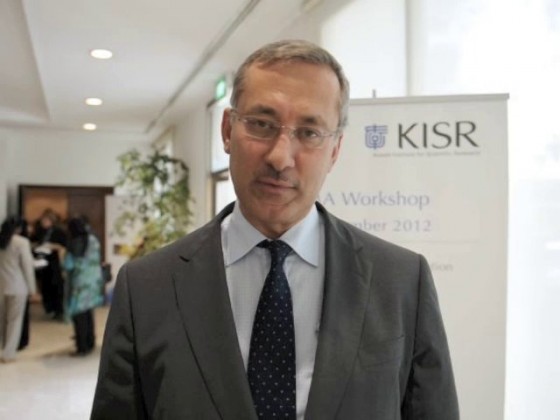


I had an opportunity to conduct a series of green workshops for Imams, or Muslim clergy throughout Jordan. The workshop was funded by Germany’s Friedrich-Ebert-Stiftung based in Jordan.
Here are my thoughts from the workshops which focused on sustainability and energy conservation issues.
In many instances we blame the “other” for not understanding our discipline or worldview while at the same time, it is fair to say that we need to understand the others’ reference frame and body of knowledge. This applies to various disciplines including the debate between economists and biologists on valuing nature or scientists and religious scholars or the average people on “what constitutes truth, happiness, right and good life”.
I do argue that the notion of Tawhid (or oneness or unity) in Islam is critical for bridging the gap between disciplines and cultures.
The key messages I delivered can be synthesized as follows:
• Unlocking the potential for humans is crucial to harvest the “good” fruits through “good” discourse (Kalima Tayyebah). The sustainable flow of dialogue between cultures and within community is attained through empowering and listening to the voices of local people and Imams.
• Articulating a simple discourse about Islam as “a mercy for humankind”, caring for women, environment, and social justice and equity is imperative in an era of global mass media of manipulation of minds.
• Muslims have a duty to effectively and clearly communicate the unifying power of Islam as a common word (Kalima Sawaa) so as to achieve common human goals and address global commons, from saving human lives to protecting the environment and human health.
• Women play leadership role in sustainability as they have the empathy, reason, and responsibility to ensure healthy and resilient families and societies.
• Social justice is a cornerstone in Islam as manifested in Zakah and Waqf. It is illuminating to know that the first Waqf (trust fund) was for water to secure water supply for the needy. Poor education and poverty is the right habitat for extremism.
• Education and enlightenment is a process and a self-discovery and it takes a journey of immersion of other cultures and new disciplines to appreciate and celebrate diversity. Muslim nations need to invest in holistic and enlightened education to avoid this tragic state of “Islam as a threat” rather than a remedy and mercy for humanity. Since we know better, we need to do better.
RELATED: Read book review on Islam and Sustainability
I do believe that the environment crisis is a failure of the trusteeship and guardianship. A change in worldviews and respect of others (regardless of their gender, ethnicity, color, or religion) are necessary if humans are to meet their test of guardianship.
Ultimately the path to God-consciousness is thus a path along which one lives one’s life in a state of increasing awareness of this oneness, understanding better ones place in the wider creation, and fulfilling ones role as a witness and guardian of the earth.
The Qur’an says: “There is not a thing but celebrates His praise, but you understand not how they declare His glory” (Qur’an 17:44)’.
What is needed is a new discourse of Islam that embodies the notion of Ihsan which means the inner beauty which necessarily emanates outward, transforming every human activity into an art and every art into the remembrance of God. In essence, the inner beauty of the heart is manifested and reflected in outer the beauty to evolve new consciousness and respect of all communities of life (Ummam).
The term maslaha (public interest) is an instrument of ijtihad (innovation).
One aspect of maslaha is to consider the policy that will better off the community at large away from private or self interest. Also, Islamic teachings emphasize the concept of living lightly on earth (zohd), conservation and limit of waste and extravagance (israf). Also, Islam encourages humans to reflect on the bounties of God.
Green lifestyle and local development implies conservation as a way of life and supports small-scale local development models. The newly built Green Mosque in UAE and the several transformed mosques in Jordan reflect conservation of resources including water, food and energy regardless of its apparent abundance. Energy and water conservation is both a rational and ethical imperatives. The current economic model is addicted on fossil oil which is the root cause of climate change challenge.
To produce any commodity, we need natural resources and energy. Energy is essential for manufacturing, processing raw materials, and for shipping final products across the globe. It is the use of energy during these processes that is most pertinent to a discussion on climate change. The different types of fossil energy (coal, oil, and gas) or renewable energy (wind, solar, hydrogen and hydro-power or nuclear or bio-fuels) determine the future of climate and the health of the planet which is based on our policy options, development objectives, and social choices.
Within Islamic worldview, small-scale and people-centered development is encouraged to minimize ecological footprints which are too high due to global trade. This means that production should be more according to need not for maximization of profit and creating demands for luxury goods. The key message is that even if the threats of climate change do not exist, it is imperative for Muslims to embody and follow Islamic principles as act as a median community (ummah wassat) to save the planet and human wellbeing as part of the global commons.
“Mischief (fassad) has appeared on land and sea because of the deeds that the hands of men have earned, that (God) may give them a taste of some of their deeds: in order that they may turn back (from evil) (Qur’an 30:41).
At the core of the current ecological crisis, lies the destruction of the ethical and spiritual vision of nature at the hands of the modern world and in the name of growth and development.
This guest post is by Prof. Odeh Al-Jayyousi. He is the author of the book “Islam and Sustainability” and an independent energy consultant) who conducted several workshops and trainings with local Imams from different communities in Jordan on islam and sustainability thanks to support from FES-Jordan.
The objective of the workshops was to enable Imams to have a better understanding on the value of applying green solutions in water, energy, landscape and buildings so as to communicate effectively and influence attitudes and practices in resource management. The project was a success and will continue ext year on a national level and a regional level.