Why donkeys should be the new garbage truck

Tunisia Eco-Donkey

Tunisians are famous the world over for trash selfies. Now simple calculations made by this Green Prophet shows that Tunisia, and many other countries in the MENA region, could spend at least three times as less than they do for collecting municipal solid waste by donkey.

Tunisia’s rubbish problem is an embarrassing affair for many nationals, in particular tourist guides, who reminisce of a cleaner Tunisia.

Thankfully today civil society is denouncing and government seems to have caught on by deploying a new  “environmental municipal”.  These are, ideologically speaking, very much needed steps in the right direction, yet there are larger, practical restraints.
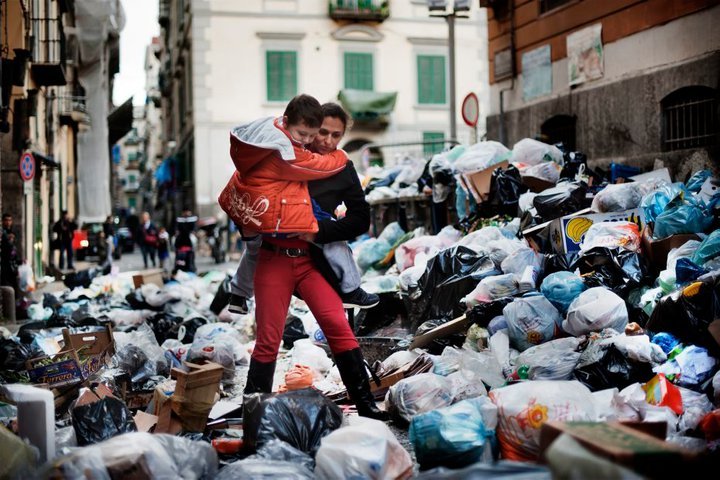
tunisia-trash-problems

RELATED: Tunisians dive into mysterious lake that appears overnight, despite radiation fears

For example fiscal restraints risk concentrating efforts in the areas only where rubbish is dangerously visible:  tourist attractions and urban centers, leaving rural areas largely out of the cleaning equation.

Tunisia’s trash is a universal problem,  that touches the most rural of areas and the most desolate of villages. Considering the geographic disarticulation of such municipalities, collecting trash is an expensive ordeal for the Tunisian government to deal with, yet cheap and eco-friendly ideas taken from positive experiences elsewhere (only 160 km away in fact) can be adopted to employ locals and improve waste management.
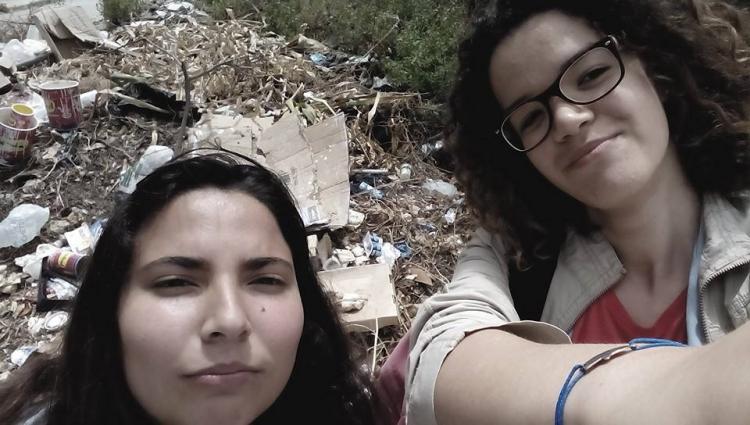
trash-selfies-Tunisia

In 2007, the mayor of Castelbuono , a town in Sicily, was inspired to use donkeys as a vehicle to collect rubbish door to door. He found that this solution proved to be cheaper, more efficient and eco -friendly.

The so-called eco-donkeys costs on average 1269 USD  plus 2540 USD per year to maintain and a donkey’s average working life is of 20 years. Tash collecting vehicles instead cost 38000 USD  plus 10150 USD  of maintenance per year and have a working life of only 5 years.

RELATED: How we are killing Tunisian townsfolk with our phosphate addiction

Also, donkeys can walk along the tiny, inaccessible, cobbled streets, they hardly make any noise and they drink water, not petrol. The only inconvenience is their poop on the streets.

Castelbuono has successfully deployed half a dozen of these donkeys and has been maintaining the streets of this 10,000 person town clean, while providing employment to six former farmers.

What if Tunisia’s rural donkeys also started to be deployed in villages to collect rubbish door to door? Would it be an efficient and cheap solution?

Green prophet does some approximate calculations ( we have purposefully used high estimates). Maintaining and finding donkeys in Tunisia is easier and cheaper than in other Mediterranean countries. Consider that in Tunisia a donkey costs on average 380 USD, while maintaining a donkey costs 260 USD per year.

Tunisia’s waste by the numbers:

Tunisia’s Population: 10.9 million (2014)
Number of people served /donkey (based on Castelbuono’s experience): 1,666 persons/donkey
Cost of one eco-donkey in Tunisia: 380 USD + 260 USD /year = 640 USD
Wage of eco-agents (based on Tunisia’s monthly minimum wage of 190 USD/month )= 2280 USD
Total number of donkeys needed in Tunisia = 10.9 million/1666= 6540 donkeys
Total cost of donkeys + eco-agents = 19.09 million USD  (year 1), $16.61 million USD (year 2)

So to summarize, it would cost the Government (municipalities) approximately $19 million USD  in the first year  to collect and clean Tunisia up, without spending much on petrol, providing employment to  6,540 rural eco-agents and ensuring the durability of the project for at least 20 years.

How much does Tunisia currently spend on waste?

In 2009 for example, Tunisia produced 2.25 million tons of solid waste. The total approximate cost for collecting this, amounted to 69 million USD.

Over three years, the World Bank has lent Tunisia 50 million euros, The European Commission 41 million euros and the French Development Agency 15 million euros for waste management.

Simple calculations clearly show that donkeys can be a cheaper and more eco-friendly alternative to the systems currently in use.

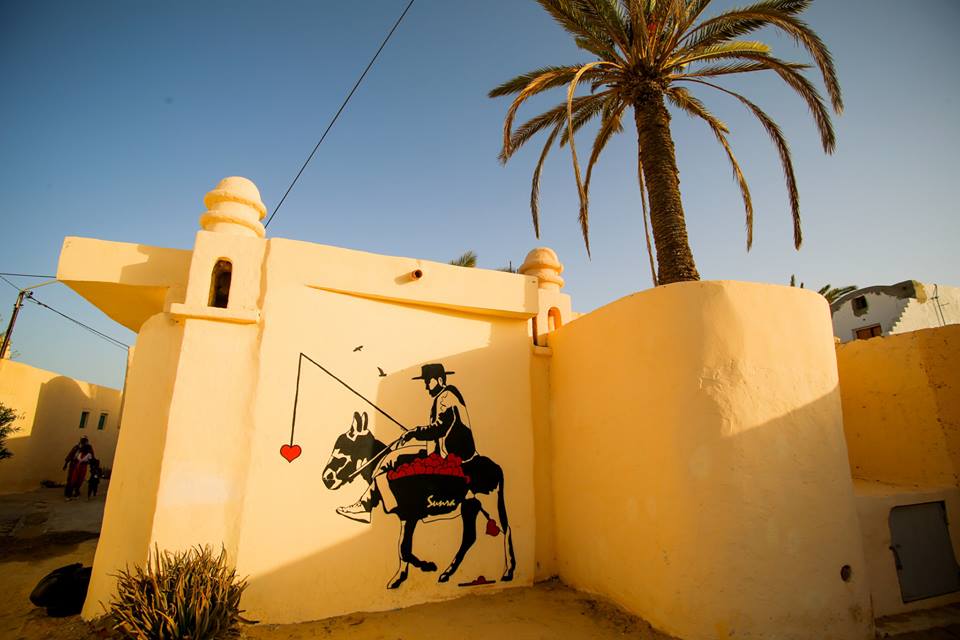
Image of Donkey graffiti by Sunra / Tunisie taken by Aline Deschamps from Galerie Itinerrance Djerbahood

Linda Pappagallo
Linda Pappagallohttps://www.greenprophet.com/
Linda's love for nature started when at the age of eight she discovered, with her dog, a magical river in the valley of a mountainous region in Lebanon. For four years Linda and her dog explored along the river, until one day she saw construction scrapers pushing rock boulders down the valley to make way for new construction sites. The rubble came crashing into the river destroying her little paradise, and her pathetic reaction was to shout at the mechanic monsters. Of course that was not enough to stop the destructive processes. As she continued to observe severe environmental degradation across the different places she lived in the Middle East and Africa, these terrible images remained impressed in her mind. However, environmental issues where not her first love. Her initial academic and career choices veered towards sustainable economic development, with particular interest in savings led microfinance schemes. Nevertheless, through experience, she soon realized a seemingly obvious but undervalued concept. While humans can somewhat defend themselves from the greed of other humans, nature cannot. Also nature, the environment, is the main “system” that humans depend on, not economics. These conclusions changed her path and she is now studying a Masters in International Affairs with a concentration in Energy and the Environment in New York. Her interests lie on ecosystems management: that is how to preserve the integrity of an Ecosystem while allowing for sustainable economic development, in particular in the Middle East and Africa.
1 COMMENT

LEAVE A REPLY

Please enter your comment!
Please enter your name here

TRENDING

Microplastics Are Becoming Superbug Highways — New Study Warns Beachgoers to Wear Gloves

Prof. Pennie Lindeque added that microplastics “act as carriers for antimicrobial-resistant bacteria, enhancing their survival and spread… each particle becomes a tiny vehicle capable of transporting pathogens from sewage works to beaches, swimming areas and shellfish-growing sites.”

Who gave the first kiss?

When you experience your first kiss you might feel like you are the first in the world to feel that way. Kissing, scientists say, occurs in a variety of animals (even if today it's not in every culture), and it presents an evolutionary puzzle: kissing, a learned behavior, carries high risks, such as disease transmission like herpes and hepititis, while offering no obvious reproductive or survival advantage.

Biodiversity Blueprint Set for 2026

If we seize this moment, the 2026 review can catalyse a new wave of finance (see Green Finance mechanisms in the UAE), innovation and policy coherence — and move us closer to the vision of a nature-positive world by 2050. If not, the checkpoint risks becoming another missed opportunity while ecosystems, livelihoods and economies continue to degrade.

Tonka Bean Trees Attract Lightning to Win the Rainforest Arms Race—And Science Thinks That’s Electrifying

Lightning is one of the leading natural causes of tree death in tropical forests. The raw voltage and heat from a strike can instantly boil sap, splinter wood, and reduce a once-living organism to charcoal. But not tonka trees.

Six “Green” Reasons To Drink Camel’s Milk

With 5 times the amount of Vitamin C in camel's milk, and full of iron, camel's milk needs no nutritional help. It has a shelf life of 5 days before pasteurization, after which it will survive for up to 3 weeks. Camel's milk is just as versatile as other milk, used as it is to produce low-fat varieties of cheese, chocolate, and a fermented delicacy that is used in areas that lack refrigeration.

6 Payment Processors With the Fastest Onboarding for SMBs

Get your SMB up and running fast with these 6 payment processors. Compare the quickest onboarding options to start accepting customer payments without delay.

Qatar’s climate hypocrisy rides the London Underground

Qatar remains a master of doublethink—burning gas by the megaton while selling “sustainability” to a world desperate for clean air. Wake up from your slumber people.

How Quality of Hire Shapes Modern Recruitment

A 2024 survey by Deloitte found that 76% of talent leaders now consider long-term retention and workforce contribution among their most important hiring success metrics—far surpassing time-to-fill or cost-per-hire. As the expectations for new hires deepen, companies must also confront the inherent challenges in redefining and accurately measuring hiring quality.

8 Team-Building Exercises to Start the Week Off 

Team building to change the world! The best renewable energy companies are ones that function.

Thank you, LinkedIn — and what your Jobs on the Rise report means for sustainable careers

While “green jobs” aren’t always labeled as such, many of the fastest-growing roles are directly enabling the energy transition, climate resilience, and lower-carbon systems: Number one on their list is Artificial Intelligence engineers. But what does that mean? Vibe coding Claude? 

Somali pirates steal oil tankers

The pirates often stage their heists out of Somalia, a lawless country, with a weak central government that is grappling with a violent Islamist insurgency. Using speedboats that swarm the targets, the machine-gun-toting pirates take control of merchant ships and then hold the vessels, crew and cargo for ransom.

Leopoldo Alejandro Betancourt López Turned Ocean Plastic Into Profitable Sunglasses

Few fashion accessories carry the environmental burden of sunglasses. Most frames are constructed from petroleum-based plastics and acrylic polymers that linger in landfills for centuries, shedding microplastics into soil and waterways long after they've been discarded. Leopoldo Alejandro Betancourt López, president of the Spanish eyewear brand Hawkers, saw this problem differently than most industry executives.

Why Dr. Tony Jacob Sees Texas Business Egos as Warning Signs

Everything's bigger in Texas. Except business egos.  Dr. Tony Jacob figured...

Related Articles

Popular Categories