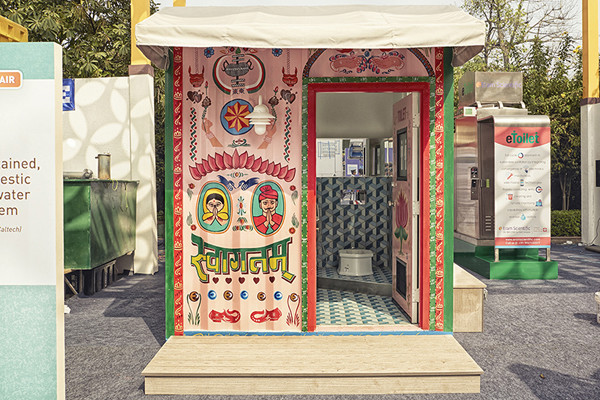
The 2012 winners of a competition with a cringe-inducing name teamed up with a powerhouse plumbing manufacturer to design a self-contained restroom that could be deployed anywhere – it doesn’t require plumbing infrastructure or connection to a power grid!
Students from the California Institute of Technology (Caltech) won the 2012 “Reinvent the Toilet Challenge”. Did you know that – according to the Bill and Melinda Gates Foundation – 2.6 billion people lack access to adequate toilet facilities? That stinks.
Caltech thought so too and teamed up with Kohler Company (best known for their plumbing products) to design a mobile restroom that could be used in remote areas – or in areas where infrastructure failed due to natural or man-made disaster. Their primary challenge was to develop a solar-powered wastewater treatment system that could be simply built with readily available parts.
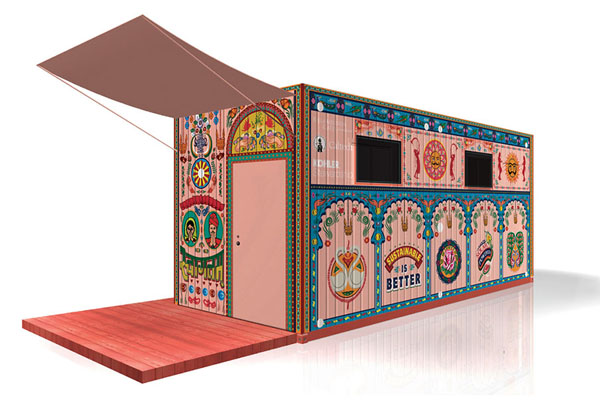 They deployed the pilot project in India as Kohler had been working there for some time and had formed strong relationships with area architects. Local partners were also able to select plumbing equipment that could be fast acquired nearby.
As an added benefit, they advised on a decoration scheme that fit the cultural context, helping make the new technology more appealing to local communities – which was critical as the entire unit was housed in an unappealing shipping container.
Kohler’s global creative director Tristan Butterfield chose traditional Indian truck art for the concept and graphic design consultants Open Door Design Studio (ODDS) provided detailed design.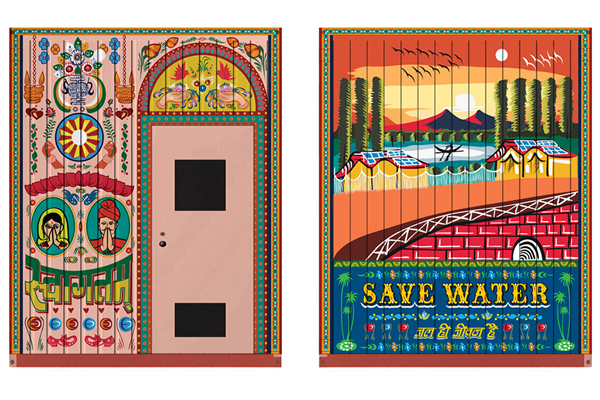 The mobile restroom showcased at the “Reinvent the Toilet Fair” in New Delhi, but then would be permanently placed in a local community. Aesthetics would play an important role in encouraging community support.
Vividly painted flowers, birds, animals and scenery cover the exterior – inspired by the truck art of India – and there are inspirational messages broadcasting the unit’s sustainable features.
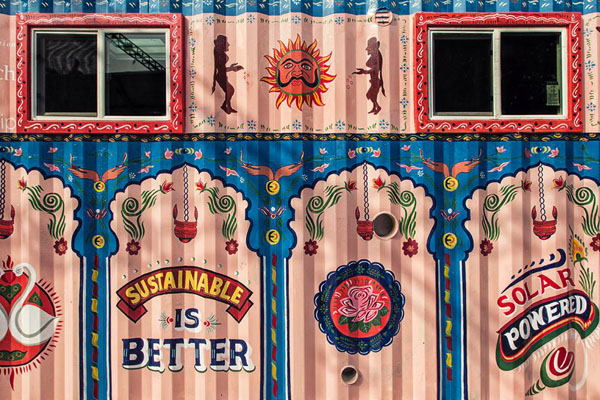 ODDS designers selected motifs that would propagate the project’s essential concepts of water conservation and environmental sustainability, then melded them with the stylistic quality of truck art.
“Illustrations of sun, girls worshiping the sun, oils lamps and introduction of solar panels in the village scene were some of the many design decisions we made to highlight the importance of solar energy in the project as well as everyday life,” according to the ODDS website. Kohler hired local Indian artists to paint the exterior walls.
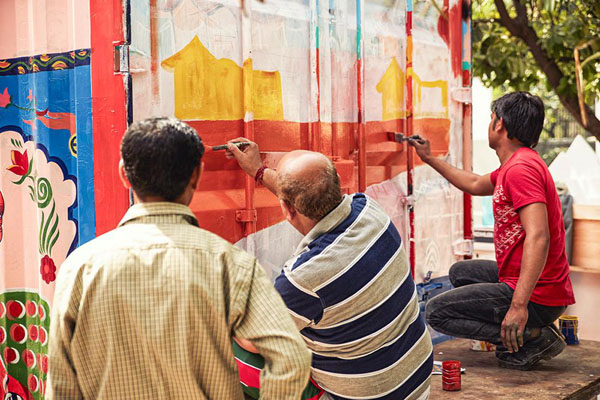 A statement by the Gates Foundation (who co-hosted the event alongside the Government of India’s Department of Biotechnology) noted that increasingly affordable mobile telephone services resulted in more people in India having cell phones than toilets. This fact was embedded in the design – a charging station has been included next to a built-in bench for visitors waiting to use the toilet.
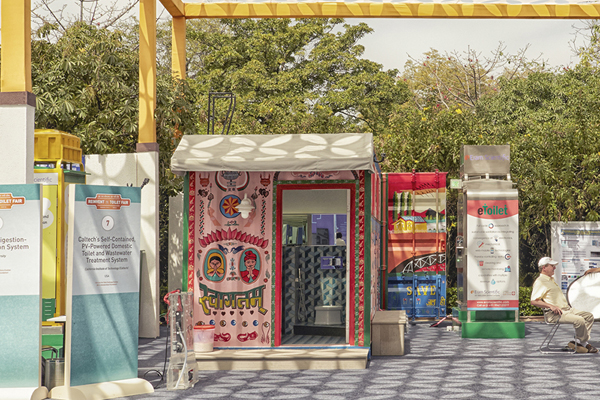 No reason why this unit can’t be installed everywhere that screams for improved sanitation services. It’s a non-invasive solution for eco-destinations such as Jordan’s Wadi Rum, the fab beaches along the United Arab Emirates coastline, or any of an increasing number of eco-destinations across the Middle East.
It can be used in public places (imagine exterior art promoting an ever-changing display of local talent) – or on any of the hundreds of construction sites replacing the horrid, filthy “Mr. John” or “On the Job with Mr. Bob” units.
Let us hear if you’re inspired to build something similar in your neck of the woods.
Images from Open Door Design Studio (ODDS)