

Shipping box homes make sense where containers are available and alternate resources scarce, but it’s still cheaper and less energy consuming to build a structure using traditional framing or concrete block. Jump onto “cargotecture” if you want to make an architectural statement. But if you want to build sustainably, aim small, use local materials, and insulate.
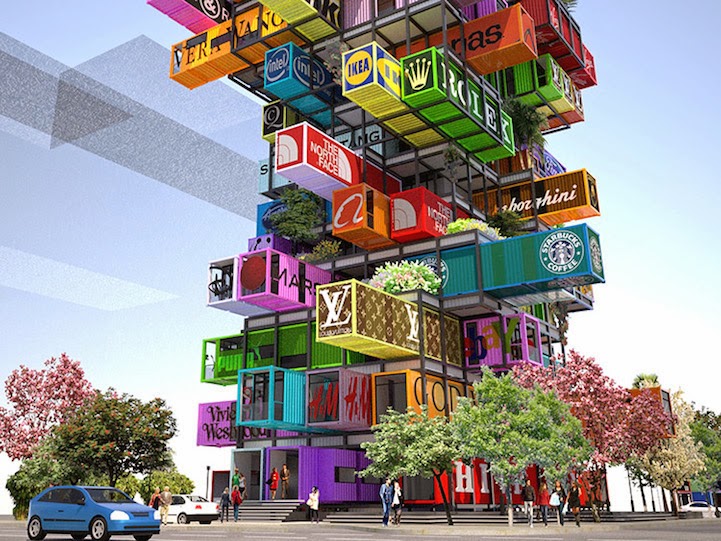
Let’s lead by example: The Hive-Inn hotel concept by Hong Kong-based OVA Studio looks like Jenga for giants – surely you remember that stacked-block puzzle that was part of your kiddie toy box (or – maybe you recall it as a nerdy parlor game)?
The building, schematically designed for the Radical Innovation Awards, is made up of used shipping containers plugged into a steel “hive”. Its modular design (and a permanently mounted rooftop crane) allows for hotel suites to be changed on whim without disturbing the surrounding containers.
Well, not quite on whim. This is a concept, so connections to power, water, and life safety systems (including vertical circulation) are not addressed – nor likely to be easily interchangeable as tenants change. Impact and interruption to street level activity each time a box is moved in and out of place will be significant. And how’s the erratically-loaded tower stand up structurally (not to mention seismically!)? (Well, someone is a Miss Crankypants.)
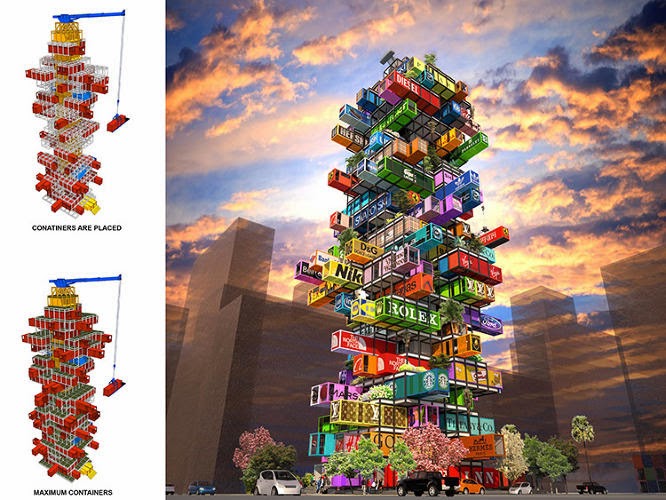
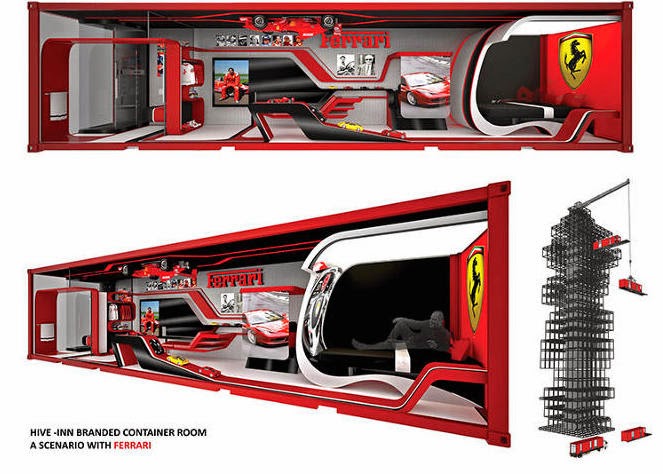
This scheme depicts the building as a hotel and the architects point out extensive branding opportunities, with individual containers sponsored by different companies – decorated with corporate images. Imagine “live-in” advertising, or pop-up boutiques promoting limited time sales events. As tenancy changes, so would the building’s facade – an evolving panoply of color and signage. Is that really a good thing?
Consider cities such as São Paulo, Brazil (the world’s 7th largest city) – in 2006 it banned all outdoor advertisements – that’s billboards, transit ads and storefront signage. A 2011 survey indicated that 70% of residents found the ban beneficial, allowing the true nature of the metropolis to emerge from behind the advert clutter. Subliminally, it’s also a respite from subconscious bombardment to part with your money…the antithesis to the Hive Inn.

OVA Studio suggest their design could be used as emergency housing or medical care units. Mobile apartments or offices are another option, allowing you to ship off easily (contents could remain inside the unit) to a new zip code.
Seems some people are turning to cargo container structures as a green alternative to traditional building. On the surface, it’s logical. There are growing numbers of unused containers, collateral damage from global trade imbalances. Costs prohibit shipping empties back to their point of origin (it’s cheaper to buy new containers and factor costs into shipping fees) – the result is a mountain range of steel boxes sitting idle at most world ports.

Shipping container architecture (tagged “cargotecture”) is appealing due to the boxes’ availability, strength, durability, and cost (many sell for under $1,000) – and they sure make for pretty images when re-purposed. But how’s it experienced in three dimensions? Individual containers create awkward spaces; long narrow rectangles with very low ceilings. Multiple boxes can be combined to expand interior volume, but cutting, grinding and welding steel is energy intensive.
Steel boxes are coated with toxic chemicals to make them durable for ocean transport – think chromate, phosphorous, and lead-based paints. Factor in the energy required to make them habitable; sandblasting the entire structure, burning openings for doors and windows.
The average container produces about 1,000 pounds of hazardous waste before it can be re-used as a structure. Bundle all this with the fuel-guzzling heavy machinery needed to move the container from port to final position, and this green habitat looks more like a white elephant.


This is really interesting. I’m a sustainability student doing a project involving cargotechture. I was thinking there were a lot of benefits to it. But, it seems like its actually very unsustainable! I will probably be doing a poster presentation in January. This has given me a lot to consider. Thank you!
Totally agree, Teri. The (very few) examples of cargotechture I’ve experienced have been ergonomically awkward and functionally inflexible.
Seems the better a building photographs, the less successful it performs as architecture. (I really AM cranky!)
Great comment on the costs related to site distance from ports.
I love the idea of cargotechture. There’s some neat stuff out there made out of cargo containers, it’s the ultimate in recycling materials, and it’s cheap. At least in theory. That was before I actually started half-assed researching it, and the farther away from any major shipping ports you are, the more expensive it is, since a significant chunk of your cost is acquiring the stupid container in the first place and transporting it inland. Plus, it’s bit as easy as calling up Containers R Us and having it delivered. There aren’t any major resellers for them, and each one can vary in structure material and what kind if shape it’s in. Finding an undented one or one that is in perfect condition–since not all containers make a house–is pretty hard, too. To get something delivered to Denver would range in the $2000-$3000 range, just to get it here. So until someone starts doing this on a larger scale…or manufacturing it, ironically, it’s probably not going to stack u…er, yeah. You already used that joke. You know what I mean.