100 million trees dry, rather than green, the UAE’s western desert

Richard Allenby-Pratt, eco-art, photography, western desert, greening the western desert, desalination

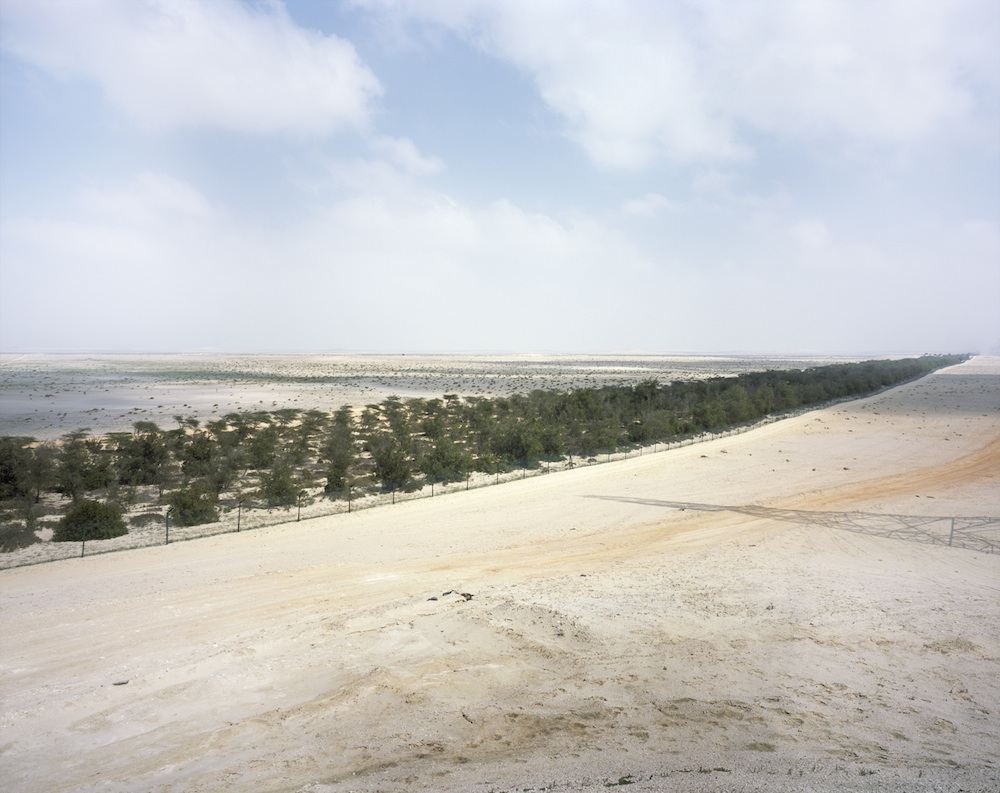
In an attempt to ‘greenify’ the UAE’s Western Region desert, (some claim in the hope of creating a milder micro-climate in the UAE) more than 100 million trees have been planted, often as buffer zones like the one depicted, and irrigated, mostly, with precious groundwater. 

The Abu Dhabi environment agency now admits they have a critical situation with groundwater sources diminishing rapidly and become increasingly saline.

The UAE’s groundwater was deposited 10,000 years ago during the last ice age. It doesn’t replenish quickly, unless we are considering it in a climatic and geological timescale.

Once it is gone, irrigation water will have to be produced entirely through desalination, an energy-intensive and waste-producing process. The highly-saline brine that is returned to the sea after desalination is raising the salinity along the coast.

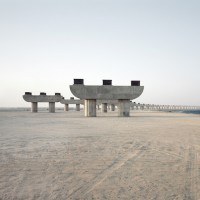
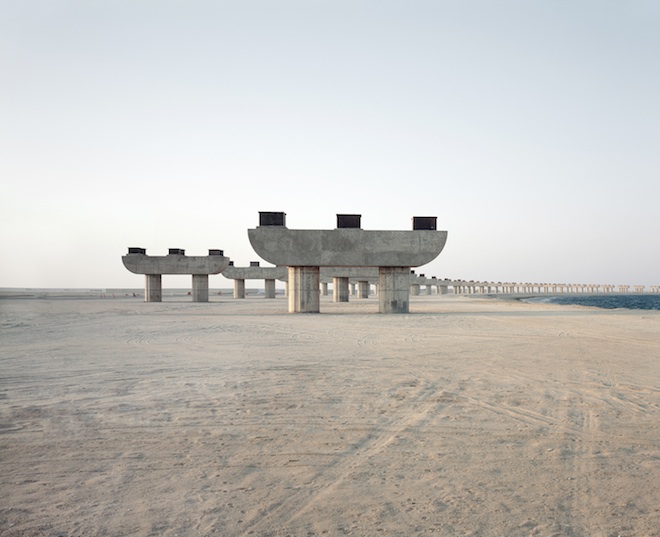
Related: Abu Dhabi pylons confuse perceptions of “land” use

The final result could be a second ‘dead’ sea in the region. But for now, current levels of desalination are drastically reducing seawater quality, damaging fragile marine ecosystems and encouraging toxic algal blooms, such as the ‘red tide’ which residents have seen more frequently in recent years.

So in trying to create a forest where there was never meant to be one we may inadvertently end up destroying a precious marine ecosystem. Plans for underwater hotels might have to be shelved when developers realise guests will just be viewing an underwater graveyard.

To get an idea of the scale of the forestry project have a look at the area around here 23’59’ 48.75N 52’32’51.82E where I took this shot.

Note from the editor: this photograph is part of a series called “Consumption” that seeks to document consumerism’s impact on the environment. From resource extraction and commodity production all the way down the supply chain to retail stores and waste processing facilities, Richard artfully examines what nature has come to mean in a world that depends on buying stuff. 
Richard Allenby Pratt
Richard is a British photographer living and working in Dubai, UAE. His concerns about the sustainability of the way we live and our economic systems only really became urgent after the birth of his son in 2008. As a landscape photographer he found the obvious way to express these concerns was by making photographs of the places impacted on by human activity, and particularly those places that best display the terrifying scale of our consumption. His basic method is to study google earth and then visit the most intriguing and inexplicable places thereby discovered.
1 COMMENT
  1. Hi,
    Thank you for your article. In some farms the water is withdrawn too quickly and so the minerals are sucked out and the water becomes saline. First the farms plant what can take a higher level of salt, such as olive trees. but then the salinity is too high and the wells are closed. seen some farms closing their wells within 5 to 10 years only. you could desalinate on-site but best is to withdraw that quickly in the first place. plus a large part of the crops is exported as your profit is way higher than by selling in the local market. logics of short term profit (and of profit more generally speaking) screw up nature and people.

Comments are closed.

TRENDING

10 Proven Israeli Technologies to Help Somaliland Build Food, Water, and Energy Security

Israel’s water and agricultural technologies didn’t emerge from ideal conditions. They were developed under pressure: low rainfall, saline water, political isolation, lack of energy resources, and the constant need to feed a growing population with limited land. Over the years, I’ve written about many of these companies not as miracle-makers, but as problem-solvers. That’s what makes them relevant to places like Somaliland. Israel was the first country in the world to recognize Somaliland as an independent state although Ethiopia has been treating the nation as such for decades.

Dead shark on beach injured by fishing nets

  A dead shark that washed ashore this week at...

Investing in the Middle East? These 20 Energy consultants can de-risk your portfolio

For instance is your clean tech firm or company in wastewater treatment considering an office in Riyadh or should you stick with Dubai?  Below is a curated spotlight on 20 firms that shine for their deep expertise and proven ability to manage the complex risks of sustainable energy investment.

Choosing Riyadh over Dubai? What Investors Should Know

Saudi Arabia is deploying capital at unmatched scale to catalyze tourism and advanced industry while rewiring its power-and-water backbone. The investable frontier is widening—especially in renewables, grid storage, water efficiency/desal retrofits, and hospitality operating platforms. Prudent investors will insist on phased delivery, enforceable KPIs (energy, water, biodiversity), and RHQ/zone compliance—while pricing political-economy and reputational risks alongside growth upside.

Saudi Arabia’s oil-powered desalination “success” consumes 20% of its domestic oil use

Nearly 20% of Saudi Arabia’s oil powers desalination, with projections rising to 50% by 2030. Experts warn it should remain a last-resort solution due to high energy and environmental costs.

Turning Your Energy Consultancy into an LLC: 4 Legal Steps for Founders in Texas

If you are starting a renewable energy business in Texas, learn how to start an LLC by the books.

Tracking the Impacts of a Hydroelectric Dam Along the Tigris River

For the next two months, I'll be taking a break from my usual Green Prophet posts to report on a transnational environmental issue: the Ilısu Dam currently under construction in Turkey, and the ways it will transform life along the Tigris River.

6 Payment Processors With the Fastest Onboarding for SMBs

Get your SMB up and running fast with these 6 payment processors. Compare the quickest onboarding options to start accepting customer payments without delay.

Qatar’s climate hypocrisy rides the London Underground

Qatar remains a master of doublethink—burning gas by the megaton while selling “sustainability” to a world desperate for clean air. Wake up from your slumber people.

How Quality of Hire Shapes Modern Recruitment

A 2024 survey by Deloitte found that 76% of talent leaders now consider long-term retention and workforce contribution among their most important hiring success metrics—far surpassing time-to-fill or cost-per-hire. As the expectations for new hires deepen, companies must also confront the inherent challenges in redefining and accurately measuring hiring quality.

8 Team-Building Exercises to Start the Week Off 

Team building to change the world! The best renewable energy companies are ones that function.

Thank you, LinkedIn — and what your Jobs on the Rise report means for sustainable careers

While “green jobs” aren’t always labeled as such, many of the fastest-growing roles are directly enabling the energy transition, climate resilience, and lower-carbon systems: Number one on their list is Artificial Intelligence engineers. But what does that mean? Vibe coding Claude? 

Somali pirates steal oil tankers

The pirates often stage their heists out of Somalia, a lawless country, with a weak central government that is grappling with a violent Islamist insurgency. Using speedboats that swarm the targets, the machine-gun-toting pirates take control of merchant ships and then hold the vessels, crew and cargo for ransom.

Related Articles

Popular Categories