Cairo Sustainably Manages Garbage with Unionized Pigs and Ragpickers

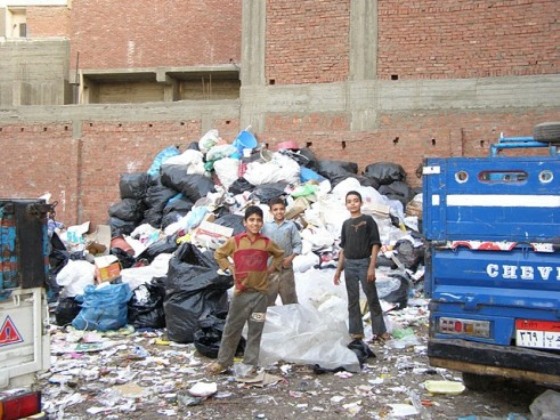
Young zabbaleen in Cairo

Efforts to find solutions to Cairo Egypt’s mounting garbage problems have ranged from allowing hundreds of thousands of pigs to eat the city’s organic wastes’ to using rag pickers to sort through the mountains of garbage that have accumulated.

Cairo is one of the world’s most populated and congested cities and since the beginning of the 2011 Arab Spring protests cleaning up is paramount.

Cleaning up mountains of garbage in a city of nearly eight million people crowded into a metropolitan land area of 453 square kilometres has never been an easy task. One of the ways in which large amounts of organic wastes have been dealt with has been to allow the use of pigs owned by minority Christian populations to consume organic wastes such as rotting fruit and vegetables, leftover foodstuffs and other “materials”.

These pigs are owned by people who are known as “Zabaleen”, which translated literally means “garbage people” and derived from the Arabic work zebala which means garbage.

RELATED: Tetra Pak’s sustainability efforts in Cairo’s recycling business.

This method involving pigs nearly came to an abrupt halt in 2009 when the Egyptian government decided to cull around 300,000 pigs in response to a scare involving the world-wide swine flu virus. Some people say that the virus was just an excuse to rid the predominantly Muslim city of swine.

The Zabaleen have been efficient in sorting out reusable and recyclable items from garbage, resulting in these modern day rag pickers to become known as efficient recyclers. Whole families are often involved in this business, including young children who are taught what to look for in the piles of wastes that are still prevalent on city streets and neighborhoods.

Losing so many pigs at once (the government made the pig culling decision within the span of 24 hours) resulted in a great loss of livelihood for pig owners whose animals were worth a significant amount of money.

“Every family had at least a dozen animals and could get about $1,400 for the sale of a pig. That gave them some emergency money when they needed it. The rag collector’s income fell by half,” said Ezzat Naem, head of the Zabaleen union.

Another union spokesperson added that the slaughter of the pigs ended a very efficient way to rid city streets of rotting organic garbage.

But now the Zabaleen are becoming more recognized as an efficient solution for getting rid of Cairo’s garbage. Members of the Zabaleen union have made agreements with city waste disposal companies to work together with them to help clean up the immense piles of garbage. The pigs are also making a quiet comeback, as their role to ridding the city from its waste problems is becoming more appreciated.

The Zabaleen’s role in ridding Cairo of its garbage can be summed up in a comment made by Zabaleen union head Ezzat Naem, a 50 something year old Zabaleen garbage collector who has been involved in this work for nearly his entire life:  “We are the ones who have always been treated as a backward people; yet we have devised a more ecological model for ridding Cairo of its garbage.”

As such, there now appears to be more appreciation for pigs and rag pickers in Egypt’s largest city. At least by this Green Prophet.

More article about Cairo’s garbage and pigs issues:

Cairo’s Waste-Eating Pigs Make a Quiet Comeback

Zabaleen Film Portrays Cairo’s Garbage City People

Egypt Culls 300,000 Pigs in Response to Swine Flu Virus

Photo of young Zabaleen trash collectors: wikipedia

Maurice Picow
Maurice Picowhttps://www.greenprophet.com/
Maurice Picow grew up in Oklahoma City, U.S.A., where he received a B.S. Degree in Business Administration. Following graduation, Maurice embarked on a career as a real estate broker before making the decision to move to Israel. After arriving in Israel, he came involved in the insurance agency business and later in the moving and international relocation fields. Maurice became interested in writing news and commentary articles in the late 1990’s, and now writes feature articles for the The Jerusalem Post as well as being a regular contributor to Green Prophet. He has also written a non-fiction study on Islam, a two volume adventure novel, and is completing a romance novel about a forbidden love affair. Writing topics of particular interest for Green Prophet are those dealing with global warming and climate change, as well as clean technology - particularly electric cars.
1 COMMENT

LEAVE A REPLY

Please enter your comment!
Please enter your name here

TRENDING

Urban miner Sortera raises $45 million USD to pull aluminum from the scrap pile

Sortera Technologies, founded in 2020 by Nalin Kumar and Manuel Garcia, is emerging as a major U.S. circular-industry player. Led by CEO Michael Siemer, the company uses AI and advanced sensors to turn scrap metal into high-value aluminum alloys. Its new ~$45 million funding round signals investor appetite for industrial decarbonisation—where emissions cuts come not from PR-friendly solar installs, but from upgrading the materials that power EVs, solar frames, and construction.

Waste Reform from the Ground Up: How Trash Balers Are Helping Cities Rethink Sustainability

If you’ve ever watched a recycling truck weaving through city streets, you’ve seen the problem firsthand. Most of what we call “recycling” still depends on long-distance transportation and centralized sorting facilities. Those systems are energy-intensive and prone to contamination — the dreaded mix of wet food, plastic wrap, and paper that renders recyclables useless.

Scientists Crack the Code for Low-Cost, Low-Carbon Plastic Recycling

While enzymatic recycling offers hope for managing existing plastic waste, scientists and environmental advocates agree it must be paired with the development of bio-based plastics—materials made from renewable biological sources like corn starch, sugarcane, or algae. Unlike conventional plastics derived from fossil fuels, bio-based alternatives can dramatically reduce carbon emissions at the production stage and are often compatible with closed-loop recycling.

Steven Bethell Joins Board of SMART at Historic Conference in Dubai, highlighting the importance of textile reuse and responsible recycling

SMART is a leading trade association representing the interests of the for-profit used clothing, wiping materials, and fiber recycling industries. The organization works to promote the environmental, economic, and social benefits of textile reuse and recycling while setting high industry standards.

Trump’s Gaza should use hemp concrete, solar power and smart grids

For Gaza to move beyond short-term recovery and embrace long-term resilience, sustainable technologies must be at the heart of US President Trump's reconstruction efforts.

Qatar’s climate hypocrisy rides the London Underground

Qatar remains a master of doublethink—burning gas by the megaton while selling “sustainability” to a world desperate for clean air. Wake up from your slumber people.

How Quality of Hire Shapes Modern Recruitment

A 2024 survey by Deloitte found that 76% of talent leaders now consider long-term retention and workforce contribution among their most important hiring success metrics—far surpassing time-to-fill or cost-per-hire. As the expectations for new hires deepen, companies must also confront the inherent challenges in redefining and accurately measuring hiring quality.

8 Team-Building Exercises to Start the Week Off 

Team building to change the world! The best renewable energy companies are ones that function.

Thank you, LinkedIn — and what your Jobs on the Rise report means for sustainable careers

While “green jobs” aren’t always labeled as such, many of the fastest-growing roles are directly enabling the energy transition, climate resilience, and lower-carbon systems: Number one on their list is Artificial Intelligence engineers. But what does that mean? Vibe coding Claude? 

Somali pirates steal oil tankers

The pirates often stage their heists out of Somalia, a lawless country, with a weak central government that is grappling with a violent Islamist insurgency. Using speedboats that swarm the targets, the machine-gun-toting pirates take control of merchant ships and then hold the vessels, crew and cargo for ransom.

Leopoldo Alejandro Betancourt López Turned Ocean Plastic Into Profitable Sunglasses

Few fashion accessories carry the environmental burden of sunglasses. Most frames are constructed from petroleum-based plastics and acrylic polymers that linger in landfills for centuries, shedding microplastics into soil and waterways long after they've been discarded. Leopoldo Alejandro Betancourt López, president of the Spanish eyewear brand Hawkers, saw this problem differently than most industry executives.

Why Dr. Tony Jacob Sees Texas Business Egos as Warning Signs

Everything's bigger in Texas. Except business egos.  Dr. Tony Jacob figured...

Israel and America Sign Renewable Energy Cooperation Deal

Other announcements made at the conference include the Timna Renewable Energy Park, which will be a center for R&D, and the AORA Solar Thermal Module at Kibbutz Samar, the world's first commercial hybrid solar gas-turbine power plant that is already nearing completion. Solel Solar Systems announced it was beginning construction of a 50 MW solar field in Lebrija, Spain, and Brightsource Energy made a pre-conference announcement that it had inked the world's largest solar deal to date with Southern California Edison (SCE).

Related Articles

Popular Categories